The Descent and Ascent of Man

In thinking about the phrase, “descent of man”, coined by Charles Darwin, the subtlety and nuance of the play on words strikes me, but not in the way Darwin likely intended.

Image ID: 150736070 Copyright: claverinza

When Charles Darwin wrote The Descent of Man[i], the title was a play on words. In the context of the book, Darwin meant the word in the sense of “derivation from an ancestor”; “the fact or process of originating from an ancestral stock”; and/or “the shaping or development in nature and character by transmission from a source”.[ii] Descent, of course, can have a quite different meaning.

The word, descent, can also mean “the act or process of descending from a higher to a lower level, rank, or state”; “an inclination downward”; and/or “a downward step (as in station or value”), as in decline.

Darwin probably meant the word in this sense, also, in that philosophers and scientists and thinkers of all types before him had mostly viewed man standing apart from the rest of the natural world, standing above it (just a little lower than the angels). Darwin’s theory revealed man descending not from heaven, but descending (originating from ancestral stock) from lower life forms and ascending (evolving) from those lower life forms to the complexity the human species is today. This is the play on words.

In thinking about these things many generations after Charles Darwin coined the book title, in the context of all that has developed since his time, the subtlety and nuance of the play on words strikes me, but not in the way Darwin likely intended.

Continue reading “The Descent and Ascent of Man”

Questions on Morality and the Materialist

if God is not the supreme moral law giver, on what basis do we have morality, and how do we judge something like genocide?

Depositphotos Image ID: 129286826 Copyright: Olivier26

In a naturalistic world in which there is nothing supernatural, nothing other than the material world, and everything there is can be summed up by what we can touch, see, hear, feel and measure, survival of the fittest reigns. In a world like that, what is wrong with genocide?

Genocide is like the ultimate survival of the fittest. The superior people group dominates, overcomes and wipes out the inferior people group. What could be more Darwinian? What could be more natural in a naturalistic world?

This, in fact, is largely the history of the world. Why, then, is this expression of survival of the fittest wrong?

Thankfully most people today recoil from such a notion, but on what basis?

Continue reading “Questions on Morality and the Materialist”

How Do We Know God is a Personal Being?

Science, the study of physical world, can’t explain the cause of the universe based on initial conditions and natural laws because the universe, itself, is the first physical state.

Depositphotos Image ID: 146490813 Copyright: SergeyNivens

Many people are not willing to trust the Bible. They are not sure whether God exists or who, or what, God might be. We can start with that simple question: who or what is God?

I like the way Dr. William Lane Craig addresses the question. He explains that the conclusion is reached in at least three different ways.

Continue reading “How Do We Know God is a Personal Being?”

Intellect and Faith

Photo by Tyler Drendel - Sunset at Fermi Lab
Photo by Tyler Drendel – Sunset at Fermi Lab

Following from part one of twobeing honest about the who and what of our underlying presuppositions

Think about it: can a finite being measure or define, let alone manipulate, an infinite God?

If God is “big” enough to create a universe so large that we cannot see past the beginning or the end, how do we expect to measure such a God?

We are more comfortable in our own element. We can understand the what and the how of the world we live in, but the who is another matter altogether. Non-believers go no further and declare, the “what” and the “how” to be all there is.

At the same time, believers should not be afraid of facts or science. Facts and science help us to know and understand the what and how of creation – and they point to the Who. If we have an attitude open to the Who, we will see the evidence for God. In fact, it will seem self-evident. If a person wants “proof” before belief, such a person will never be satisfied – especially when the proof is a priori limited to the what and the how.

Continue reading “Intellect and Faith”

Counter-Critiquing the Moral Argument for God

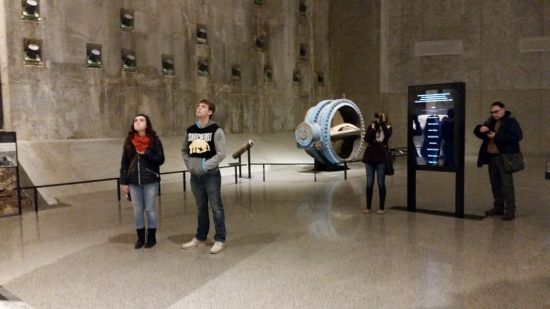
At the 9/11 Museum underneath the World Trade Center

The moral argument for God is one of the basic arguments for proving that God exists. In this piece I follow a critique Dr. William Lane Craig presents of a critique done by Richard Dawkins of the moral argument for God. Continue reading “Counter-Critiquing the Moral Argument for God”