I recently listened to episode #47 on the podcast by the Dr. Michael Guillen in which he explored the latest scientific research on near death experiences (NDEs). Michael Guillen is a former Harvard physics professor. You can listen to the half hour episode through Spotify at this link:
He acknowledges from the start that scientific study of NDEs provides few clear answers. Even defining something as seemingly simple as death has become more difficult, rather than simpler, over time. We have gotten so good at reviving people that people we once thought were dead have been brought back to life.
Most people today define death synonymously with brain death. When brain activity ceases is when death is declared. Even patients who cease brain activity, however, sometimes go on living in fashion. Circulation and breathing may continue, the body may continue to regulate temperature, and the body may continue to excrete urine and feces for instance.
Determining the exact time of death is not an exact science. Dr. Guillen calls death “the ultimate mystery”. Death has been the focus of poets, writers, prophets, and scientists for centuries. For millennia, civilized societies have built elaborate rituals around death and the hope of life after death. Recent scientific studies have begun to shed some light on death.
Photo Credit to Tyler Drendel, a sunrise at Fermi National Laboratory in Batavia, IL
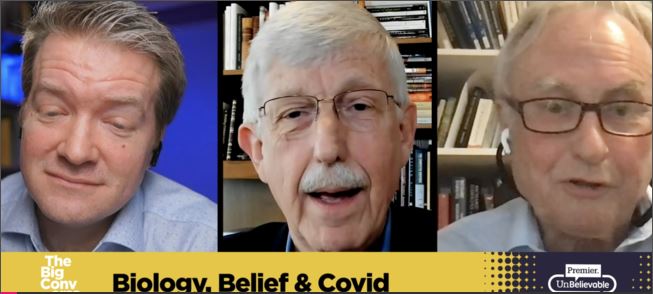
The last episode of the Unbelievable? Podcast (May 21, 2022) featured Francis Collins and Richard Dawkins on Biology, Belief and Covid: Can science and faith be reconciled? Justin Brierly has set the standard for facilitating thoughtful, civil conversations on opposing views of the world, like faith and atheism.
In this particular conversation, Francis Collins, the former head of the Human Genome Project and well-known scientist who professes religious faith, just finished explaining briefly why he came to believe in God at the age of 27. Richard Dawkins, the very well-known scientist and “new atheist”, responded this way:
“If I were God and I wanted to create life, maybe even human life, which is part of the expectation of a religious person, I think I would not use such a wasteful, long-drawn-out process. I think I would just go for it. Why would you choose natural selection, which has the possibly unfortunate property that it could have come about without you? Why would God have chosen a mechanism to unfold His design and chose the very mechanism that would make Him superfluous?
Dawkins speculated that God might have thought, “I wonder what would happen if I set up a primeval, self-replicating molecule and leave it to see what happens.” Dawkins called such an experiment “interesting” and sympathized with the thought of God experimenting in that way. Then he added, “If I wanted to make complex life, I wouldn’t choose that astonishingly wasteful, profligate – cruel actually – way of doing it.”
Dawkins focused on the suffering that comes from competition and evading starvation. He focused on the weeding out process of some animals starving to death, being eaten by predators and succumbing to disease. Dawkins summarized, “It is not a benign process at all.”
Dawkins admitted that this line of thinking is “not a good argument”, but it is what “struck” him as Francis Collins was talking. Indeed, I have heard Richard Dawkins say similar things in debate and in his writings. This line of thinking is obviously compelling to him, good argument or not.
I don’t want to be overly critical of Dawkins. I am not here to blast him or judge him. We all have a judge, I believe, and it isn’t me!
Dawkins is not an ignorant man, obviously. He is a foremost scientist who is a very poignant and elegant communicator and champion of the evolutionary paradigm. His many books and body of work speak to his exceptional intelligence. As people go, he is at the top of the food chain in scientific knowledge and understanding.
Francis Collins is good company for Dawkins, having advanced the relatively new science and understanding of human DNA, perhaps, further than any person before him. Yet, these two men have diametrically opposed views of whether God exists. Neither of them is an intellectual slouch.
I am writing, though, on what Richard Dawkins said. Just as Dawkins was “struck” by what Collins said to respond in the way he did, I am struck to respond by what Dawkins said.
His instinct or intuition or line of thought – whatever you want to call it – was to consider, “If I were God….” Dawkins gravitated toward comparing what he would do if he were God and the world as it exists. Dawkins’s point is, ultimately, that he finds the world as it exists not to live up to what he would have created if he were God.
My inspiration this morning comes from “the woman at the well” and Galileo. They are separated by about 1500 years, but their stories resonate together for me this morning.
The theme is inspired by the questions: “How should we read Scripture?” and “How should we understand science and faith?” Those questions were relevant over 2000 years ago; they were relevant 500 years ago; and they are still relevant today.
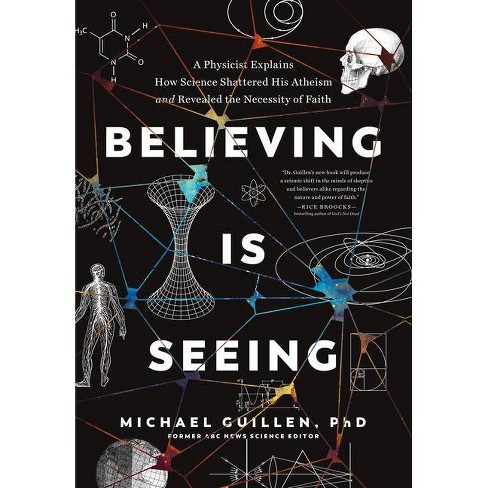
Michael Guillen, in his book, Believing is Seeing, reveals how logical and trans logical thinking are different tools, and each have a place in the intellectual toolbox. Logic is necessary to understand simple, “trivial” truths, but “profound” truths, he says, require trans logical thinking.
We err to apply logic to every problem. Simple matters are the province of logic, but complex matters require trans logic. As much as we might want to keep complex matters simple, we cannot gain insight into many complex matters without a willingness to go beyond the familiar confines of simple logic.
Guillen recognized the necessity to stretch beyond simple logic to more complex, trans logical thinking, among other things, in the realization that dark matter and dark energy make up 95% of the universe. In other words, 95% of the universe is invisible to us! (p. 9)
If we insist on limiting ourselves to things that we can see, touch, feel, smell, and hear, we must give up on 95% of the universe. If we want to explore outside the boundaries of what we can see, we need to adopt more robust, trans logical thinking.
Trans logical thinking is not anti logic, but it isn’t as linear as logic, and it may require holding things in tension that may seem contrary on their face. Classical physics and quantum physics are good examples of things we believe are both true, but which seem to be contradictory on their face.
If we are not willing to give up on 95% of reality, we must be willing to adapt. We must let go of our insistence that everything be reduced to what we can affirm with our senses and to what will fit into simple formulas and logical constraints. We need to think outside the box.
Guillen sees a parallel in the “stretching” that scientists must do to grapple with the unseen world at the edges of simple science and the revelation of the Bible of more “spiritual” things:
“’What no eye has seen, what no ear has heard, and what no human mind has conceived’ — the things God has prepared for those who love him— these are the things God has revealed to us by his Spirit.”
1 Corinthians 2:9
What the Spirit of God can reveal to us is somewhat similar to the stretching the scientist must do in his thinking to understand things like dark matter and dark energy, quarks, quantum entanglement and other mysteries of science that defy Aristotelian logic and conventional principals. For people who like to live with their feet planted solidly on the ground and with certainty anchoring their beliefs, the prospect of revelation by God’s Holy Spirit is like a black hole. We dare not venture too close for fear of being sucked into a black hole.
Yet, God not only invites us in; He insists that we venture close to understand Him.
“The Spirit searches all things, even the deep things of God. For who knows a person’s thoughts except their own spirit within them? In the same way no one knows the thoughts of God except the Spirit of God. What we have received is not the spirit of the world, but the Spirit who is from God, so that we may understand what God has freely given us. This is what we speak, not in words taught us by human wisdom but in words taught by the Spirit, explaining spiritual realities with Spirit-taught words.”
1 Corinthians 2:10-13
The difference between logic and trans logic in science and the study of the edges of the physical world have application to the metaphysical world in the encounter of the woman at the well with Jesus. I will lay out the similarities I see below.
I listened to an episode of the Unbelievable! podcast from 2011 that was rebroadcast recently. Stephen C. Meyer was on with Keith R. FoxMA, MPhil, PhD, professor of Biochemistry, Principal Investigator (Nucleic Acids) at University of Southampton in the UK and Associate Director of the Faraday Institute for Science and Religion, Cambridge. The topic was Meyer’s groundbreaking book, Signature in the Cell, and the origin of life.
Keith Fox and Stephen Meyer are both professing Christians. Fox holds dogmatically to the evolutionary paradigm and does not believe intelligent design is an appropriate framework for scientific inquiry. Meyer maintains that intelligent design is a better explanation and is warranted by the science.
I will not attempt to explain everything they discussed, as I would require much more space than a blog article and more time than my schedule might allow at the moment. I encourage you to listen to the whole discussion if this article piques your interest. (You could also read the book.)
I want to focus on one point Steven Fox made about the intelligent design argument: that intelligent design is a “science stopper”.
He explained that he believes the promotion of intelligent design as an explanation for the origin of life would stop further scientific inquiry and frustrate science. It will effectively inhibit further inquiry as to how the origin of life occurred, says Fox. If we conclude that “intelligence did it” (a kind of God of the gaps argument), science would grind to a halt.
Meyer didn’t address the point immediately or directly. The discussion went off in a different direction, but I found myself unwilling to let it go.
“Why would intelligent design be a science stopper?” The statement begs for a response.
Fox claims that invoking the intelligent design explanation stops the process of asking questions, but he didn’t explain why. I have heard the statement before, but the statement is conclusory, and does it really follow?
I understand the anecdotal evidence of certain people who have advocated a kind of blind faith approach to the Bible and science issues, but that’s only a segment of the population of people who call themselves Christians. It’s not the majority, and they don’t have any influence over people who do science (Christian or non-Christian).
Implicit in that response is, perhaps, the thinking that we have done biological science very well on the evolutionary paradigm for about 150 years. It works. Let’s not mess it up.
I can appreciate that.
A person might also observe, correctly, that the focus of science, narrowed many years ago, focuses on purely natural processes. Science is not concerned with the supernatural. Let theologians think about God, but the scientists should focus on the natural world (the “non-overlapping magisterium” approach).
I understand that science is limited to the study of nature and natural processes. Science has nothing to do with theology (though theology was once considered the Queen of the sciences). Science has nothing to do with philosophy (though many scientists don’t appear to know the difference between science and philosophy, and that is a problem).
I am only speculating that these kinds of thoughts are behind the resistance against considering intelligent design as a competing paradigm to evolution. I understand them, but I would like to push back.
The objection to intelligent design seems to be an extension of the “God of the gaps” argument.
It incorporates the same assumption – that belief in God stifles and stymies science, but I don’t believe it’s a good assumption, and I don’t believe that the evidence warrants that conclusion.
Alright, I admit the title of this short article is a bit provocative, but I got your attention. I would actually say the Darwinian paradigm is going through something more like an evolution. The explosions are not in the paradigm, but in the facts that have been slowly uncovered in the fossil record since Darwin championed the evolutionary paradigm.
The short video at the end of this article produced by Science Uprising alludes to a number of “explosions” that elude a Darwinian explanation. Paleontologist Günter Bechly, summarizes,
“The phenomenon of sudden appearances in the fossil record is not just an exceptional case, but actually is a pattern that is found everywhere.”
The obvious example is the Cambrian explosion in which most of the phyla that exist today appeared in the blink of geological time, in a mere five to ten million year window. Charles Darwin, himself, acknowledged the problem the Cambrian Explosion posed for evolutionary theory, but he expressed confidence that future fossil discoveries would fill in the gaps and provide evidence of the precursors to the Cambrian life forms.
the Avalon Explosion (see Wikipedia (“The Avalon explosion appears similar to the Cambrian explosion in the rapid increase in diversity of morphologies in a relatively small time frame”)),
the Great Ordovician Biodiversification Event (GOBE), (see Wikipedia (characterized by “taxonomic diversity explosions”))
the carboniferous insect explosion (See Insects of the Oxygeniferous (“The number of insect families increased from 1 or 2 to more than 100 during the Carboniferous, and many of the insects were huge, and no one has been able to say exactly why.”)),
the Triassic explosion,
the origin of flowering plants See The origins of flowering plants and pollinators (addressing the “abominable mystery” of “the surprisingly rapid rise and early diversity of flowering plants”)),
the Upper Paleolithic Revolution (See What Was The Upper Paleolithic Revolution? (describing the “significant behavioral changes” in the development of modern humans over the 40,000-year flash in a pan time period in the Late Stone Age)).
Technical scholarship is replete with the recognition of explosions (radiations or revolutions) of insects, fish, birds, dinosaurs, mammals, and the “big bang theory of human evolution” with no credible transitions in the fossil record. Many scientists, though continue to look for the precursors and clues to plug in the evolutionary gaps.
It seems that the evolutionary paradigm, which arose abruptly and transformed science overnight, is very slow in adapting to new information as it is uncovered. Not that we should be overly critical of the painstakingly slow progress. Science is slow and methodical with intention.
Explosions, though, such as the relatively sudden rise of Darwinian theory, may give way to equally sudden corrections, kind of like the mass extinction events that give way to new “radiations” or “revolutions'” in life forms. For more on the “time crunch” facing evolution, watch the short video that follows.