What is the Basic Order of the Universe? Bottom Up? Or Top Down?

Stephen Meyer says, “I think nature is actually telling us something”

Digital golden ratio

Where does order in nature and the cosmos come from? Stephen Meyer & Saleem Ali recently met up with Justin Brierly on the Unbelievable? podcast to discuss the nature of order in the universe. Saleem Ali’s focus on the comparison between natural order and human social systems in his book, Earthly, Order, is the backdrop for the discussion with Stephen Meyer, who wrote Return of the God Hypothesis.
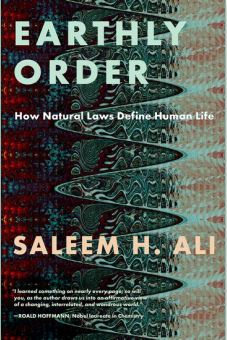
Saleem Ali’s book, Earthly Order: How Natural Laws Define Human Life, explores the linkage between natural order and societal order. He ultimately argues that mankind should synthesize social structures to match the order found in the natural world for the benefit of mankind and the environment in which we live. In reaching this conclusion, Ali devotes attentions to the beauty of natural order, which he sometimes calls design.


Saleem takes the consensus, scientific approach to the natural order. He assumes that natural order developed from the bottom up: that stars and planetary systems formed from initial cosmological constants present in the fabric of the universe at the instant after the “Big Bang” and that life formed spontaneously from inert matter into self-replicating molecules that grew exponentially more complex over time.

Saleem Ali is the Blue and Gold Distinguished Professor of Energy and the Environment at the University of Delaware. He has a B.S. degree in Chemistry and Environmental Studies from Tufts University, 1994, and M.S. degree in Environmental Studies from Yale University, 1996, and a Ph.D. in Environmental Planning, Department of Urban Studies and Planning from Massachusetts Institute of Technology, 2000. Stephen Meyer, who also wrote Signature in a Cell and Darwin’s Doubt, has degrees in physics and earth science from Whitworth College, 1981, and an M.Phil. in history and Ph.D. in philosophy of science from Cambridge University, 1987 and 1991.

In Return of the God Hypothesis, Meyer attempts to show that what we see in nature is better explained by a top down model of order. He argues that “specified complexity” defies a bottom up explanation, and begs for a top down approach. He claims that this is a not a “god of the gaps” argument. Rather, it is the natural conclusion to be drawn from what we observe: that the specified complexity we observe in the world always comes from a mind.
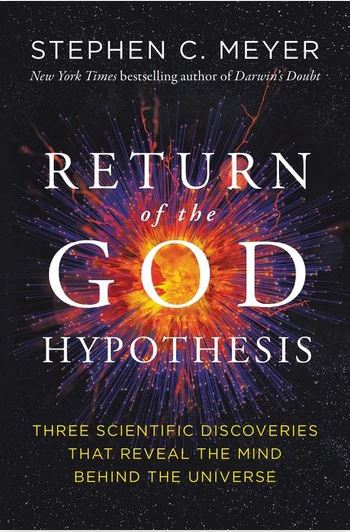

Meyer doesn’t necessarily chart new ground in the evidence or the methods he uses to reach his conclusions. He using principals consistent with good science and the evidence revealed by modern science to argue that they point in a different direction than the modern scientific consensus. He argues that the evidence we see in science is better explained by the conception of top down order and it points to a particular kind of top down order.

I am not going to attempt to describe either book more than what I know, most of which can be gleaned from the descriptions of those books and the descriptions provided by both gentlemen. I am also not going to attempt to get too deep into the conversation between Ali and Meyer. You can watch their interaction yourself if it piques your interest. (Linked in the photo below.)
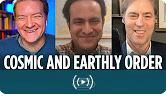

Saleel Ali’s perspective is the one you have heard. It is the perspective that is included in every textbook (by law). It is grounded in the predominant view: that the universe is self-organizing, and life is self-replicating. His responses to Meyer reflect a carefully guarded reluctance to allow for intelligent agency in the design we see in the natural world.

Stephen Meyer and other people, some religious and some not at all, are questioning the propriety of that reluctance to allow for intelligent agency, or what we might simply call “mind”, in or behind the processes that created the universe and life in the universe. One argument in favor of that view is derived from the scientific experiments intended to show how life evolved on earth, says Meyer:

“I love these new approaches in the origin of life and the simulation experiments that are done to test them. I think that they are telling us something, though, about the importance of, as Thomas Nagel put it in Mind and Cosmos[i], that in addition to physical order there is a reality of consciousness and mind, and, we can see hints of that in life…. You see this actually in the origin of life simulation experiments that are conducted to test these new models, because the logic of simulation experiment is to try to reconstruct conditions that we think might have been present on the early earth, and then see what happens in the present. So our knowledge of those cause and effect processes that we see ensuing will help us reconstruct what might have caused life to arise on planet earth.”

These experiments are a kind of “reverse engineering” of the conditions that might have given rise to life from the inert chemistry of the primordial earth, assuming that life developed in that way. Reverse engineering requires an enormous amount of intentional effort and creative design. It also suggests that our efforts at reverse engineering proves an initial engineering that was also the product of intentional effort and creative design. Meyer continues:

“There is something that has emerged invariably from these experiments, and that is to get the chemistry to move in a life relevant direction, the chemist repeatedly has to impose constraints on what the chemical reactions would naturally do. If you have got reagent A and reagent B, and they are combined, they will make A/B, but they will make a whole slew of versions of A/B…. The chemist has to fish the A/B version three out of that gamesh of possibilities…. What the chemist is doing at that point is excluding some options, electing another…. [Often]what they will do is just buy the reagent that they want off the shelf that has already been purified by an intelligent agent. At each step along the way there is an impartation of information. If you exclude some options and elect others, you are imparting information into your simulation, and that information is invariably coming from the experimenter.”

The impartation of information, of influence, of direction is the activity of a “mind” – a causal agent. By agent, I don’t mean a compound that is, itself, a product of inert matter that always reacts according to its properties; I mean a “will” that is directed by “mind”. A billiard ball is inert until it is stricken by a person with a cue, and then it acts according to its properties and the laws of motion until friction causes it to slow and to stop. Meyer says:

“So, I think nature is actually telling us something. These simulations invariably require the imposition of intelligence to proceed in a life relevant direction. You have to ask, ‘What are they simulating?’ If this is something that is consistently arising in all simulation experiments, maybe they are pointing to a need for a top down explanation (explaining the origin of life) because all of the simulations require top down imposition of intelligence and information into the systems.”

These experiments intended to show the possibility that life might arise spontaneously, given the right conditions, are demonstrations of the importance of outside influence to cause it to happen – if indeed it can happen that way.


The famous Miller-Ulrey experiment still referenced in high school textbooks was heralded as proof of the concept. It comes woefully short, however, in demonstrating that life might have arisen out of a primordial soup. (I explored the limits of that famous experiment in What’s in Your primordial Soup?) In the Miller-Ulrey experiment, the experiment was done with elements that were not known to have existed in the early “primordial soup” of the earth at the time in which we know that life arose.

To be fair, though, they were just trying to show that it’s possible: that life can form on its own, given the right environment. On the other hand, it is a good example of the way in which an intelligent agent (the scientist) must jury-rig an experiment to try to produce the intended result he is trying to achieve.

Continue reading “What is the Basic Order of the Universe? Bottom Up? Or Top Down?”

A Preface to the Problem of the Origin of Life

The problem of the origin of life is an Achilles heel, not for science, but for the materialist

Particles of DNA strands flying through space to Earth.
Concept of the origin of life. Elements of this image furnished by NASA.

Michael Guillen, who obtained degrees in physics and mathematics from Cornell University, where he studied under Carl Sagan and Fred Hoyle, and who taught physics at Harvard University, has a podcast in which he addresses the problem of the origin of life (among many other things). (See Science + God with Dr. G. Episode #44)

Guillen was an atheist into his late 20’s or early 30’s. Then he became a theist, and then a Christian. He has always been a “science guy”, however.

You can find the explanation of how he gravitated from atheism to Christianity in earlier episodes of the podcast. I am not going to address it here. I want to address the origin of life problem using this particular episode as a backdrop because I think he explains the problem well.

Before I do that, I want to preface the origin of life problem and put it in some context. The unspoken and unexamined assumptions we make can cloud our understanding, so I want to seek a little clarity first.

Continue reading “A Preface to the Problem of the Origin of Life”

Thoughts on Perspective, Science and Faith

As finite beings, We have no choice put to adopt our fundamental principles on faith. We do not have the requisite perspective to have more certainty than that.

I have two blogs I maintain currently: Perspective and Navigating by Faith. Perspective and faith loosely characterize my journey over many years: trying to find perspective and understanding the value, the necessity, and the integrity of a faith grounded in reality, both observable and unseen.

Many people believe that faith is the opposite of fact and at odds with science and reason. I strongly disagree. I have come to believe that faith is inescapable for finite beings – both religious ones and non-religious ones alike – and faith lies at the core of everything we believe to be true.

I was listening to a podcast discussion recently when one of the participants said something like this: When we approach any evidence, we approach it with a perspective. This is a non-pejorative way of saying that we are all “biased”.

As finite beings we are all necessarily “biased” by our own perspective, our own experiences, our own knowledge, understanding and ability to grasp, synthesize and categorize what we know and understand. Our perspective is influenced and filtered through our location in the world, our place in the culture and society in which we live, the history that we remember, and too many other things to summarize them adequately in a short blog article.

The discussion in the podcast that prompts this writing focused briefly on the fact that we all bring assumptions to the table when we consider anything. Those assumptions, however intentionally or surreptitiously developed, are the bedrock of each of our worldviews. They are the foundations on which we stand. They are the filters through which we see the world.

Those assumptions are developed, to a greater or lesser degree, by some combination of our external influences, our internal leanings and reactions to those external influences, and our consciously or unconsciously chosen compass points we use to guide ourselves in sorting out the information we encounter.

At the most basic level, those assumptions are axiomatic. They are truths we take for granted. We cannot prove them, and we rarely question them without crisis. We are fortunate if they hold us in good stead, if they are well-enough grounded in reality and fact to be of benefit to us in our dealings with the circumstances of our lives.

If those basic assumptions are not well considered and well-grounded, we can be blown about by every wind. If they are not based in fact and an accurate grasp of the nuance of reality, they can prove little consolation or comfort in times of crisis. If they are not well-anchored in timeless truth, they can leave us adrift when we need to count on them most.

The unique perspectives in light of which finite beings approach any evidence is necessarily limited and biased because we are limited and finite beings. At best, we can only hope to orientate ourselves in the direction of truth. We don’t define truth. We don’t establish truth. We don’t’ generate truth.

This is necessarily the case with finite beings who can only approach reality from a particular location at a particular time in the context of a particular cultural, historical, and philosophical point of view.

If I was omniscient and all seeing, I could have ultimate confidence in my perspective. My perspective would be objective and factual. My perspective would be the measure of all reality.

But no human being can validly make that claim (though we may and often do think and act like we can). In all honesty and humility, we must each admit that we come at evidence from a perspective with bias born out of our own experience, cultural context, limited knowledge and limited understanding.

We don’t know what we don’t know.

As a necessary corollary to these things, which I believe with all the certainty that I can possibly ascribe to these things, we are creatures of faith. All of us. We have no choice put to adopt our fundamental principles on faith. We do not have the requisite perspective to have more certainty than that.

My conclusion in this regard is based on fact (that humans are finite beings) and “logic” or philosophy, which reasons from the fact that we are finite to conclude that our perspective is limited thereby. Because our perspective is limited, we must rely on faith in making our conclusions which, themselves, derive from the fundamental assumptions we also take on faith. We can’t escape these limitations because they are inherent in finite creatures such as ourselves.

Some people even in this modern age, however, have boldly claimed that science is the study of all the reality that exists. Further, they say, therefore, we no longer need philosophy or theology. (I have heard Neil deGrasse Tyson say this very thing.) I am going to push back on that idea in this blog post.

Continue reading “Thoughts on Perspective, Science and Faith”

Christianity’s Ties to the Scientific Method

Christianity was the fertile soil in which scientific method and modern science began to grow


I have heard a number of people assert that Christianity gave birth to the scientific method. Perhaps, the first time I heard that claim was from John Lennox, the famous Oxford University professor of mathematics. I was intrigued, but I didn’t take the time to research his claim at the time.

I have heard the claim repeated multiple times, most recently by Dr. Michael Guillen the astrophysicist, former Harvard professor and TV personality. In fact, he devoted a podcast to the subject (embedded below), so I figured it was time to learn more.

I started with Wikipedia, which has a page on scientific method. Wikipedia begins with Aristotle and focuses on rationalism as the basis for scientific method.

Properly speaking, rationalism is not a method. It is a philosophy, a way to approach the world. Rationalism and Aristotle, though, seem to have led the way to the development of the scientific method.

Aristotle’s inductive-deductive method that depended on axiomatic truths and the “self-evident concepts” developed by Epicurus was an early conception of the way to do science. It was jettisoned, however, for something more like the modern scientific method beginning around the 16th Century. Perhaps, this is why Guillen doesn’t mention Aristotle, except in passing.

After those early pioneers, Wikipedia references some great Muslim thinkers who were influenced by Aristotle (including Avicenna (Ibn Sina) and Averroes (Abū l-Walīd Muḥammad Ibn ʾAḥmad Ibn Rušd)). They placed “greater emphasis on combining theory with practice”, focusing on “the use of experiment as a source of knowledge”. Guillen starts his history of scientific method with these early “flashes” of scientific method in the Muslim world.

These men of the Islamic Golden Age pioneered a form of scientific method, but the inertia did not continue. Moses ben Maimon (Maimonides), the great Jewish theologian, physician, and astronomer, developed a similar emphasis on evidence. He urged “that man should believe only what can be supported either by rational proof, by the evidence of the senses, or by trustworthy authority”. He foreshadowed a future scientific posture, but his prescience also did compel further advancement at the time.

Dr. Guillen credits Robert Grosseteste and Roger Bacon with the formation of the first actual principles of scientific method. Their ideas “caught fire” in Christian Europe from the tinder of academies that began just after the turn of the first millennium, igniting a blaze that would fuel scientific inquiry and endeavor for centuries to come.

“Concluding from particular observations into a universal law, and then back again, from universal laws to prediction of particulars”, Grosseteste emphasized confirmation “through experimentation to verify the principles” in both directions.

Roger Bacon, Grosseteste’s pupil, “described a repeating cycle of observation, hypothesis, experimentation, and a need for independent verification”, including the recording of the way experiments were conducted in precise detail so that outcomes could be replicated independently by others. Bacon’s methodology lead to the modern emphasis on peer-review in science, says Guillen.

Wikipedia mentions Francis Bacon and Descartes. Bacon and Descartes emphasized the importance of skepticism and rigid experimentation, expressly rejecting Aristotle’s dependence on first principles (axioms). Guillen, however, glosses over Descartes to get to Galileo Galilei and Isaac Newton.

Galileo Galilei introduced mathematical proof into the process and continued to distance science from reliance on Aristotelean first principles. Galileo and Newton reformulated the terms of scientific method that would inform modern scientists ever afterward.


That the two latter men were men of faith, along with Grosseteste (a Catholic Bishop) and Roger Bacon, his student, is significant. Maimonides and the Islamic thinkers before him were also men of faith. These men who pioneered the way to modern science were all monotheists who believed in a creator God. 

Science did not really take off until the 17th Century. The trailblazers of the modern scientific method were religious men, and the modern scientific method was born in the religious environment in Christian Europe lead, primarily, by men of faith.

Why did science catch fire in Christian Europe and not in other parts of the world? Why not in China? Or in the world of the eastern religions? This is a question Guillen poses, and he provides a possible answer.

Continue reading “Christianity’s Ties to the Scientific Method”

An Interview with Dr. Bruce Greyson on Near Death Experiences, Part 2

If you lose your fear of dying, you also lose your fear of living.

A woman dies and her spirit arises.

I have done two articles on Dr. Michael Guillen’s treatment of near-death experiences (NDEs) based on his podcast (Science + God with Dr. G}. Guillen is an astrophysicist who taught physics at Harvard and earned his degrees from Cornell University under the tutelage of men like Carl Sagan and Fred Hoyle.

He is no slouch when it comes to science, and it was his “beloved science” that led him to question the materialistic worldview he assumed to be true. As his worldview expanded with the quantum entanglement of scientific discoveries that pushed those once fixed boundaries out of his comfort zone, he began a journey that eventually led him to faith in a Creator, God.

Dr. Guillen’s current interest in NDEs is understandable. It didn’t take much convincing for Dr. Guillen to determine that NDEs are real. His interviewee in episode #48 of the podcast, Dr. Bruce Greyson, on the other hand, was puzzled, but initially dismissive, when he encountered a patient who experienced an NDE. He didn’t have room in his materialistic worldview for NDEs, but the curiosity of his scientific mind propelled him forward.

Greyson is the Chester Carlson Professor Emeritus of Psychiatry and Neurobehavioral Sciences at the University of Virginia. You can listen to his interview with Dr. Guillen here. Among other things, he tells the story behind his lifelong study of NDE’s together with what he has discovered along way.

Dr. Greyson has studied NDEs, now, for about 50 years, and the data he has accumulated is significant. In this second article on the interview of Dr. Greyson, I want to begin with the question posed by Dr. Guillen to Greyson: whether the near-death stories people tell are “all over the map”? Greyson did not hesitate with his response:


They are not all over the map. There are similarities in what people tell us, not only between different individuals but between different cultures and religions. A lot of people tell the same stories. We find near-death experiences from people in Ancient Greece and Rome that sound like they could have happened yesterday.”


The consistencies Greyson describes are the result of many years of tracking NDEs throughout time and across geographical and cultural boundaries, categorizing them, and comparing them to each other.

As a scientific study, researchers have tried to correlate NDE’s with physical, environmental factors, such as oxygen deprivation and over-stimulation by drugs. Greyson says, however, “We don’t find any correlations at all.” His current conclusion after 50 years of research is that environmental factors don’t appear to explain NDEs.

The consistencies from person to person and culture to culture over the span of time leads Greyson and other NDE researchers to view them as a singular phenomenon. Greyson says the same characteristics of NDEs reoccur with great consistency regardless of who has experienced them. Gender, ethnicity, cultural background and religiosity (or the lack thereof) don’t seem to factor into NDEs. “Atheists describe the same things as Catholics do,” says Greyson.

Commonalities in the NDE experience, however, may not be as intriguing to Dr. Greyson, the psychiatrist, as the common outcomes. The most interesting outcome to him, he says, is the effect NDEs have on the people who experience them.

Dr. Greyson says, “I make my living trying to help people change their lives, and it’s very difficult to do.” The NDE experiences that take a few seconds or a few minutes at most “totally transform someone’s attitudes, beliefs, values, and behavior.” For that reason, Greyson says NDEs are “a powerful experience!”

The data shows that NDEs are a universal phenomenon. Greyson won’t speculate whether NDEs indicate some universal reality, something universally going on with physical bodies, or something that is a universal psychological trait. He is cautious to say, “We don’t know the answer to that.”

As Greyson continues with the interview, I am impressed that his scientific training and skepticism – consistent with his materialistic worldview – guide him circumspectly in a field that might tempt another person to run wild with imagination. He is careful not to speculate, but he is candid about the things that appear to be evident from the volume of data, even if they cannot be explained by his worldview.

Continue reading “An Interview with Dr. Bruce Greyson on Near Death Experiences, Part 2”