I previously wrote on the subject of the James Webb Telescope and the headlines claiming that recent discoveries call the Big Bang into question. (Is the Big Bang finally Over?) The Big Bang theory is a theory based upon the fact that we have an expanding universe, and the fact that we have an expanding universe suggests that it is expanding from a point in time. The Big Bang theory that the universe is expanding from a point of beginning some finite time ago is alive and well, but the standard model(s) developed to explain how the expansion we see is being called into question by the James Webb discoveries.
I didn’t go into technical detail about why the evidence for an expanding universe remains solid, mostly because I am not physicist, or even a “science guy”. I am interested in science and try to keep up with certain areas of science because they interest me, but I am not educated or trained in the sciences.
Today, however I heard an explanation for why the James Webb discoveries do not undermine the basic Big Bang principal, that the universe is expanding, that was simple and clear and worth repeating (if for no other reason than for me to remember it).
In conversation with Joe Rogan on his podcast, Stephen Meyer explains why the James Webb Telescope discoveries do not undermine the basic premise of the Big Bang theory. To understand this, we need to understand how the James Webb Telescope is constructed to observe matters in space further away from us than we have observed before.
We also need to understand the evidence for an expanding universe because the James Webb Telescope incorporates design elements that take advantage of the phenomenon that gives us proof of expansion in the universe. That evidence was discovered in the 1920s, and it provided the first evidence that the universe is expanding, and not static as was thought up to that point.
I will quickly explain that first evidence for an expanding universe. Then I will explain how the James Webb Telescope’s design is based on this evidence (thanks to Stephen Meyer in his conversation with Joe Rogan), and then I will explain how the success of the James Webb Telescope actually proves the basic Big Bang principal – that the universe is expanding.
I am going to do something unusual (for me) today. I have listened to long podcasts and summarized them or focused on particular aspects of them. I have also read books and done the same.
Today, I am going to link to a long podcast without much comment. the podcast is the Joe Rogan Experience, the most poplar podcast available today. I am not really a Joe Rogan fan. I don’t often listen to his podcast. I am not sure I have ever listened to an entire episode, so this is a first for me.
Joe Rogan is unquestionably a curious and surprisingly intelligent interviewer. He can say some stupid things, but then (I have to confess) so can I. I suppose that combination of “common guy” persona, willingness to ask the “stupid” questions and challenge the status quo, and a modicum of intelligence is why he is so popular.
In the episode I am embedding below, Joe Rogan interviews Stephen C. Meyer, a “proponent” of “intelligent design”. The interview is particularly interesting because Joe Rogan tends toward people like Sam Harris, and Bart Erhman, and other materialists, atheists, and skeptics of religion.
Rogan isn’t just a Cretan (to use an old biblical word) as his popular persona might suggest. Though he clearly favors materialist explanations of the world, he asks good questions and gives his guests opportunity to explore contrary points of view. This is the case in the embedded interview that lasts for over 3 hours.
I am still working my way through it, but I have heard enough at the 50 minute mark to consider it worthy of putting it out there. Maybe I will come back to summarize or focus on particular aspects of the conversation. If you have listened to it (or are listening to it as I am), feel free to post your own comments.
Stephen Meyer is the author of the New York Times bestseller Darwin’s Doubt: The Explosive Origin of Animal Life and the Case for Intelligent Design and Times (of London) Literary Supplement Book of the Year Signature in the Cell: DNA and the Evidence for Intelligent Design. His many other publications include contributions to, and the editing of, the peer-reviewed volume Darwinism, Design and Public Education (Michigan State University Press, 2004) and the innovative textbook Explore Evolution (Hill House Publishers, 2007). His most recent book, Return of the God Hypothesis: Three Scientific Discoveries That Reveal the Mind Behind the Universe, is generating much discussion, like the interview embedded in this blog.
Meyer graduated from Whitworth College in Spokane, Washington, in 1981 with a degree in physics and earth science. He worked as a geophysicist before returning to academia at Cambridge University, to earn an M.Phil. in 1987 and a Ph.D. in 1991 in the Philosophy of Science. His doctoral thesis was titled “Of Clues and Causes: A Methodological Interpretation of Origin-of-Life Research.”
The title of this piece is a bit of poetic license. I am combining the Psalmist’s challenge to “taste and see that the Lord is good….” (Psalm 34:8) with Paul’s admonition to “test everything”. (1 Thess. 5:21) The general thrust of these two verses is an invitation to seek God and truth and to test what we think we know.
Tasting suggests that we can experience that God is good, and testing suggests that we can measure, in some respect, that experience with God. While the existence of God is not susceptible to testing and measurement like we do with science in a laboratory or in physics (for many reasons), these statements are claims that we can in some sense measure, prove, and have confidence in our conclusions.
Both writers are talking about experience in these passages, something that is frowned upon as evidence in our modern, western culture. I will come back to that. First, though, I want to make some observations.
It should go without saying that tasting and testing requires some commitment to the process. Tasting is highly experiential. If we are going try to “taste” something, we have to engage in that process.
We cannot taste through another person’s experience. It requires our own engagement in the tasting, and that requires some willingness on our part to engage.
On the subject of being scientific about spiritual experience, we can and should listen to what others say who claim to have tasted that God is good. We can and should weigh the “results” and conclusions of various people who make these claims.
In that process, we could categorize, compare, and contrast the tasting and the testing and reach some conclusions purely on basis of the data collected. I have done that anecdotally for years, and I suspect I could find some more objective data pools of these largely subjective “experiences”. The larger the data pool, the more objective we can be in our analysis of them, though they are subjective for the individuals involved.
Tasting and testing, as we are challenged to understand it in the Bible, however, is more personal than that. We can study other peoples’ experiences for a lifetime and never really know what the experience is like in the “biblical” sense of knowing.
These thoughts today are inspired by the following quotation by CS Lewis from his seminal book, Mere Christianity:
“A man can accept what Christ has done without knowing how it works; indeed, he certainly won’t know how it works until he’s accepted it.”
The emphasis on accepting something without knowing how it works seems to run counter to the way we do science, but I don’t think it really is. We do a lot of science on a hunch without knowing whether we are right or wrong. We might call those hunches educated guesses. We don’t know whether a hunch or educated guess is right until we put it to the test, and we understand it better in the process.
As often is the case with me as I read, listen to discussions, and watch YouTube videos, a number of strands from those media come together. I am going to attempt to weave some of those strands together today as I tackle the edges of our human limitations, dark matter, and knowing God.
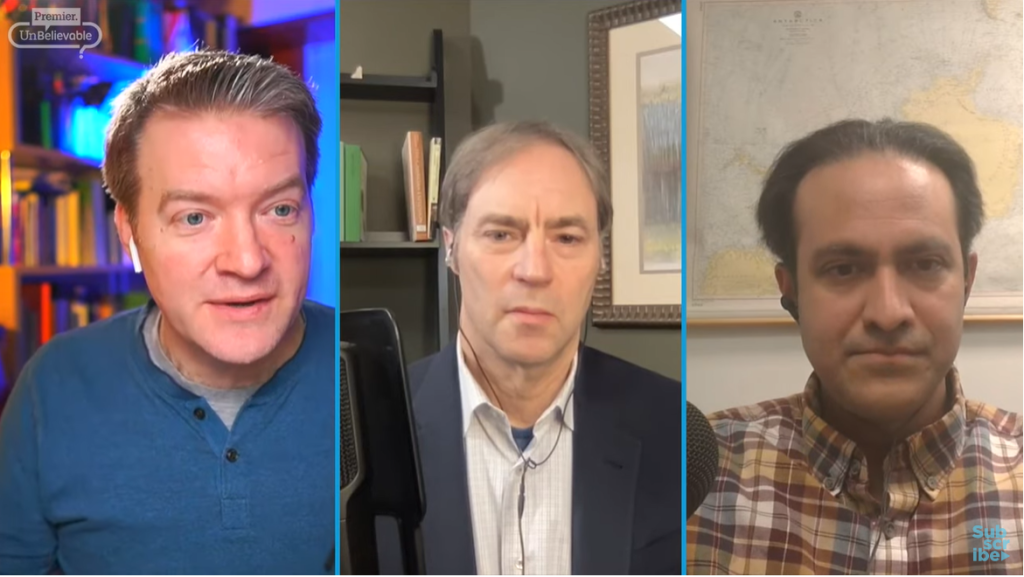
In a recent discussion between Saleem Ali and Stephen Meyer on the Unbelievable! podcast, Some things that Ali said prompted me to want to respond. I wrote of the discussion recently in What is the Basic Order of the Universe? Bottom Up? Or Top Down? But, today, I want to take my observations a bit further.
Saleem Ali has a background in chemistry and environmental studies, and Stephen Meyer has a background in physics, history and the philosophy of science. In their discussion, Meyer argues that our study of the physical world reveals evidence for a God who created it (a top-down design). In Ali’s response, I agree with his statement that certain things are unknowable to human beings because of our empirical limitations.
Ali said these things to highlight that we cannot know with scientific certainty that God exists. I agree with that. I would simply add this: Because science is the study of the natural, physical world, and humans are creatures of the natural, physical world, we are constrained to the limitations of the natural, physical world in our scientific endeavors.
Ali also admits that we may not ever be able to know the origin of the causes of the universe, or of the origin of the laws of physics, or of the origin of life because these things would require us to search beyond the parameters of the constraints of the natural, physical world in which we are bound.
Since we, ourselves, are physical creatures in a world that is limited by physical constraints, we may never know with scientific certainty what else exists.
This assumes, however, that we have no capacity to know of anything that exists beyond the natural world. Some people are content to foreclose the idea that we are incapable of knowing anything that is not material and physical in nature. I am not convinced, and I see evidence that we are not so limited.
We have basically two choices: 1) assume that the existence of the universe is nothing more than a brute fact; or 2) assume that the universe had a creator. We can either resign ourselves to agnosticism or choose to test one of those two assumptions.
I made the assumption that the universe makes more sense on the premise of a creator, and I have been testing that hypothesis ever since. I won’t apologize for making that assumption, and the degree to which I have tested that assumption has not left my unsatisfied.
To those people want to judge me on that point, I say that you may be in a worse position than me to be a judge. I assume an intellect far greater than me created me with intellect. I do not trust it on my own account. On what basis do you have confidence in your intellect and agency that derived merely from inert, unintelligent matter?
To the extent that you believe your reasoning power evolved from lower life forms, why do you have confidence in the reasoning of a monkey’s mind? I say this not of my own accord; I am applying Darwin’s reasoning that he applied to own his convictions. (See Reflections on Faith and Atheism and Universal Design Intuition and Darwin’s Blind Spot))
As hints of the painter appear in his painting, our study of the natural world can (and does I believe) give us hints of the God who created it. We see the personality of the painter in his painting as we see the personality of God in His creation – including the creation of human beings.
I cannot prove that, just as I could not prove the painter by virtue of his painting. If I had no connection with the painter and knew no one who knew him, my knowledge of him would be mere speculation. But, I would be right in assuming a painter.
Ali says that finite creatures such as ourselves are going to encounter a certain amount of mystery and awe, but that mystery and awe does not necessarily validate a theistic explanation. Mystery and awe by themselves do not warrant a conclusion that God exists. I agree with him on the statement, as far as it goes, and I think we need to be candid about these things.
If God exists, who preexisted, and caused the universe and all things that we know to come into being, including ourselves, we may be cut off from knowing that God and from viewing that causality by our physical limitations and the physical limitations of the universe in which we are bound. Even if the universe hints of Him, we may be incapable of knowing Him by our own abilities because of our limitations.
The only exception I can think of would be for such a God to reveal himself in some way to us. Of course, that is the claim of theism.
We do not know the painter of a painting unless we meet him, and we cannot know the God of the universe unless we “meet” Him in some way. We might be able to track down the painter of a painting, because that painter exists within the same bounds of the same world as we do. Because of our limitations, however, Godwould have to introduce Himself to us.
That is the claim of people who claim to have “met” God in some fashion. We can explore those claims as we can explore the claims of anyone who witnessed an event or met a person we we have not met ourselves, but let’s lay that aside for the moment.
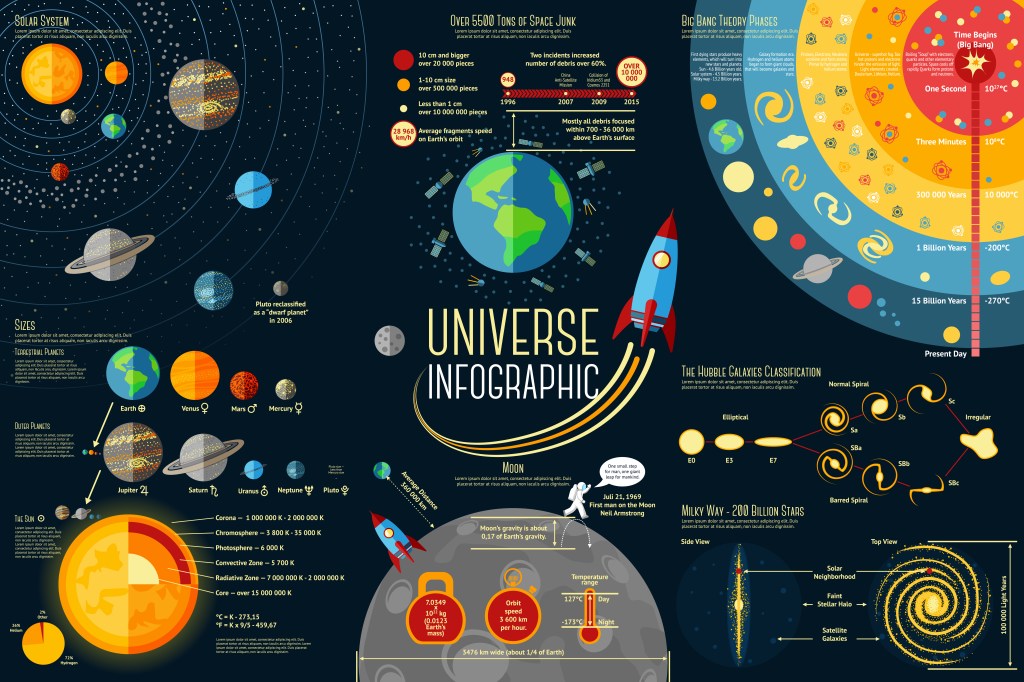
Set of Universe Infographics – Solar system, Planets comparison, Sun and Moon Facts, Space Junk made by man, Big Bang Theory, Galaxies Classification, Milky Way description. Vector illustration
The question that forms the title of this blog article is the subject of a recent video on YoutTube. I am embedding the video here so you can watch and listen for yourself. The suggestion, however, that the James Webb Telescope is disproving the “Big Bang”, is overstated. You might even call it clickbait!
Before launching into my thoughts on this, however, what is meant by the “Big Bang” needs to be defined. The terminology is credited to Fred Hoyle. When Hoyle coined the phrase in a 1949 a talk on BBC Radio, he was probably speaking tongue in cheek.
Hoyle (like most scientists of his age) had long believed in a steady state universe. The new evidence indicating that the universe is expanding was like a big bang to them. It rocked the long-held view that our universe is static and unchanging.
The laws of physics seemed immutable. Why wouldn’t scientists believe the universe was equally immutable?
That the evidence that the universe is expanding was unsettling to the accepted “science” at the time is an understatement. As Hoyle was describing the then recent discoveries and the theories that derived from that evidence, he said:
“These theories were based on the hypothesis that all the matter in the universe was created in one big bang at a particular time in the remote past.”
Because these discoveries came as a shock wave to scientists in the first half of the 20th Century. the term, “big bang”, may have been used to characterize how those discoveries were received!
The evidence that the universe is actually expanding raised the specter that the universe isn’t static, and it might even have had an origination “point”. This realization that the universe may have had a beginning wasn’t lost on scientists at the time, and it wasn’t eagerly received.
The term didn’t really “stick” until the 1970’s, and it isn’t really a good descriptor for what we (think we) know happened. It probably wasn’t a “bang” for instance, because no sound was likely generated. The history of the development of this evidence is interesting and can be found on Wikipedia.
The Big Bang does suggest a beginning to the Universe (to put it bluntly). This possibility, of course, has theological implications, another realization that wasn’t lost on scientists who largely viewed the universe through a materialistic lens. That possibility was largely downplayed then, and many scientists have continued to downplay that possibility.
We still don’t have evidence that reveals how the universe was formed. We can’t see back that far, and doubt exists whether we ever will be able to see back that far. As the Wikipedia article states: “[T]he Big Bang model does not describe how energy, time, and space were caused, but rather it describes the emergence of the present universe from an ultra-dense and high-temperature initial state.”
The current suggestion that the James Webb Telescope is disproving the “Big Bang” (the implication of an expanding universe with a “beginning”) comes from people who would like to downplay the implication of an expanding universe with a beginning, and it seems to be more wishful thinking than reality.
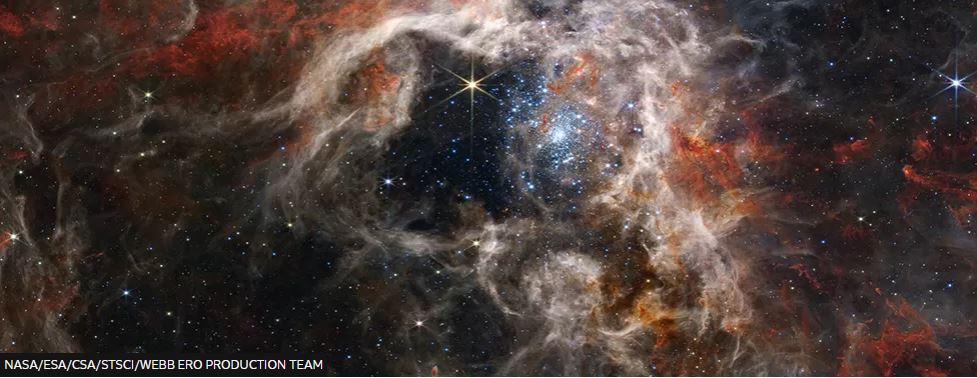
The James Webb discoveries fueling this resurgence in old thinking include images of old stars and galaxies that are more formed than they should be on our standard (Big Bang expansion) model of the Universe. The standard Big Bang expansion model is similar to the concept of evolution. If the universe expanded, it must have progressed from a simpler state to a more complex state.
Just as life began with a simple, self-replicating molecule and progressed to ever increasing complexity over a long span of time, the thinking has been that the universe must have developed in the same progressive sort of way. This is the paradigm that has driven much of modern science: that natural processes developed from the bottom up.
The new James Webb images reveal more highly developed stars and galaxies than we imagined would exist in the earliest stage of the universe on the standard model. The mature development of ancient galactic stars and star formations is surprising on the progressive view.
These images do not contradict the fact that the universe is expanding, however, and they don’t disprove the appearance of a “beginning”.
People are “surprised that things grew so quickly”. People are perplexed that stars and galaxies are so well-formed at such an early stage, when they would expect to find “fledgling” galaxies in more undeveloped states.
People are scratching their heads at the appearance of extremely small and extremely large galaxies in the early Universe because it does not comport with the progression of the expansion of the Universe as modern scientists have modeled it before the advent of the James Webb Telescope.
These observations have nothing to do with the evidence that the universe is expanding. A more accurate statement is that models for how that expansion occurred are being called into question: not the fact of expansion from “a point of beginning”.
The James Webb findings do not negate the evidence we have that our universe is expanding from some very dense “point”. If anything, the findings evoke even more theological implications, perhaps, than the standard Big Bang model.
The idea that the universe developed from simple to complex over time is difficult to maintain when stars, galaxies, and other formations in the farthest (and earliest) regions of the universe that we can see are so well-formed and “mature”. These things conjure up the specter that this evidence is more consistent with the idea of the universe being created than we previously thought.
Of course, we had clues that this should be not surprising to us: the standard expansion inflation model incorporates the assumption that an early, extremely rapid and short “burst” of expansion occurred, and this assumption was necessary to accommodate the short time frame in which the Universe appeared to have “developed” based on what we could see before the James Webb telescope. Perhaps, then, we shouldn’t be surprised to find even greater “development” at earlier stages.
We shouldn’t be surprised either that modern scientists who are committed to a materialistic worldview are struggling with these things. A materialistic worldview has colored modern science for a couple hundred years, at least.
A materialistic worldview was perfectly at home with the old static state view of the universe. It took a hit with the evidence that the universe is actually not static, but expanding from a point of beginning, though materialist thinking held firm, and most scientists have continued to hold to a strictly materialist position.
Stephen Hawking and Roger Penrose famously calculated “singularity” that “proved” the so-called Big Bang (that expansion necessitates a “beginning”). Vilenkin (and some other guy who I can’t remember, lol) determined that even a multiverse that is expanding would have to have a “singularity” (a euphemism, it seems, for a beginning).
So far, modern discoveries have continued to negate good reason to believe in a static universe (which theory was discarded after centuries of use when we found that our universe is expanding) or an oscillating or cyclic universe. Multiverse(s) seem to make sense theoretically, but we will likely never be able to prove it/them anymore than we are likely to see back before the “beginning” of this universe.
Scientists like Neil de Grasse Tyson, Hawking, and Penrose who are committed to finding explanations for these things that do not implicate a Beginner (a/k/a God), will likely continue to try to prove their point. Hawking spent much of the rest of his life after mathematically proving the “singularity” trying to get around “singularity” and its theological implications. Penrose (and Vilenkin) do not concede any theological implications either.
Nothing (much) has changed on that score, but the new james Webb images are certainly is producing some head scratching! Some scientists, like Hoyle, who were once very antagonistic about people drawing theological implications from cosmology have backed off their dogmatic stances. Penrose seems to concede the possibility of a legitimate “metaphysical” component to reality, though he “doesn’t go there” in his own thinking.
There certainly is a lot of head scratching going on, and these are interesting times. We may all be at the edges of our seats to learn where all of this will take us, though I strongly doubt that we will get definitive answers to our most fundamental questions, like the origin of the Universe in my lifetime – if ever.
The new discoveries do call into question the expansion models that scientists have developed, but they do not call into question the evidence that the universe is, indeed, expanding. The new discoveries do not align with they way scientists have believed the universe expanded, but the evidence that the universe expanded from a “point” of singularity remains solid.






 Navigating by Faith