The Importance of How We View God and Ourselves

He who is forgiven little, loves little.

depositphotos Image ID:31614317 Copyright: DesignPicsInc
depositphotos Image ID: 31614317 Copyright: DesignPicsInc

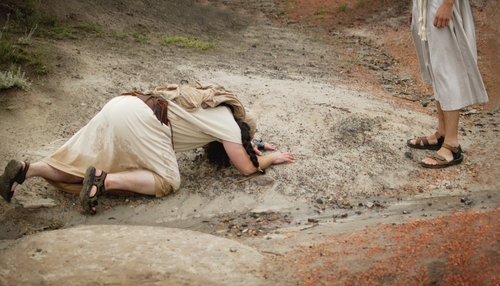
The story of the sinful woman who wipes Jesus’ fee with her tears and anoints them with oil is a tender but rather uncomfortable story. [i] A Pharisee had invited Jesus to eat with him at his house. While reclining at the Pharisee’s table, a woman, a known sinner, came up behind him.

Where did she come from? How did she get into the Pharisee’s house? Was she, perhaps, a daughter of the Pharisee, one of whom he was not very proud? was there something else going on? We don’t know.

When she came up behind Jesus, she was weeping, and she began to wet his feet with her tears. She wiped his feet with her hair, kissed his feet and anointed them with oil. A greater display of open, unabashed affection is hard to imagine. Thinking of the vulnerability and openness of her affection is even uncomfortable.

The Pharisee was taken aback, as we would be, mumbling to himself that surely Jesus must know who this woman is. Her reputation was well known, at least to the Pharisee.

Continue reading “The Importance of How We View God and Ourselves”

Christianease: Born Again Part 1

Being born again means that God offers us new (spiritual) life that begins now, not at some future date after our death.

canstockphoto25691654
(c) Can Stock Photo / GDArts

Now there was a man of the Pharisees, named Nicodemus, a ruler of the Jews; this man came to Jesus by night and said to Him, “Rabbi, we know that You have come from God as a teacher; for no one can do these signs[1] that You do unless God is with him.” Jesus answered and said to him, “Truly, truly, I say to you, unless one is born[2] again[3] he cannot see the kingdom of God.”

Nicodemus said to Him, “How can a man be born[4] when he is old? He cannot enter a second time into his mother’s womb and be born, can he?” Jesus answered, “Truly, truly, I say to you, unless one is born[5] of water and the Spirit he cannot enter into the kingdom of God. That which is born[6] of the flesh is flesh, and that which is born[7] of the Spirit is spirit. Do not be amazed that I said to you, ‘You must be born again.’ The wind[8] blows where it wishes and you hear the sound of it, but do not know where it comes from and where it is going; so is everyone who is born of the Spirit.” (John 3:1-9)

One of the most ubiquitous and enigmatic Christian phrases is the phrase “born again”. It is as enigmatic now as it was when spoken to Nicodemus who asked the question of Jesus that sparked the answer that is now famous.

Continue reading “Christianease: Born Again Part 1”

Christmas Thoughts: God Redeems the Line of Judah through Tamar

 (c) Can Stock Photo / halfpoint
(c) Can Stock Photo / halfpoint

Amazingly, the genealogy of Jesus in Matthew lists five women. In a patriarchal society governed by paternal lineage, that fact should jump out at us and cause us to take notice. What is God saying? What was He doing? How should we view that today?

We can gain insights by looking at the women who are listed. The first woman listed is Tamar. Her story is found in Genesis 38, and it is a wild one for people of polite sensibilities.

Tamar was the wife of Judah’s oldest son, Er. Judah was the fourth son of Jacob (son of Isaac, son of Abraham). It might seem odd that Judah, the fourth son, is the one from whom Jesus (the Messiah) descends, but that is only a minor oddity compared to the rest. Continue reading “Christmas Thoughts: God Redeems the Line of Judah through Tamar”

Christmas Thoughts: Psalm 22

We celebrate the humble birth of Christ, knowing that the redemptive work God started then is finished, even as it is playing out in our own lives and the times we live in.

canstockphoto32323116

I don’t typically think of the Psalms when I think of Christmas. My Christmas thoughts this season have revolved around prophecies in the Old Testament, and that is where the Psalms enter the picture. The Old Testament is full of prophecies that came true in the person of Jesus from Nazareth, who was born in Bethlehem a little over two millennia ago.

Psalm 22 may have been written by David before he became King when he was on the run from King Saul, who was jealous. On the other hand, it may have been written after David became king when his son, Absalom, formed a coupe to wrest the kingdom from him. Psalm 22 is David’s cry to God in the midst of his own impossible circumstance.

But Psalm 22 is more than that. Psalm 22 is a foreshadowing of God’s own cry when His creation turns against Him. It becomes the cry of God, who shed his divine glory to enter His own creation in the form of a man, which we celebrate at Christmastime. We don’t think of Christmas in these terms, but it foreshadows the death of God incarnate at the hands of His own creation.

Continue reading “Christmas Thoughts: Psalm 22”

Christmas Thoughts: Prophets & Fools


My Christmas Thoughts have taken me to the prophecies in the Old Testament of the coming Messiah. At Christmas, we celebrate the birth of Jesus, the Christ, which is the Greek term for Messiah. Jesus fulfilled the prophecies of the Old Testament, and he said the Old Testament is about him.[i]

The concept of a Messiah is unique to the Abrahamic religions. A messiah is a savior or liberator of the people. The Messiah predicted in the Old Testament (Tanahk) is the Savior of the Jewish people according to Jesus, and he is also the Savior of the world. The Messianic prediction goes back to Abraham:

I will greatly bless you, and I will greatly multiply your seed as the stars of the heavens and as the sand which is on the seashore; and your seed shall possess the gate of their enemies. “In your seed all the nations of the earth shall be blessed, because you have obeyed My voice.” (Gen. 22:18-10)[ii]

Both the Jews and Muslims trace their lineage and heritage back to Abraham, and Jesus, the Christ, the Messiah, is traced directly back to Abraham through David.  (Matthew 1:1-17)[iii] That the Messiah would come through the lineage of Judah, of whom David was a descendant, is echoed forward in the prophetic passages in the Old Testament writings.

Continue reading “Christmas Thoughts: Prophets & Fools”