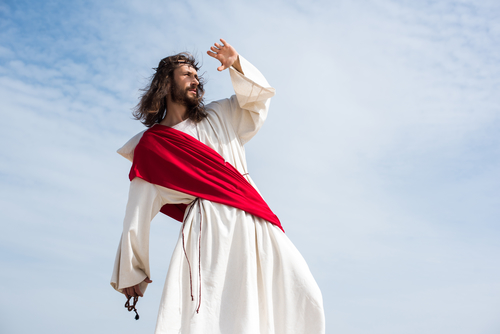
Is the Story of Jesus a Story of Divine Vengeance or Love?

Many people interpret the story of Jesus as if God was looking for someone on whom to take out his vengeance, and His son got in the way – so that somehow makes it right.


NT Wright made a statement on Justin Brierley’s new podcast recently, Ask NT Wright Anything, that is worth repeating. He says that people read John 3:16 (“That God so loved the world that he gave his only begotten son….”) this way: “that God so hated the world that he killed his only son.”

People, especially today, view God as an angry bully. They interpret the story of Jesus, Wright says, “as if God was looking for someone on whom to take out his vengeance, and His son got in the way – so that somehow makes it right”. The people who interpret the story in this way don’t think it is right. They recoil from God as from a cosmic bully.

Of course, many people who moralize about God are simply refusing to acknowledge God as God. They sit in judgment of God. At least they sit in judgment of “the God of the Bible” as they perceive Him.

Many who hold these views also don’t believe God exists, so they are really sitting in judgment of God as they perceive God to be who other people believe in. (Nevermind that this cosmic bully god is not the god other people actually believe in.)

Skeptics aside, I think believers may also view God as more of a cosmic bully than a loving Father, sometimes. It isn’t just skeptics; sometimes believers wrestle with a muddled view of God.

Continue reading “Is the Story of Jesus a Story of Divine Vengeance or Love?”

Reflections on Confidence in Faith and Atheism


Lord Richard Harris, the once Bishop of Oxford, and author of Haunted by Christ: Modern Writers and the Struggle for Faith, participated in a podcast discussion with the former Catholic priest, now agnostic philosopher, Sir Anthony Kenny and Justin Brierly, the host of the Unbelievable podcast. During the interview, he reflected:

“On [the] issue of transcendence…. there is something about the experience of beauty which is tantalizing. It … mysteriously pulls us into itself and beyond itself, but it is ultimately ungraspable.” Harris likened this “mysterious pull” to “an elusive call that haunts us” and which “has its fulfillment in God.”

Harris is quick to note that the tantalizing pull of beauty is not an argument for the existence of God, but it’s also not irrational. He says, “Once you come to believe [Christianity], everything falls into place. It coheres together. This experience of beauty makes sense, as the experience of morality makes sense.”

Of course, this observation is reminiscent of CS Lewis when he said, “I believe in Christianity as I believe that the sun has risen: not only because I see it, but because by it I see everything else.”

Sitting opposite of Harris, Sir Anthony disagreed, saying that he grew up in the church, but Christianity makes less sense to him today than it did when he was younger. As “proof” he commented on a couple of different aspects of theology (the idea of punishment for sin among them) that don’t make sense to him any more.

As I listened to him I thought, as I often do when I listen to atheists and decided agnostics, that Kenny puts a great deal of stock in what he, himself, thinks. Because it makes no sense to him, it makes no sense at all, which he asserts as a brute fact. In that sense, he elevates his own understanding into the place of an ultimate arbiter of truth.

Of course, what else are we to do?

That’s a fair question. We only have ourselves, ultimately, as tools for deciphering truth.  Continue reading “Reflections on Confidence in Faith and Atheism”

Homosexuality and the Church

What we need is for the church to have the conversation on homosexuality better.


I am a big fan of Justin Brierley’s podcast, Unbelievable! on Premiere Christian Radio in the UK. The theme of the podcast is to interview persons with different viewpoints on a variety of subjects that usually focus on some aspect of faith. Often the interviewees include a person of faith and a person of no faith. Sometimes, the interviewees are people of different faiths. The podcast that aired on November 24, 2018, included two Christians on different sides of the debate about homosexuality: How should gay Christians express their sexuality?

David Bennett “grew up in an agnostic/atheist home” but became a “conservative” Christian, while Justin Lee represents the mirror image of David’s experience. Justin grew up in “a very devoutly Christian home”.

Justin relates that he understood that being a Christian meant “taking a loving but principled stand against homosexuality” and that “being gay is a sinful choice”. He felt it was his obligation as a Christian to speak out and encourage people not to be gay. He believed that God would “lead people out of homosexuality”. He believed that homosexuality was a choice, which is what his Southern Baptist church taught.

But then, Justin came to realize that he was same sex attracted himself. In spite of praying and believing that God would change him, his feelings didn’t change. He struggled with that realization until he came to believe that same sex attraction is not a sin. Though Justin is still single, he now engages in ministry to the gay and lesbian community who he says have been left adrift by the greater Christian community.

These two men, both same sex attracted, have come from opposite shores, crossed in between, and take different positions in respect to homosexuality and faith. They engage in a very thoughtful, honest and thought-provoking conversation with Justin Brierley in the podcast.

You can hear the whole thing by clicking on the link in the first paragraph above. Meanwhile, I will summarize their divergent experiences that cross over from opposite shores below.

Continue reading “Homosexuality and the Church”

A Place for Truth in a Pluralistic Society


Is truth so all-inclusive that it doesn’t really matter what you believe as long as you are sincere? We wouldn’t say that about scientific truths, but what about religious truths?

In particular, are the distinctions between the various religions so minor that it doesn’t matter which one of them you believe? Or any of them at all?

These are questions that arise in a pluralistic society such as we have in the United States and much of the Western world. Pluralism accommodates differences, celebrates diversity and promotes inclusion. Pluralism, generally, is a good and wholesome thing in a civilized society.

Whereas, people with differences once harbored hostilities toward one another, and waged war and walled each other out on the basis of those differences, a pluralistic society tolerates, accommodates and even celebrates diversity.

Pluralism allows people to live as they see fit to live and as they believe they ought to live, within reason of course. (My right to live as I see fit ends at your right to be free from my intrusion.) Pluralism maximizes liberty and freedom and allows people choice. Pluralism is a necessary construct in a free society.

Truth, however, is not so inclusive. We don’t accommodate any or all theories in science. We don’t tolerate views in science that compete with proven evidence without equally compelling evidence to the contrary because truth matters to the scientific endeavor.

Truth is what it is.

This is not to say that people aren’t free to adopt their pet theories, but pet theories are not relied upon by a circumspect scientific world that is trying to launch probes to Mars and program vehicles to drive by themselves without killing innocent people.  In the same sense, if truth matters, and if there is any truth to be found in religion, we defy logic and common sense to say that one religion or set of beliefs is just like the next. And the consequences of failing to discern fact from fiction may be just as dire.

Continue reading “A Place for Truth in a Pluralistic Society”

The Myth of Human Rationality

Rationality isn’t wholly missing from the human thinking process; it’s just that rationality isn’t always the driving factor


Ed Atkinson was recently interviewed with Austin Fischer by Justin Brierly on his podcast, Unbelievable, on the issue of doubt. (A Tale of Two Doubters) The personal story of both men involves their public dealings with doubt. One ended up on the unbelieving side of the faith divide, and the other on the believing side.

The point that intrigued me most about the discussion was when Ed Atkinson brought up Jonathan Haidt, who wrote a book called The Righteous Mind: Why Good People Are Divided by Politics and ReligionOne of the topics Haidt addresses is what he calls “the rationalist delusion”, which Atkinson summarizes as a “wild overestimation of our rationality that was … birthed to us in the Enlightenment”.

Atkinson says, “We like to think of ourselves as very rational beings [who] very rationally work and think our way through the world sorting through the syllogisms and … coming to what is the correct answer.” The work that Haidt and others have done on the subject have debunked that view of ourselves. Atkinson says, “Our decision-making process really isn’t very rational.”

I have often thought about this very thing. When I look back on my own journey, I recall that I went off to college with a passionate desire to discover meaning and truth, believing it was attainable, and having a naïve confidence in the rationality of the human mind. What I found in college was a very mixed bag. Though my quest for meaning and truth never waned, my confidence in the rationality of the human mind was disappointed.

I came to distrust that confidence in myself and in others, especially in others whose confidence in their own rationality seemed unwavering. Elevated self-confidence often seems more like brute will than rationality.

Since that time I have been continually disappointed in the rationality (or lack thereof) of the human mind, especially in those who seem to have no doubt about their own rationality. That I am sometimes guilty of the same over-confidence only adds to my disappointment and angst.

As a lawyer whose vocation is getting at the truth through the presentation of the evidence on both sides of a matter to a neutral judge, I have had generous opportunity to test human rationality. What I have found (over and over again) is that human rationality is often affected by things that have little or nothing to do with reason.

Continue reading “The Myth of Human Rationality”