I am reading A World Without God by Chris Palmer. In Chapter 7, in the section titled, “The Indifferent Universe,” the protagonist describes the death of a five-year-old boy from a mysterious plague.
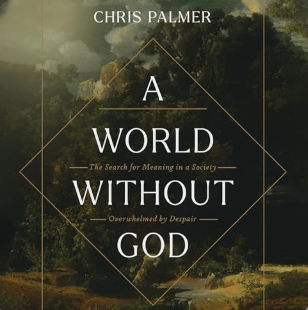
The section opens, saying, “The death of a child has a way of undoing everything…. [including t]he scaffolding we use to make sense of the world.” The protagonist wandering through fictional Novemberton recalls Albert Camus and his “stubborn refusal to look away from the raw edge of things,” and he finds comfort in Camus’ refusal to rescue meaning from chaos.
A strange comfort it seems to be that humans like things we can understand. We want to understand the world and to reduce it to terms we can grasp. We have an innate desire in us for meaning and understanding, and we are unsettled when meaning and understanding elude us.
Some things are obvious but we don’t want to see them. Camus was willing to acknowledge what most of us can’t seem to grasp: that the universe is utterly indifferent to us. He was not just willing to acknowledge it; he was willing to resign himself unreservedly to it.
Most people can’t or are not willing to do that. The death of a child for no reason is absurd, says the protagonist. Most of us are inclined to agree, but why?
Children sometimes die. We all know that it happens, yet it shocks us each time. The death of a child, the sudden death of a husband, father, and provider for his children, and the mass casualties of an earthquake or a flood evoke the same shocked response.
We cannot help but think the world has gone mad. The world has become absurd.
The protagonist in A World Without God praises Camus for exposing “the mismatch between the human heart and the mute mechanics of the universe.” The human heart longs for meaning – or for a particular king of meaning – but the universe seems to defy that meaning in things like the death of a child.
It seems clear to me that perspective is crucial to meaning. If I do not know English, I could not read the book I am reading that is written in English. I have to approach the book from the perspective of the English language to understand it.
From our perspective, the world makes no sense. We want the world to correspond to us but it doesn’t. If we are at the center of the world, it makes no sense. The world seems “utterly indifferent,” indeed, when we consider the death of a 5-year old child to plague, the death of a father and provider for his family, or the mass casualties of an earthquake or a flood.
It seems tragically factual that the world is utterly indifferent to us, but we are not indifferent to that fact. Thus, it seems “absurd” to us.
The problem is our perspective. We seem to expect (or at least desire) that the world should embrace us, coddle us, tend to us. We find it shocking – absurd – that the world is so indifferent. Because the world does not exist the way we want it to exist, we call it absurd and fail to find the meaning in it.
If I see myself in the world at its center, and the world makes no sense to me, perhaps I am not at the center of the world. If I find it absurd because it doesn’t bend toward me, perhaps I am looking at the world from the wrong perspective.
By what metric do we declare the world absurd?
I think all people have some sense that Camus is right about the absurdity of pain and death from our shared perspective as people seeking meaning with ourselves at the center. From that perspective, the world is absurd because it does not bow to the way we desire the world to be.
People praise Camus for being brutally honest and willing to accept the stark truth of that reality. But it seems to me that the absurdity lies in thinking that the world should bend to my desires and that the world should have the meaning I ascribe to it. Perhaps, the absurdity lies in my thinking it is so.
A human being recognizing the great tragedy of the death of a five-year-old just beginning to blossom in the world means something. Why do we find that so unsettling? Frankly, so absurd. That fact – the fact that we are disturbed by it – is the clue to the meaning we long for.
If the world just is, if the world is simply and utterly indifferent, why do we care? Why do we label it absurd? And why, if we think it absurd, would we resign ourselves to go no further in our thinking, but to accept the absurdity of it?
The very fact that it matters, the very fact that we care, the very fact that we find it absurd, is staring us right in the face.
Of course, we want a world that bends to us. Of course, we want a world that cushions our fall, that soothes our pain, that comforts us in our discomfort. But it ain’t so.
What we want is the world to be our god – a god that is subservient to us. When we (repeatedly) “discover” the world does not bow to our wishes, we protest, we lament, we become undone.
But why?! If that is the way it is, why are we always so undone about it. Why not just accept it – not as absurd – but as the way it is. Why do we not simply shrug?
The fact that we are so unsettled by the fact that world does not bow to us, does not comfort us, does not yield the meaning we desire out of it, should suggest to us that we are missing something. To come to the brink of that realization, to come to the very edge of it—and go no further—is the absurdity.
If life seems absurd from the perspective of human beings at the center, perhaps, we need a new paradigm.
We cannot deny that human beings long for meaning and for something different than what we experience in this world. As good as it sometimes can be, we cannot deny that our experience falls short of what we desire. If we resolve ourselves to that fact, the real absurdity is in the resignation. The real absurdity is that we do not seek a new paradigm – one in which meaning makes sense of our actual reality.
The human race has grown in the progress of science. Once we realized that natural laws are dependable, we began to use that knowledge (paradigm/perspective) to our advantage. Once we understood the reality, we adapted to it.
We seem not to have progressed in our knowledge and understanding of the world in other ways. Perhaps, our success with science is partially to blame. We have had such success with science, once we understood how it works, that we want everything to work the same way – only it doesn’t.
Our success with science also tempts us to think, perhaps, that we are the center of the paradigm – except we aren’t. The human race is not the center of the world that we know. The world does not bow to us. Though we are undoubtedly unique – maybe even special – among the living creatures in the world, we are insignificant in terms of the scale of the universe.
We live in a world in which we are not gods, and we live in a world that is more or less indifferent to us. Yet, we live in a world in which the concepts of beauty, meaning, ideals, and transcendence are real enough to animate our imaginations and desires. We live in a world in which humans universally grasp for more than what the world actually has to offer.
We might call such a world absurd, or we might adjust our paradigm to make sense of it.
The human race once thought the world was inhabited by gods who toyed capriciously with the stuff of the world to create chaos for us. Then we adjusted our perspective and discovered that the “chaos” had rules that governed it – rules we could depend on. Our understanding of those highly dependable rules have allowed us to live better, more fulfilling lives.
Despite those rules, however, enough chaos, unpredictability, and “indifference” exists that currently defy our ability to understand and do not allow us to manipulate the world to our control. Perhaps, that control will always elude us. Perhaps, that is the point.
The writer of Ecclesiastes said that God set eternity in the human heart, but not so that we would know the end from the beginning. (Ecc. 3:11) The “reality” of a sense of meaning that does not seem to have an anchor in this world suggests something that transcends the world – something that resonates within us that doesn’t arise out of an indifferent world because its source is beyond it.

 Navigating by Faith