
The age old questions humans have asked since time immemorial are, “What is God, and how do I know God?” We have conceived of gods as animated trees, mountains, and the sun, the stars, and the moon. We have conceived of gods as a pantheon of god-men and god-women. We have conceived of God as a force that is in everything, and we have conceived of God as an aloof judge and guardian of the ever after.
The Hebrew Scripture provides a robust concept of God, the Creator of the universe, who reveals Himself to human beings, but who remains mysterious and even “hidden” to people who must seek Him. The Tanakh (the Law, the Prophets, and the Writings) that Christians call the Old Testament purports to be God’s revelation to human beings with a promise that those who seek may find Him, “though he is not far from any one of us.” (As the Apostle Paul said to the Greeks in Athens. (Acts 17:27))
Of course, the God of the universe must be greater than we could ever fully comprehend to have created such an intricately designed universe as the one in which we live. If the men who passed on the revelation of this God that has been recorded in the Bible are correct, we can know much about God even if much remains a mystery.
I am impressed today with the words of the Prophet, Jeremiah, who provides a glimpse of who God is in the words of warning he spoke to Jehoahaz, the King of Judah,
“Woe to him who builds his palace by unrighteousness, his upper rooms by injustice, making his own people work for nothing, not paying them for their labor. He says, ‘I will build myself a great palace with spacious upper rooms.’ So he makes large windows in it, panels it with cedar and decorates it in red. “Does it make you a king to have more and more cedar? Did not your father [King Josiah] have food and drink? He did what was right and just, so all went well with him. He defended the cause of the poor and needy, and so all went well. Is that not what it means to know me?” declares the Lord.”
Jeremiah 22:13-16
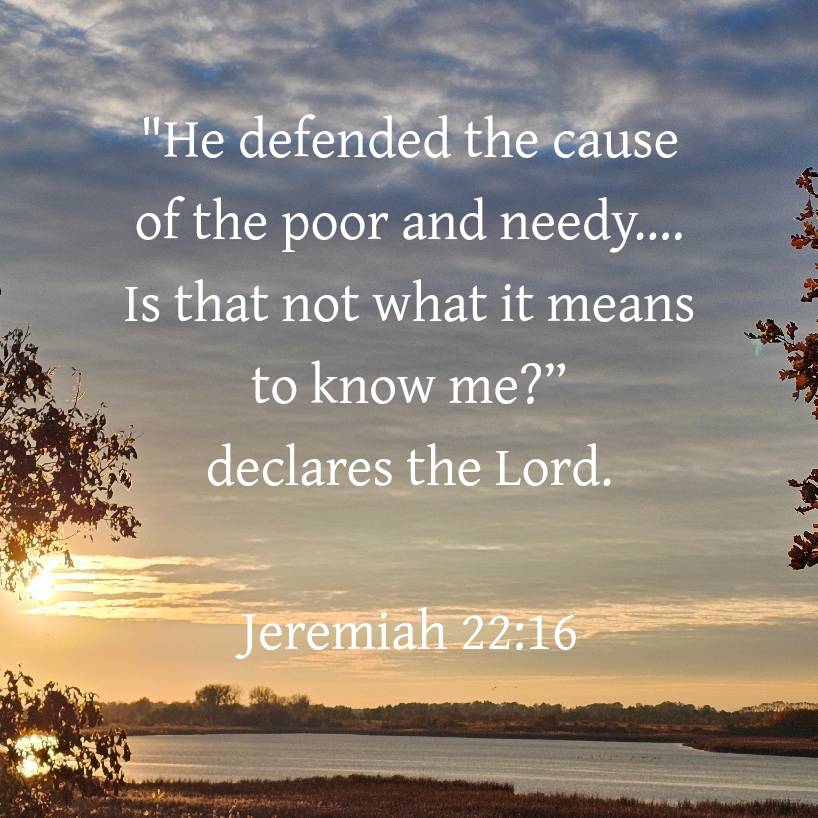
I have never noticed before that Jeremiah equates defending the cause of the poor and needy with knowing God. In defending the cause of the poor and the needy, we come to know God.
We can search for God here and there and, perhaps, never find Him. In defending the poor and needy, however, we can know the Lord. It’s that simple.
To know someone in a biblical sense is to know more than facts about someone. To know someone biblically is to know someone intimately. The ultimate example of knowing someone biblically is to know someone as a spouse.
Thus, when Jeremiah says that defending the cause of the poor and needy is to know the Lord, he is talking about an intimate, experiential knowledge of the character and nature of God. The cause of the poor and needy is close to God’s heart, and it is essential to who God is.
The Psalmist says, “A father to the fatherless, a defender of widows, is God in his holy dwelling….” (Psalm 68:5) A dwelling place is where a person is most able to be who they are. God’s holy dwelling is where God is “at home”, where God is most like Himself, and the cause of the fatherless and the widow is at the core of who God is in His most intimate place.
Thus, people can intimately know who God is by taking up the cause of the poor and the needy, the widow and the orphan, and similarly vulnerable people.
The opposite is also true. People do not know God to the extent that they do not defend the cause of the poor and needy. This was the point Jeremiah was making when he said of King Johoahaz:

The father of Jehoahaz was Josiah. “He did what was right in the eyes of the Lord.” (2 Kings 22:2) Josiah found the Book of the Law, reestablished Temple worship of God, and destroyed the idols in Judah. (2 Kings 22 & 23) Josiah also defended the cause of the poor and needy, according to the Prophet Jeremiah, and defending the cause of the poor and needy is what it means to know God.
Indeed, Josiah modeled the entire law that Jesus said can be summed up in these two statements: 1) love God with all your heart, mind, body, and soul; and 2) love your neighbor as yourself.
Throughout the Bible, then, we find that a sure way of knowing who God is and what it means to know God is to be concerned with the cause of the poor and needy. This is not liberal wokeness; it is the essence of who God is and what it means to know God.
“Whoever claims to love God yet hates a brother or sister is a liar. For whoever does not love their brother and sister, whom they have seen, cannot love God, whom they have not seen.”
1 John 4:20
Jesus even goes so far as to say that we should love our enemies and so be perfect as our heavenly Father is perfect. (Matthew 5:43-48) Loving others – caring for the poor and needy – is not superfluous or secondary; it is central to who God is and a key in what it means to know God.

 Navigating by Faith
One thought on “What It Means to Know God”