As often happens with me, the things I have been listening to and reading have converged in a meaningful way. Whether we attribute these “convergences” to God’s presence in our lives or dumb luck, pure happenstance, or “coincidence” is a matter of speculation and faith.
Whatever you want to call it, I take special notice of these things. I pay attention. I take them seriously, and they become signposts on my journey through life.
Perhaps, I am just being a good attorney. I am trained to find harmony and contrast in nuanced fact patterns and to apply legal principals to them. Finding harmonies and contrasts and applying spiritual principals to them operates in the same vein. That’s the way my mind works.
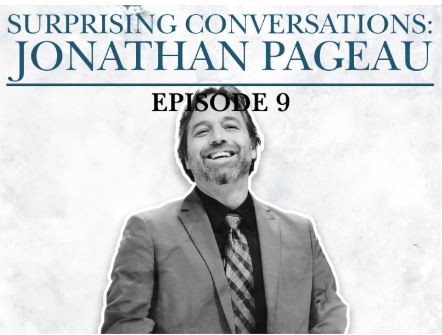
Yesterday, I listened to an interview of Jonathan Pageau by Justin Brierley. Pageau is an interesting character and a critical thinker. His recent conversation with Brierley inspires my writing today.
Raised in Montreal influenced by French Catholicism in a French Baptist Church community, Pageau has moved over to Eastern Orthodoxy by way of 4-year and 3-year stints in the Congo and Kenya. He has an undergraduate degree in postmodern art. He returned from Africa to obtain a degree in Orthodox Theology and Iconology from Sherbrooke University in Quebec. Along the way, Jonathan Pageau has become a cutting edge Christian thinker who is in demand as a speaker.
One line of discussion caught me ear in the interview with Justin Brierley that I want to explore. The subject touches on post-Enlightenment, neo-religious thinking and the proof of God.
Pageau commented that some atheists (like Richard Dawkins) want to control the parameters of the discussion by forcing the believer to remain in the sphere of the atheist when it comes to proof of God. The atheist’s sphere is limited to the material world. Thus, the Richard Dawkinses of the world want a proof of the existence of God consistent with proofs for the existence of chemicals in the universe.
Pageau maintains that such an approach is not the right way to go about proving the existence of God because cause cannot be proven from the constituent elements of the universe. The God of biblical faith (by definition and fundamental character) is not in the elements of the Universe. He is “external” to them.
Pageau says that insistence on limiting the proof of God to the elemental constituents of the Universe is “a ridiculous idea,” like trying to prove the existence of the United Kingdom from the composition of the English soil. It is simply the wrong way to go about it.
The analogy I like to use is of a painting and the painter. We cannot prove the existence of a painter by a chemical analysis of the painting.
Perhaps, more intriguing to me is Pageau’s claim that “the Enlightenment has played itself out.” He claims that the deficiencies in the Enlightenment way of thinking have been exposed and have come up short in modern thinking. Among other things, he says, “The religious has crashed back into the world of the Enlightenment,” and credits the New Atheists with exposing these deficiencies without realizing it.
Many New Atheist thinkers have recently embraced the “woke” culture, which he says is the product of a primarily religious impulse – not a scientific/naturalistic one. He calls this a “re-enchantment” because it is driven by religious impulse and does not derive from the Enlightenment, rational framework. In this way, he says, “the religious” has crashed back in on Enlightenment thinking.
He is suggesting that the reemergence of such a religious impulse signals the end of their Enlightenment thinking. Modern atheists find it wanting, and they are jumping the Enlightenment guardrails to adopt a framework that bends reality, as revealed by the limits of naturalistic thinking that the Enlightenment insists on, to match identity. Such thinkers have adopted their own set of sacred and taboo things that cannot be questioned. Thus, they embrace a religion-like dogma and rituals to support them.
I am not a big fan of the term, “woke”, but I agree that there is an ideology that some Enlightenment thinking people have adopted is a religious way of thinking, not a scientific one. It is as dogmatic as any religion, and it defies the same kind of proof for which the New Atheists famously criticized at religion at the outset of the New Atheism.
Pageau says no one set out to reenchant the world with religious thinking, but it is happening, nonetheless. We are seeing a return of sacred behavior, and this became especially apparent during COVID when people moved to positions that were religious in their form, says Pageau.

These people insisted that churchgoers mask up for Lenten services. At the same time, when people took to the streets without masks after the George Floyd incident happened, they ignored the same precautions in a kind of “ecstatic expression” of religious purpose.
I see a parallel track in the way secular society has become morally self-righteousness. I have noticed this secular, moral self-righteousness grow while the self-righteousness of more traditional religiosity has waned. This secular religious expression is empowered by its own dogmas, sacred texts, and artifacts, and it is enforced by a new set of taboos and commandments that “thou shall not” break.
Justin Brierley, opines that people have never stopped being religious. It’s just that people are religious in different ways.
Brierley has been chronicling the movement of secular people away from the New Atheist way of thinking to a more religious way of thinking – even if they might not admit as much. (See the book, The Surprising Rebirth of Belief in God: Why New Atheism Grew Old and Secular Thinkers Are Considering Christianity Again, and the podcast, THE SURPRISING REBIRTH OF BELIEF IN GOD)
This is happening among the woke crowd and anti-woke crowd alike, including such atheist thinkers as Jordan Peterson, Douglas Murray, and the historian, Tom Holland, among others. These new secular thinkers are finding fresh appreciation for Christianity. They are also recognizing the ways in which the Enlightenment has failed us. They recognize that a purely materialist outlook does not resonate at the core of humanity, and these secular thinkers are rediscovering the resonance between the Bible and psychology, sociology, history, science, and other fields of study.
Some of these secular thinkers find in Christianity what they call a “useful fiction” and in Jesus a “beneficial archetype.” They affirm a form of Christianity without moving all the way to faith. Their flirtation with Christian ideology raises the question: whether the benefits and “truth” found in the symbolism and model of Christianity is only a fiction, or whether there is some bedrock of reality, historicity, and ultimate truth in Christianity?
I obviously believe that there is a bedrock of reality and truth in these things, which is why Christianity is resonating so much in secular circles among some intellectual elites. The embrace of a “woke” ideology among other secular thinkers is the catalyst for this ironic rediscovery. It cannot be justified on the science they insist is the arbiter of all truth, but many have made the leap, nonetheless
Pageau claims that the fact that they see Christianity merely as a useful fiction means that they have not followed their thinking all the way to its logical conclusion. Pageau says the symbolism and archetype “works” precisely because it is a pattern of reality.
According to Pageau, a psychological pattern of reality and a material pattern of reality cannot be logically separated from each other. The fact that they resonate, means either that they participate in reality together, or they deviate from reality together.
Even from a purely materialistic position, Pageau says, it doesn’t make sense that these patterns of reality that correspond with each other are separated by actual reality. If one, or the other, correspond to reality, and they both correspond together, they both correspond with reality/truth.
I live for these kinds of discussions. I have only summarized the segment of the interview that intrigued me most. All of it is worth a listen. You can access the whole discussion between Brierley and Pageau here.
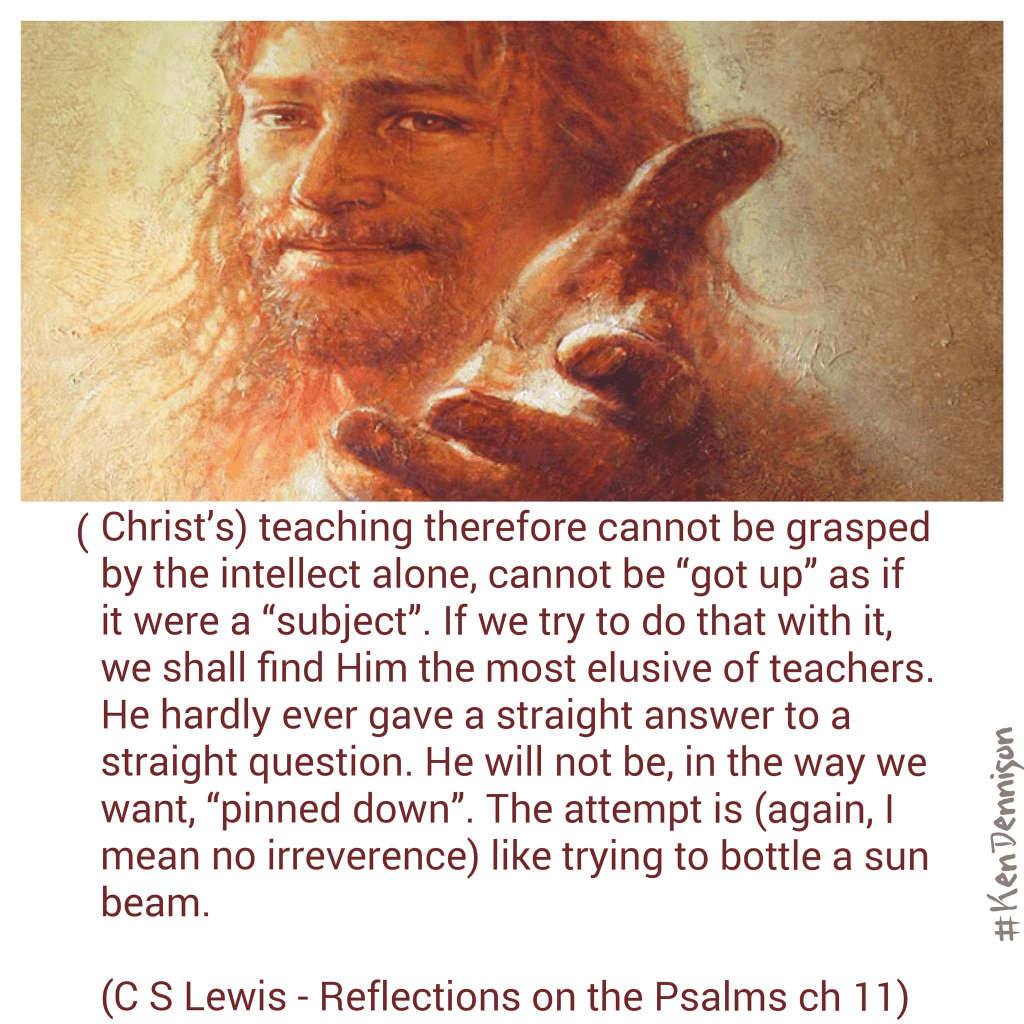
I will end with not much additional comment, except to say that all of this resonates with me, and the graphic below with the quotation from CS Lewis that I stumbled on today brings it home. As CS Lewis puts it in his usual common eloquence, proving the truth of spiritual reality by purely scientific means is like trying to bottle sunshine. Some truth (like the fact that my parents or spouse love me) is known in other ways.

 Navigating by Faith