
Do you identify with Elijah? Do you squirm thinking about his zeal? Do you feel guilty about not sharing the Gospel with your neighbor? Then, maybe a new look at Elijah may resonate with you.
We know Elijah for his zeal for Yahweh in a time when the culture and national leaders were rebelling against God. Sound familiar?
Elijah is famous for challenging the Israelite king, Ahab, and his rebellious wife, Jezebel, and all of the prophets of Baal and Asherah that were commissioned by that royal pair. He felt like he was the only one standing for God in a world that wanted him to shut up and go away.
Some of us may feel like Elijah, while many others of us may feel guilty that we are not like Elijah. He is a pillar of the faith, right?
Yes, of course, he is! As I read through these passages, though, I am seeing something I didn’t catch before. For one thing, I get the feeling that Elijah probably wasn’t a fun guy to be around.
He certainly didn’t go along with the crowd. He wasn’t known for his diplomatic tact. (To put it mildly) He said what was on his mind, and he didn’t pull any punches.
These characteristics of Elijah begin to give us an idea of what he is like. They also point toward a more human side of Elijah that I hadn’t noticed before, which is why I want to dive deeper into the story of Elijah and the prophets of Baal.
Elijah is famous for challenging 450 prophets of Baal to an Ancient Near Eastern duel of the gods. It was Elijah against all the prophets of Baal; Yahweh against Baal in a cosmic duel with mortal consequences for the losers.
This is the way Elijah rolled. No holds barred!
Elijah challenged the prophets to sacrifice a bull on an altar without setting fire to it, letting Baal or Yahweh, as the case might be, consume the sacrifice directly. Which one would show up?! The stakes were high. If Yahweh didn’t show, Elijah was toast!!
Elijah offered to let the prophets of Baal go first. (A bit of showmanship?) They cut up the bull; they placed it on the altar; and they did their ritual thing to entice Baal to come out of whatever stone he might live under … but nothing happened.
Elijah taunted them. (He was not a master of subtlety!) He egged them on to shout louder and offered the following “helpful” comments (paraphrased by me):
- Maybe your god is daydreaming”;
- Maybe he fell asleep and you need to shout louder; and
- Maybe he is relieving himself, and he will be back in a minute!

Elijah’s taunting wound those prophets up into a religious frenzy. They cut themselves with knives, and swords, and spears until they bled everywhere … but still nothing happened.
When their time was up, all eyes turned to Elijah.
I imagine the anticipation in the crowd rivaled a Las Vegas audience watching Siegfried and Roy walk a full grown tiger onto the stage. Elijah let the expectation mount as he built his own altar. The atmosphere was electric. The crowd was undoubtedly hoping for more action than the prophets of Baal gave them.

I can imagine the smug look on Elijah’s face and the brash confidence in his demeaner as he instructed volunteers from the crowd to pour water on the offering. Elijah was nothing if not dramatic!
Lest we forget, they were in the middle of a long draught. Elijah didn’t just have them sprinkle water. Three times Elijah instructed his helpers to fill up the jars, and pour them out on the bull, the wood, and the altar until it was soaked and water pooled in the trench around it.
Anticipation hung like a funnel cloud overhead as darkness loomed over the mountaintop stage. The expectant crowd, the exhausted prophets recovering from their failed ordeal, and Ahab sat poised on the edge of their proverbial seats.
In the flash of a moment, fire came down from heaven. Like a galactic flamethrower, the fire was so fierce it completely consumed the bull, the wood, and the altar itself!
Nothing remained but hot, smoldering ash.
Yahweh showed up as Elijah said he would! Elijah was vindicated!
But that wasn’t enough for him. With freshened zeal fueled by the powerful demonstration of God’s power, Elijah provoked the excited crowd to grab the cowering prophets of Baal and march them down the mountain where they were slaughtered in the valley below.

Elijah was at the height of his prophetic career. Elijah may have thought, “Not even Moses presided over such a powerful demonstration of God’s awesome power!” Elijah was on top of the world!
It’s hard to imagine greater faith and boldness or a more decisive display of God’s power. Perhaps, the only thing more amazing than all of that was Jezebel’s response:
She was not… impressed… at all.
When Ahab raced to deliver the news to Jezebel, his haughty audacious wife didn’t even hesitate. She ordered death to Elijah with ice in her veins.
Elijah must have been thinking, “What’s a man of God got to do?!” (Never mind that the crowd seemed properly convinced.) If his greatest act of faith couldn’t turn the hardened hearts of Ahab and Jezebel, nothing would! He had done his absolute best, and it wasn’t enough.
Have you ever felt that way? Have you ever felt like nothing you do, or can do, makes any difference? Have you ever come to the place that you have done your best, and your best wasn’t good enough? Have you ever felt like you are the only one who stands for God?
Have you ever gotten mad at God for not defending you for standing up for Him? Then, read on.
Elijah took off, and ran into the wilderness until he could run no more. He finally slumped under a broom tree, exhausted, depressed, and bitter.
He was emotionally and spiritually spent. He even wished he was dead. An angel of God appeared out of nowhere and brought him food and water, but that didn’t lift him out of his dejected state.
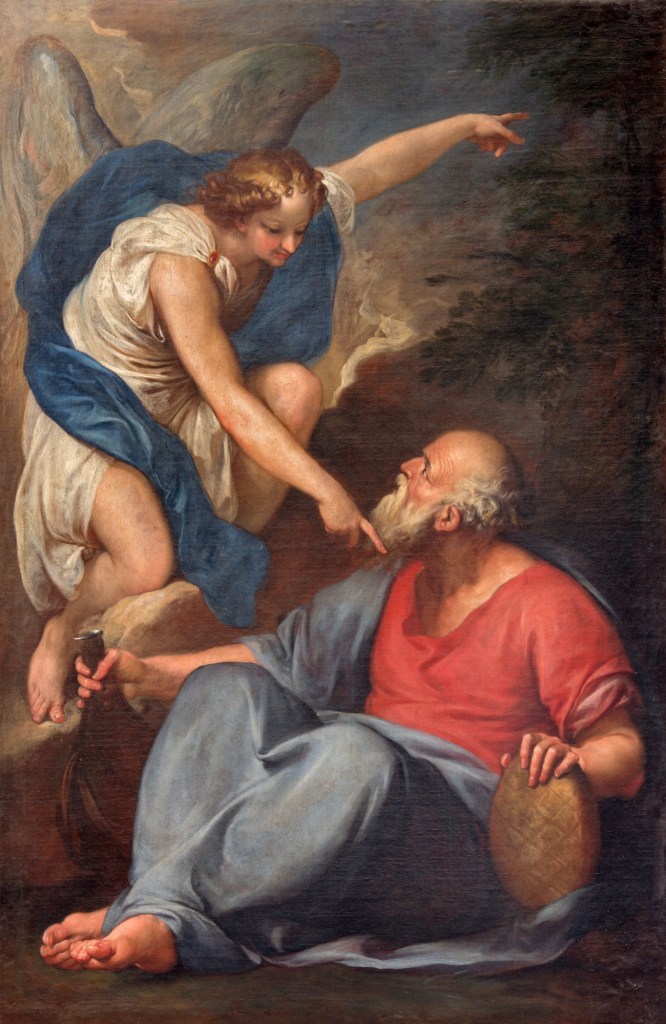
With nourishment in his body, but not in his soul, Elijah got up and headed south, and he kept going. He walked 40 days and 40 nights to Horeb, the mountain of God, where he had it out with God.
This is how it went down:
God asked him, “What are you doing here, Elijah?” Elijah challenged the Almighty God:
“‘I have been very zealous for the Lord God Almighty. The Israelites have rejected your covenant, torn down your altars, and put your prophets to death with the sword. I am the only one left, and now they are trying to kill me too.” (1 Kings 19:10)
Ok, to begin with, Elijah dodged God’s question. He didn’t answer it. Instead, he championed his own boldness and faithfulness in the face of the rebellious Israelites and the failure of other prophets willing to stand up to them.
Elijah was zealous, but was he really all alone? Was he really the only one left?
The answer to these questions provides some insight into Elijah and his situation that we should not miss, but we need to back up a little bit to see it. Go back to 1 Kings 18 where the story of Elijah’s challenge against the prophets of Baal begins. Do you see what it says there?
Obadiah, the palace administrator “was a devout believer in the Lord”.
It’s true that Jezebel was killing off the prophets of the Lord, but Obadiah remained faithful. He even managed single-handedly to protect one hundred prophets from the rebel queen’s attempt to rid the land of God-fearing people, so Elijah was not “the only one left.”
In light of these clues in the biblical text, it seems that Elijah was maybe a loner. Why wasn’t he with the other prophets in the cave? I can’t believe he didn’t know about them. Maybe he judged them for not putting their necks in Jezebel’s noose too. Maybe he didn’t get along with them either. Maybe Elijah had an attitude.
I had that attitude in my early Christian years. It’s called self-righteousness. I dressed it in religious clothes and called it zeal. We might call it a complex – the Elijah complex.
Elijah was bold in his faith and fierce in his zeal, but he was also a wee bit dramatic! And just a tad self righteous. He probably thought the other prophets were faithless cowards (hiding in a cave while he took on the world). He may have thought more highly of himself, perhaps, than he should have.
Let’s look at how God deals with His zealous prophet with a complex:
“The Lord said, ‘Go out and stand on the mountain in the presence of the Lord, for the Lord is about to pass by.’ Then a great and powerful wind tore the mountains apart and shattered the rocks before the Lord, but the Lord was not in the wind. After the wind there was an earthquake, but the Lord was not in the earthquake. After the earthquake came a fire, but the Lord was not in the fire. And after the fire came a gentle whisper. When Elijah heard it, he pulled his cloak over his face and went out and stood at the mouth of the cave. Then a voice said to him, ‘What are you doing here, Elijah?’” (1 Kings 19:11-13)
Notice the dramatic display of power in the wind, the earthquake, and the fire! Yet, God was not in any of those things. Is God not trying to say something to Elijah?
Remember: this display of God’s power follows immediately on the heels of Elijah putting God on the spot. Yes, Elijah exercised great faith, and God came through, but was that really necessary?
Is God, perhaps, trying to show Elijah that his zeal and displays of the power of God are not necessarily the right way to go about things?
God was not in the wind that tore the mountains apart and shattered rocks. God was not in the earthquake, and God was not in the fire. We have to wonder whether was God really “in” the fiery challenge of the prophets of Baal?
Yes, God “showed up”, but was that really God’s idea? Or was it more of Elijah’s idea to challenge the prophets of Baal to that deadly duel?
Whatever it is, God is trying to tell Elijah something, and Elijah isn’t listening. So, God repeats the same question, (“What are doing here?”) and Elijah ignores it again, renewing his protest to God:
“I have been very zealous for the Lord God Almighty. The Israelites have rejected your covenant, torn down your altars, and put your prophets to death with the sword. I am the only one left, and now they are trying to kill me too.” (1 Kings 19:10)
Elijah is fixated on himself and he seems to be oppositional toward God. Here is my paraphrase:
“Those Israelites rejected your covenant. They tore down your altars. They killed your prophets. I am the only one trying to protect your honor, and you are doing nothing about it!”
Let’s look at how God responds:
“Go back the way you came, and go to the Desert of Damascus. When you get there, anoint Hazael king over Aram. Also, anoint Jehu son of Nimshi king over Israel, and anoint Elisha son of Shaphat from Abel Meholah to succeed you as prophet.” (1 Kings 19:15-16)
God orders Elijah back and instructs him to appoint new rulers of God’s choosing. Then God orders Elijah to pass the torch to Elisha. end of story.
Elijah was zealous for God, and he did have great faith, but we have to wonder whether he was really doing what God wanted him to do the way God wanted it done. Elijah, himself, had perhaps become too much part of the story.
This is where things really get interesting.
God does mete out judgment to Ahab and Jezebel, but He doesn’t use Elijah. (There were other prophets of the Lord after all!) This all came home to me as I wrote recently about about another incident in which Elijah displayed great faith and great zeal. (See Should Christians Be Like Elijah and Call Down Fire on People Who Reject Them?)

This incident took place later, but I believe we should read this story in the context of the challenge of the prophets of Baal. This incident took place after Ahab and Jezebel died and Ahaziah had become king. Twice Elijah called fire down from heaven to consume people who came to escort him to King Ahaziah.
The theme of fire continues, and it signals that we should consider these three stories together: Elijah calling down fire in a challenge to the Baal prophets, the fire on the mountain (that God was not in), and Elijah calling down fire to incinerate the posse sent to bring him to King Ahaziah.
Frankly, though, I missed the connection until I read Luke 9. In Luke 9, Jesus sends out the 70 disciples to evangelize, and he tells them, “If people do not welcome you, leave their town and shake the dust off your feet as a testimony against them.” (Luke 9:5) Hold that thought….
Some time later, Jesus instructs his closest disciples to go on ahead of him as he set out to journey to Jerusalem (where he would be crucified) and prepare the way for him to travel through Samaria. The Samaritans, however, would not welcome them.
Remember John the Baptist? His mission was to “prepare the way”. Jesus even called John the Baptist “the Elijah who was to come”. (Matthew 11:14)
Perhaps, that was in the mind of James and John when they reported back to Jesus that the Samaritans rejected them and refused to receive them. Fully in the spirit of Elijah, they asked Jesus, “Should we call down fire to destroy the Samaritans.”
This, now, is where we close the loop. They wanted to respond like Elijah when he called down fire on the men who came to bring him to King Ahaziah. Jesus responded to the suggestion by James and John to call down fire, however, by rebuking them! (Luke 9:55)
This is the “lesson” I see for us: we are not to act like Elijah did; we are to pick up our crosses and follow Jesus; we are to turn our other cheeks; we are to follow in the way of Jesus, and not in the way of Elijah.
We can and should commend Elijah for his faith. I would not dare to say that Elijah was wrong to do the things he did. I do not stand in judgment of Elijah or his actions or his attitude. Maybe times were different, then, and God “needed” Elijah to act and think as he did.
It seems to me, however, that we should take note of the way Jesus reacted to James and John. The way that Elijah went about things is not the way for the followers of Jesus to be. Elijah’s attitude is not the attitude that we should have. It may not have even been the attitude God wanted Elijah to have or the way God wanted him to act.
The truth is that we do not see the big picture. God is big enough to accomplish His ends. With us or without us. We cannot be more zealous then God. We are not indispensable, and the story is not about us!
We are not the only people who follow God. We may be tempted to think we are the only ones, that other people in the church are failing, and that we need to take on the world, but we should not give in to that thinking!
We don’t know all that God is doing. We don’t care more than God does. God is sovereign, and we are not.
In our zeal, I believe we can actually get in the way of what God is doing. Sometimes we may do things in our zeal that are contrary to what God wants us to do and contrary to who God is. Our scorched earth ministry does not accomplish God’s purposes.
When we feel an Elijah complex coming on, we need to recognize it, acknowledge it as a shortcoming, and repent. We need to remember that God is not in the fire, or the wind, or the earthquake; God is in the whisper. God can accomplish more in quiet than any loud demonstration of faith and zeal.
Do you trust God? He’s “got this”!

 Navigating by Faith
Hello Kevin
I enjoyed then shared this article. Just now after reading your 2nd, realised I had neglected to say , thank you.
Blessings from downunder.
<
div>Kaylene
Sent from my iPhone
<
div dir=”ltr”>
<
blockquote type=”cite”>
LikeLiked by 1 person