
I set the stage for digging deeper into the story of Abraham and Isaac in The Story of Abraham and Isaac Revisited: Introduction. Abraham’s faith is the lesson we all learned in Sunday school. Faith is the basic place we start, but Abraham’s faith is only scratching the surface of the story.
We often view this story as simply a test of Abraham’s faith, which it is, but it’s much more than that. This story is not simply about Abraham’s faith, because what we learn through Abraham’s faith may be just as important, if not more important.
Think about it: Does God need to test Abraham to know who he is? God already knows what kind of man Abraham is. He knows our thoughts from afar and the words we speak even before we say them! (See Psalm 139) That should give us a clue that there is more to this story, so let’s go back and see what else there is to see.
Many decades before, we are told that Abraham believed God, and his faith was credited to him as righteousness. When God called Abraham to leave his country, his people, and his father’s household – which was his legacy – and God said He would make a great nation of Abraham’s descendants, Abraham left – though he didn’t even knowing where he was going! Though he was 75, Abraham responded with faith and went. (Gen. 12:1-4)
Many years and adventures later, Abraham was still childless, living in the land God showed him, and Abraham still believed the promise God made to him, though he had nothing to show for it. Abraham’s faith was already counted to Abraham as righteousness, but the promise Abraham believed was not yet realized. (Gen. 15:1-6)

Isaac was not born to Abraham and Sarah until Abraham was 100 years old, a quarter century after the initial promise was made. (Gen. 21:1-7) All the while, Abraham had faith. The story of Abraham and Isaac is not just a story about Abraham’s faith, but about how God is revealed through Abraham’s faith.
Though the story begins with the statement that God was testing Abraham, it doesn’t say God was testing Abraham’s faith. (Gen. 22:1) Perhaps, God tested Abraham, at least in part, to show Abraham (and us) who God is!
I will explain, but first we need to understand something of the Ancient Near East culture Abraham lived in. A key element of this story is the fact that child sacrifice was a common and universal practice in the Ancient Near East.
Abraham would have been intimately familiar with how people understood the gods of his culture. They were considered unpredictable, arbitrary, and capricious, demanding allegiance and sometimes even child sacrifice to be appeased.
What Abraham may have sensed, but didn’t fully understand, was that his God was not like the other Ancient Near East gods. The character of God, as revealed to Abraham, would have been a complete paradigm shift from what he and his culture believed about gods.
In our western mindset, we might expect God to announce at the outset who He is: we might expect Him simply to tell us. In a more eastern mindset, we they expected to discover truth through their lived experience and the lived experiences (stories) of other people.
Similarly, it seems, God doesn’t simply tell us who He is; God desires to show us. To “know” God is not simply an intellectual exercise; it is a lived experience. Thus, all of Abraham’s life is an example for us, and we learn who God is through Abraham’s lived experience (and our own).
God reveals Himself to Abraham experientially through Abraham’s faith, and He reveals Himself to us through Abraham’s story and our own faith. If you haven’t read the introductory article yet, I encourage you to do it now at the link above.
With this basic understanding, I encourage you to read Genesis 22:1-14. Then, we get into the details of the story.
The story begins with God calling to Abraham, and Abraham responding, “Here I am!” This verse should prompt you to think of Adam and Eve, and God calling to them after they ate the forbidden fruit, but they hid.

Abraham’s orientation toward God is different than theirs. When God calls, he says, “Here I am!” This is because Abraham is a man who responds to God. Abraham learned not to hide in shame or fear, but to respond to God in hope and faith.
I believe God was seeking anyone who would respond to Him, and Abraham was that man!
Go ahead now and read the passage again, this time with the emphasis I have provided at the following link (Genesis 22:1-14).[1]
The phrase, “Here I am!” is repeated multiple times, and that means it should attract our attention. The Hebrew word is הִנֵּה (hinneh), meaning “lo! behold! Here I Am!” This phrase appears three (3) times in the story. Twice Abraham says, “Here I am!” in response to God, and once Abraham says, “Here I am!” in response to Isaac.
Abraham’s responsiveness to God is important in the story. He responds immediately and willingly at the beginning of the story, and he responds even when God seems to be demanding the ultimate sacrifice of his son. (Gen. 22:7) He doesn’t shy away; he remains hopeful and responsive.
Abraham responds just as immediately when the angel of the Lord calls out to him in the moment Abraham was about to do the deed and finish the sacrifice of Isaac. (Gen. 22:11) Abraham is always a man who responds to God – even when it makes no sense.
We see this when God instructs Abraham to sacrifice Isaac on a mountain that God said He would show him in the land of Moriah. (Gen. 22:2) This is much like God’s initial prompt to Abraham many decades earlier to leave his country, his people and his father’s household to go to a land God “will show you”. (Gen. 12:1) Abraham may have recognized the similarity, and so should we.
That responsiveness to God is echoed here again. One more time in this passage Abraham responds by saying, “Here I am!” But the last time this is Abraham’s response to Isaac.
(In the BEMA Discipleship podcast, Marty Solomon points out that the Hebrew word for “Here I am” appears in its unconjugated form only three places in the Bible, and all three times are in Genesis 22. That phrase is echoed elsewhere in Scripture, but that will be the subject of the next article.)
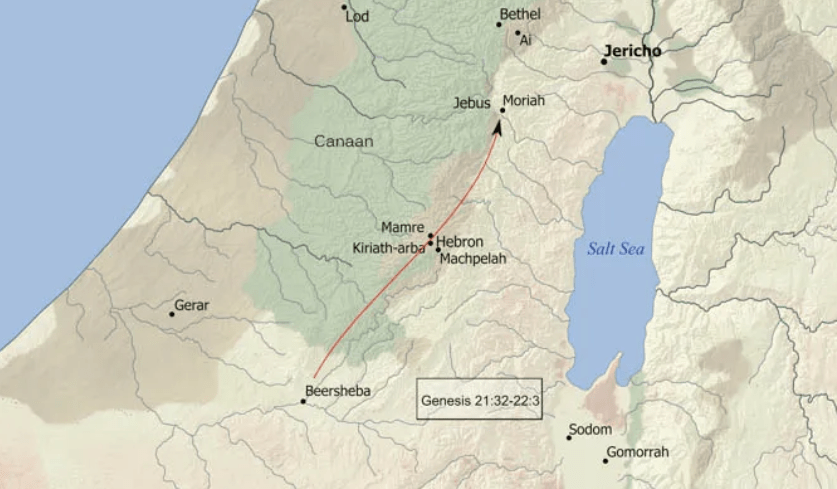
https://accordancebible.com/measuring-the-march-to-moriah/
Going back to the story, we read that Abraham walked for three days. (Gen. 22:4) For three days, they walked to the mountain. For three days, Abraham mulled over in his mind what God was asking him to do. For three days, Isaac and the two men Abraham invited with them wondered what they were doing.
Did Abraham tell Isaac or the men what he was being asked to do? The passage suggests he didn’t.
Abraham prepared the wood for the burnt offering at the beginning of the journey. (Gen. 22:3) When they could see the mountain God showed him, Abraham put the wood for the burnt offering on Isaac to carry. Only when Abraham and Isaac separated from the men who had gone with them (Gen. 22:6) did Isaac ask Abraham, “Where is the lamb for the burnt offering?” (Gen. 22:7)
Before Isaac asks the question, however, he breaks the silence, saying, “My father!” (Gen. 22:7) And Abraham responds, “Here I am!”
According to the BEMA podcast, there is nuance in the structure of the original Hebrew suggests that Isaac interrupted his father. It implies, therefore, that Abraham was talking, or maybe he was silent. Then, Isaac breaks in to get his father’s attention and ask the question that was on his mind.
Imagine Abraham in that circumstance, trying to make small talk, trying not to think about what he is about to do, trying to avoid the subject. Maybe he was lost in thought, wondering how he was going to explain this to Isaac. (And Sarah!) Maybe Abraham was talking to God under his breath. Then, Isaac breaks in: “My father!”
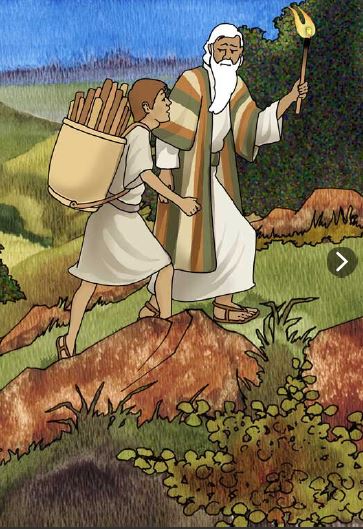
Isaac interrupts Abraham’s thoughts and highlights the angst that Abraham no doubt would have felt with the words, “My father!”
the Abraham responds, “Here I am!” Why does he respond that way?
Of course, Abraham was there. Why did Abraham say, “Here I am”?
Jewish teaching from the Midrash suggests that Abraham is giving Isaac assurance. He was saying, “Here I am!”, and I am not going to leave you!
Finally, when Isaac asked the pointed question about the lamb for the sacrifice, Abraham provides his insight: “God will provide Himself the lamb…” (Gen. 22:8)
This is key! Hold onto that thought ….
It wasn’t until Abraham prepared the altar with the wood for the burnt offering, put Isaac on top of the wood, and was about to go through with the deed that God finally intervened. In similar fashion to the other dialogue, God called, “Abraham! Abraham!”
God intervened! And Abraham responded with great relief, “Here I am!” (Gen. 22:9-11) And, I imagine that Abraham probably responding this time faster than he responded before!
Abraham told Isaac God would provide, and He did! Immediately, Abraham saw a ram caught in the thicket: an offering for Abraham to use. Just as Abraham believed and told Isaac, God provided the offering Himself.
I believe God used the sacrifice of Isaac as an object lesson. All the other gods seemed to demand child sacrifice (or so everyone, likely including Abraham, thought), but God is not like that.
In this way, Abraham learned through his firsthand experience, by virtue of his faith and willingness to respond to God, that God is not like the other Ancient Near East gods. God makes promises, and He keeps them. God can be trusted!
God is not unpredictable. He is not arbitrary, and and He is not capricious. God is trustworthy. We can commit ourselves in response to God and trust Him, even when we don’t understand where God is taking us or what He is doing. Abraham has been learning this lesson his whole life.
This is a lesson that Abraham would never forget, and it’s a lesson Isaac would never forget. It would be passed down generation after generation. It would stand as lived proof that God is not like the other gods.
Most significantly of all, God demonstrated to Abraham (and to us) who He is.
There is even more to the story as well. God foreshadowed the blessing He would provide through Abraham and his descendants to all the families on earth through this story, but it will take more articles to flesh out the significance of Abraham’s faith (in Abraham, Faith, and the Hope Deferred) and to explore how Abraham knew that God would provide (in Abraham, Isaac, the Blood Path, Christ and Him Crucified).
[1] After these things God tested Abraham and said to him, “Abraham!” And he said, “Here I am.” He said, “Take your son, your only son Isaac, whom you love, and go to the land of Moriah, and offer him there as a burnt offering on one of the mountains of which I shall tell you.” So Abraham rose early in the morning, saddled his donkey, and took two of his young men with him, and his son Isaac. And he cut the wood for the burnt offering and arose and went to the place of which God had told him. On the third day Abraham lifted up his eyes and saw the place from afar. Then Abraham said to his young men, “Stay here with the donkey; I and the boy will go over there and worship and come again to you.” And Abraham took the wood of the burnt offering and laid it on Isaac his son. And he took in his hand the fire and the knife. So they went both of them together. And Isaac said to his father Abraham, “My father!” And he said, “Here I am, my son.” He said, “Behold, the fire and the wood, but where is the lamb for a burnt offering?” Abraham said, “God will provide for himself the lamb for a burnt offering, my son.” So they went both of them together. When they came to the place of which God had told him, Abraham built the altar there and laid the wood in order and bound Isaac his son and laid him on the altar, on top of the wood. Then Abraham reached out his hand and took the knife to slaughter his son. But the angel of the Lord called to him from heaven and said, “Abraham, Abraham!” And he said, “Here I am.” He said, “Do not lay your hand on the boy or do anything to him, for now I know that you fear God, seeing you have not withheld your son, your only son, from me.” And Abraham lifted up his eyes and looked, and behold, behind him was a ram, caught in a thicket by his horns. And Abraham went and took the ram and offered it up as a burnt offering instead of his son. So Abraham called the name of that place, “The Lord will provide”; as it is said to this day, “On the mount of the Lord it shall be provided.” Genesis 22:1-14 ESV

 Navigating by Faith
6 thoughts on “The Story of Abraham and Isaac Revisited: Here I am!”