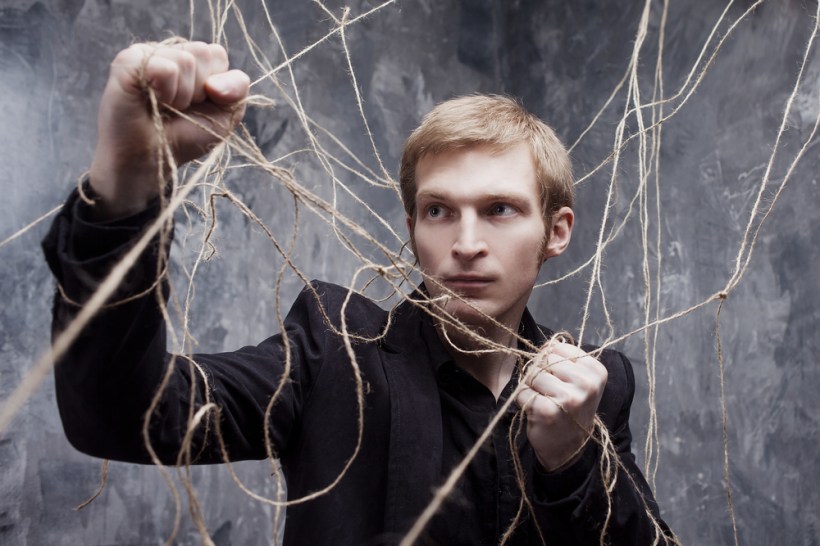
Do we have free will? Modern science seems to suggest that we do not have free will. This is what I learned watching an episode in a series on science that was hosted by Stephen Hawking on Public Broadcast Television.
In one experiment designed to test question whether humans have free will, the subjects were told to choose to push a button and to note the time on the clock at which the decision was made. At the same time, the subject’s brain waves were being monitored for activity. Over and over again, the brain waves registered activity before the subject was conscious of the decision being made to take the action.
The experiment demonstrated the following sequence: (1) a brain signal occurs about 550 milliseconds prior to the person’s finger moving; (2) the person is aware of his decision to move his finger about 200 milliseconds prior to his finger moving; and (3) the person’s finger moves.
This was interpreted as evidence by Hawking that we don’t have free will. The decisions we make are actually prompted by brain activity before we are conscious of making a decision. The conclusion is that we are responding to some prior stimuli and only think that we are making independent decisions.
This experiment was only one experiment in a series of experiments that demonstrate such things as the cosmological constants that that we learn in physics and the apparent indeterminism that we appear to see in quantum mechanics. Each experiment, however, that to the conclusion that our world and even we are determined by natural laws in an endless stream of cause and effect.
Ancient Greeks might have called it fate. Modern science calls it determinism. We have even have a religious term for this apparent phenomenon: predestination.
I think that skepticism of what we think we know is a good thing. The Apostle Paul seems to agree when he encourages people to “test everything”. Therefore, I dug a little deeper and found that the scientist who first conceived and conducted these experiments, Benjamin Libet, actually came to the opposite conclusion.
Scientific experiments like this often seem hyper-theoretical, but they can have some practical application. As I dug deeper and sought greater understanding of what is going on in these experiments and what it means for you and I, I find some interesting applications to our struggles with sin.
Benjamin Libet is described as “a pioneering scientist in the field of human consciousness”, and he “was the first recipient of the Virtual Nobel Prize in Psychology” for these experiments. (See Wikipedia) The experiment Hawking duplicated in the television series was designed to demonstrate that the unconscious electrical processes in the brain precede conscious decisions to perform what seem to be volitional, spontaneous acts. The apparent implication is that unconscious neuronal processes precede and maybe even cause actions we perceive to be the product of our choices, but we only retrospectively perceive them to be consciously motivated.
Wikipedia seems to describe Libet how materialists would describe themselves (presumably) – a non-dualist. But, Libet does not fit neatly into that box. He found something else at work in his experiments, something he coined the “free won’t”. “Libet’s own conclusion is that we do have conscious volition, but that volition is exercised in the form of “the power of veto”. It isn’t operative in the initiative to take action.
Wikipedi doesn’t describe how he came to that determination, but I found an explanation in a video by Michael Egnor that I have embedded below. Libet did find, as Hawking demonstrated, that brain wave activity is observed before a seemingly volitional act (the decision to do something) and the prior brain activity seems to be driving the “decision” to do something, but he also found that no brain wave activity is observed before a decision not to act.
This phenomenon became evident when Libet asked the subjects to choose to push the button, and then he asked them to choose not to push the button. The subjects were asked to note the exact moment of choosing to act, and they were asked the exact moment of choosing not to act.
What the experiments showed was that the brain activity was evident just before a decision to do something, but there was no brain activity to be observed before a decision not to do something. Brain activity was evidenced before a decision to act, but no brain activity was seen when a decision was made to refrain from acting.
Libet speculated from this additional component of the experiment that, while free will may not be involved in the initiation of an action, it may well be involved in the decision not to act.
“While consciousness plays no part in the instigation of volitional acts, Libet suggested that it may still have a part to play in suppressing or withholding certain acts instigated by the unconscious.”
This qualifying conclusion is downplayed in the Wikipedia article, but its significance should not be missed. Neither should we discount Libet’s own conclusions, which don’t match the conclusions drawn by Stephen Hawking and other people with a materialistic worldview. In his own words, Libet describes the “Free won’t” or “conscious veto” this way: “
“The conscious will could decide to allow the volitional process to go to completion, resulting in the motor act itself. Or, the conscious will could block or ‘veto’ the process, so that no motor act occurs.”
Thus, Libet effectively discounts the conclusions drawn by the materialists that we don’t have free will. While the experiments suggest that we may not be acting freely when we choose to do something, they just as legitimately suggest that we are acting freely when we choose not to do something (the conscious veto or free won’t). If lack of free will follows from the one, free will follows from the other.
As with much of reality, two seemingly inconsistent things can be true in some sense at the same time. There is evidence for determinism, and there is evidence (at least) for some modicum of agency that is inherent in the human condition.
The Libet experiment is not conclusive evidence of determinism in human behavior. At best, it shows that our actions may be “suggested” to us, that we are influenced by “forces” that operate “outside” us, but we have the choice, ultimately, whether to act on those “suggestions” or “forces”.
William Lane Craig observes, “Libet himself considered his experimental results compatible with the existence of free will.” (See Reasonable Faith) Craig also observes that the decision to act and consciousness of the decision to act are two different things. Thus, the lag between the decision and consciousness of the decision being made doesn’t necessarily mean that our decisions are determined (not volitional). He concludes,
“[B]ecause of the finite velocity of neural signals it takes time for the person to become conscious of it. Just as we never see present events because of the finite velocity of light, but only events just slightly past, so we do not have consciousness of our decisions simultaneously with our making them but unnoticeably afterwards. “
The critique (by Angus Menuge) that informs Craig’s observation includes the additional point that we shouldn’t fail to note: that the subjects were instructed to initiate the action. Thus, the instruction means a prior consciousness of the decision to be made; and then the decision was made. The lag between brain activity, may have more to do with “the finite velocity of neural signals” than determinism.
For more on the subject, consider the observations of nueroscientist, Michael Egnor:
What do these things have to do with the price of tea in China, as they say – or, more relevantly, faith? After all, this blog is Navigating By Faith. Christians have their determinists too. We call them hyper-Calvinists.
I am reluctant to draw any ultimate conclusions, and I am skeptical of the propriety of drawing hard and fast conclusions from these experiments. for that reason, I wouldn’t want to draw any conclusions on the basis of these experiments about the relationship between God’s providence and man’s free will, for instance.
But I see some possible application of these experiments to the subject of sin. The Bible affirms that we have a sin nature that is often called “the flesh” or “the old man”. The Bible also affirms that Satan tempts us, and that we are influenced by “the world”.
Thus, the Bible affirms the influence of “forces” that are “outside” of us. We don’t have to associate volition to these forces, though the Bible seems to do that.
The Bible also affirms that God communicates to us through His Holy Spirit. Thus, we have outside influences from various sources – including the “outside” influences “within” us that include our natural inclinations and temptation toward sin and the Holy Spirit, which may or may not be the same thing as our consciences. I am going to stay away from being too theological here.
We also experience forces that influence us from a myriad of environmental sources, including the time period we live in, geographical location, culture, society, family, friends, and other people who influence us, the DNA we are born with, chemicals we come into contact with, good and bad experiences, etc. Those truly outside influences are too innumerable to count.
We, like animals, we have something akin to instinct that propels to eat too much or to lash out in anger to harm others if we don’t “take charge”, exercise self-discipline and direct our own way. We also seem to experience conscience and an inner struggle between that conscience and more “expedient” impulses. We might attribute these competing influences to God and Satan.
Perhaps, these inner “outside” influences serve the purpose of breaking into the natural inclinations and giving us pause … literally … so that have opportunity to exert the free will most Christians believe God has given us.
Indeed, I believe God has given us some modicum of free will. After all, God made us in His image. Our ability to exercise will may just be one of the most important qualities found in God that have been built into us, albeit we certainly not have perfect free will. The free will we do have may even be much less “free” than we like to think.
The Libet experiments suggest we may not have any choice in the urging, prompting, temptation, natural inclination, etc. that we feel in the first instance, but we may have more choice in how we react to those influences. We can either exercise the choice “given to us (“go with the flow”), or we can step into the “pause” and exercise out own agency in the matter. Even the adage, “If it feels good, do it”, is a kind of exercise of agency. It’s a decision to go with the initial inclination, rather than put the brakes on.
We can either be reaction machines, or we can be self-directed agents. We have, at least some, ability to refrain from acting on our impulses. We have some ability to stop the actions we are inclined to take and to take a different course, or to choose inaction, or even choose to go with our initial impulses.
In fact, it could be that we exercise our agency most completely and most fully when we choose not to act on the impulses that press in on us. This is where I see some application to sin.
I haven’t really thought through all the implications of that idea, but it seems to have some application to the way we fight the sin that so easily entangles us (as Paul puts it). Influences come at us from the “inside” (both consciously and unconsciously), and influences come at us from the outside, but those influences are separate and distinct from us – even the “inside” ones. Modern materialists might miss the distinction, as they assume we simply dance to the tune of our own DNA.
On the other hand, we can also give ourselves too much “credit”, characterizing the influences that act on us as our own determinations, when those “determinations” we make are really little or nothing more than actions we are “determined” to make as a product of the accumulated influences that prompt us to act. A deterministic materialist, like Hawking, would call this the illusion that we have free will.
We may think these influences are our own decisions, but they are really “outside” influences acting on us in ways that we fail to distinguish from our own determinations. Thus, the may sinner identify with the sinful impulse and call it “who I am”.
But maybe it’s not. Maybe outside influences are prompting us that we simply “accept” unquestioningly. Maybe, our true selves can only be achieved in arresting those impulses and “choosing” not to be carried along by them.
Maybe our free will is not exercised as much in the initial actions we are apt to take, but in the conscious, assertive pause on those initial inclinations. Maybe we don’t have free will, really, but we have “free won’t”, a “conscious veto”, and this is the key to dealing with that sin that so easily entangles us.

 Navigating by Faith