Originally posted on Navigating by Faith: Copyright: alefbet editorial use onlyArchaeological site, City of David in Jerusalem, Israel on May 9, 2017 This blog article is prompted by a Christmas tax article. Yes, Christmas and income taxes go together. Who would’ve thunk it?! In Luke 2:1, we read that Caesar Augustus sent out a decree…
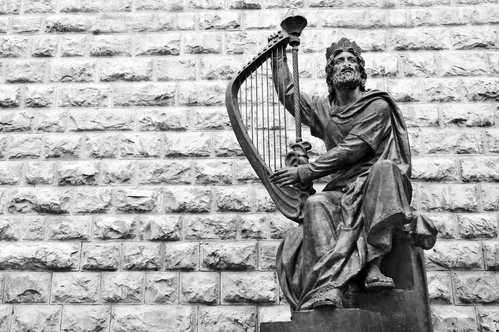
King David statue outside his tomb in Mount Zion Jerusalem, Israel. The Messiah is a direct descent of King David.
We are counting the days down to Christmas, and this is the time of year I tend to write Christmas-themed pieces. Kind of fitting I guess! The Christmas season is always a great time for reflection of the amazing thing God did when He entered into the history of His own creation and became one of us. It’s a time of great hope and a time to appreciate what God has done for us. In this piece, though, I look back from the birth of Jesus, the seed of Jesse, father of David, to David, remembering the human frailties and predisposition to be led astray, and God’s heart for those who have a heart for Him.
Copyright: alefbet editorial use only Archaeological site, City of David in Jerusalem, Israel on May 9, 2017
This blog article is prompted by a Christmas tax article. Yes, Christmas and income taxes go together. Who would’ve thunk it?!
In Luke 2:1, we read that Caesar Augustus sent out a decree for a census. It turns out the census was declared so that the Caesar could tax people. I didn’t know that before.
That previously unknown fact (unknown to me at least) isn’t what caught my eye or what prompts this article, though. The article is also not about unjust taxes that burden the poor and avoid the rich. This article also isn’t about the controversy over whether Luke is accurate about the census and the timing of it.
What prompts me to write this piece is the reference to a previous census and previous tax and the surprising and shocking…
I was reflecting before God this morning and praying when the following question arose in my head: whether it is more important to believe the historical fact of the biblical stories or to believe the stories themselves.
For whatever reason, the story that occurred to me as I was thinking about this is the story of Lot’s wife. After they left Sodom, a place that was known for its wickedness and sin, a place in which God could not identify even 10 good men, she turned back (against the orders of God’s angels that led them (delivered) them out of Sodom), and she turned into a pillar of salt.
Is there really a pillar of salt somewhere in the vicinity of Sodom where lot’s wife turned back? Does it matter?
As I was thinking about the question, it occurred to me that the story is what matters. Sodom is representative of depravity, wickedness and sin, the nature of the world around us in which we live, the state of a person who has not given himself or herself over in loving submission to the God who made us. God calls us out of that sinful state to follow Him. This is true whether Lot’s wife turned into a pillar of salt or not.
In the Midrash, Lot’s wife is identified as a Sodomite. Sodom was her hometown. We read in Genesis that Lot was slow to leave when the angels warned him to get out. The Midrash suggests that Lot’s wife didn’t want to leave, and she left only reluctantly. The Hebrew word translated “looked back” implies a “wistful regard”. (See the Pulpit Commentary on Genesis 19:26 in BibleHub)
Looking back was as much an act of the heart (desiring to be back in Sodom) as a physical one. The application to us is that we should not be tempted to look back wistfully on the sinful lives we once lived. It’s like a dog returning to its own vomit. (Proverbs 26:11 and 2 Peter 2:22) Why would we turn back to the sin from which we escaped? And yet we are tempted to do that.
Returning to the point of the question that flitted into my mind this morning, I am reminded that “all Scripture is God-breathed and is useful for teaching, rebuking, correcting and training in righteousness….” (2 Timothy 3:16) The Scripture is what is useful, not (necessarily) that the stories are true. The critical truth of most stories is contained within the story itself.
I am not necessarily suggesting that the Bible is full of nothing but fanciful stories, religious and fables. (I tend to believe they are mostly, if not wholly, factual.) But, for those who have trouble reconciling the stories with historical fact, this is for you. The quantum of proof necessary to believe a biblical story may seem lacking in some cases, but reconciling historical fact with story isn’t the critical point. The story is the point.
Christmas is a time of reflection for most of us, a time to reflect about the past year and our journey to this “place” that we find ourselves. It’s a time to reflect on God and the amazing introduction of Himself into our history almost 2000 years ago. That is the part of the message in a manger: God emptying Himself of all His privilege and position as Creator of the universe and inserting Himself as a weak, vulnerable child into a humble family in a lowly province of the Roman Empire. this is only the beginning of a Message in a Manger.
God put eternity into the hearts of men said the writer of Ecclesiastes, and Jesus is the answer to that longing that is built into us. We live imperfect, flawed lives, and then we die. The writer of Ecclesiastes says that “all is meaningless.” We came from dust and to dust we return, but when Jesus Christ was born, he introduced the antidote to that condition of sin and death.
The sins and wrongs of fathers and mothers pass down to their sons and daughters and have done so from the beginning. In Jesus, God introduced a new lineage and a new possibility. Born a man, but also born of God, through Jesus comes the answer to the finite frailty that is humankind.
The birth, life, death and resurrection of Jesus Christ is the core of the Gospel. If Jesus did not rise from the dead, all of our hope…
Many people interpret the story of Jesus as if God was looking for someone on whom to take out his vengeance, and His son got in the way – so that somehow makes it right.
NT Wright made a statement on Justin Brierley’s new podcast recently, Ask NT Wright Anything, that is worth repeating. He says that people read John 3:16 (“That God so loved the world that he gave his only begotten son….”) this way: “that God so hated the world that he killed his only son.”
People, especially today, view God as an angry bully. They interpret the story of Jesus, Wright says, “as if God was looking for someone on whom to take out his vengeance, and His son got in the way – so that somehow makes it right”. The people who interpret the story in this way don’t think it is right. They recoil from God as from a cosmic bully.
Of course, many people who moralize about God are simply refusing to acknowledge God as God. They sit in judgment of God. At least they sit in judgment of “the God of the Bible” as they perceive Him.
Many who hold these views also don’t believe God exists, so they are really sitting in judgment of God as they perceive God to be who other people believe in. (Nevermind that this cosmic bully god is not the god other people actually believe in.)
Skeptics aside, I think believers may also view God as more of a cosmic bully than a loving Father, sometimes. It isn’t just skeptics; sometimes believers wrestle with a muddled view of God.

 Copyright: alefbet editorial use only





 Navigating by Faith