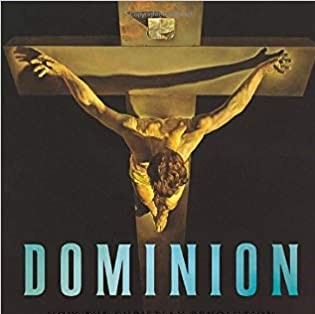
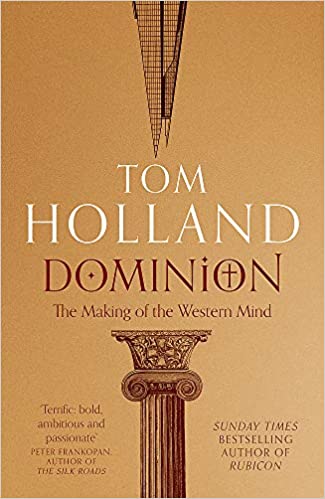
Tom Holland, in his book, Dominion: The Making of the Western Mind, published in 2019, traces western civilization from Darius, the Persian king, through the present time. Holland links the development of modern thinking to its various sources as expressed through the thread of religious views form age to age.
The mode of his analysis is, perhaps, a unique one for an atheist. It also exposes the wellspring of one predominant source for most of the fundamental assumptions of the modern western world. Holland was surprised, himself, to find how prominently one source showed through.
To his chagrin, Holland found that source flowing from the influence of an itinerant, first century carpenter of humble background. Holland’s work reveals that the source of modern western thought is decisively Judeo-Christian, and particularly Christian.
The river in which the Christian spring wells up is, first, Mesopotamian (the Persian version), then Greek, then Roman, but the source of the thinking that invigorates all our basic, western assumptions is not reducible to Persian, Greek or Roman principals – or any combination of all three. Holland’s work demonstrates how the spring of Christianity overwhelmed the river leading to modern western thought and irrevocably changed and defined its course.
Holland traces the assumptions of the modern western world forward through the evolution of religious expression. From Persian Zoroastrianism that was, perhaps[1], the beginning of monotheistic thought, through Judaism converging into the Roman world that combined Greek gods and philosophy, Holland finds from the currents of religious expression the sources of those assumptions that inform the modern western mind and sensibilities.
Holland’s history reveals that the values we take for granted, like the water that comes from a tap, find their source predominantly in Christian origins. Like a spring that swelled the river and came to define it over time, despite its headwaters and tributaries, Christianity overtook the river and ineffably changed and defined its course.
For Holland, the discovery that the values that inform his modern, humanist worldview are Christian came as a paradigm shift from the Enlightenment, modern and post-modern position. His book shows how a modernist can no more escape the spring of Christian influence than drain the water from the river.
The ways in which the theme reveals itself are myriad. Following is one example revealed through the life of Flavius Claudius Julianus. Julian, who would be known as Julian the Apostate, was the nephew of Emperor Constantine. Constantine, of course, set the course of history in his conversion to Christianity and decree to lift the prohibition against its practice. Up to that point, Christianity flourished only despite the efforts to curtail it.
Julian was also raised Christian, but he renounced Christianity to embrace the paganism of his ancestors. Tom Holland describes how Julian sought to reclaim the empire from people who had “’abandoned the ever-living gods for the corpse of the Jew’”.
Julian believed the god, Cybele, had rescued him from the darkness of Christianity. In his effort to promote the worship of Cybele, Julian wrote a letter to the priests in Galatia, blaming them for what he called a lack of faith in Cybele, the god whose temple they kept. His accusation against them? That they were getting drunk in taverns instead of devoting themselves to the poor. Julian committed the funds himself to a program of providing food and drink to the poor, travelers and beggars.
What’s the big deal?
Holland, was a noted historian of the Greco-Roman world before writing Dominion. He knowing well the values of that world. They were incongruous with Julian’s plea. He addresses the incongruity of Julian’s appeal as follows:
“The heroes of the Iliad, favourites of the gods, golden and predatory, had scorned the weak and downtrodden. So, too for all the honour that Julian paid them, had philosophers. The starving deserved no sympathy. Beggars were best rounded up and deported. Pity risked undermining a wise man’s self-control. Only fellow citizens of good character, who through no fault of their own had fallen on evil days, might conceivably merit assistance. Certainly, there was little in the character of the gods whom Julian so adored, nor in the teachings of the philosophers whom he so admired, to justify any assumption that the poor, just by virtue of their poverty, had a right to aid. The young emperor, sincere though he was in his hatred of ‘Galilean’ teachings, and in regretting their impact upon all that he held so dear, was blind to the irony of his plan for combatting them: that it was itself irredeemably Christian.”
“’How apparent to everyone it is, and how shameful, that our own people lack support from us, when no Jew has ever to beg, and the impious Galileans support not only their own poor, but ours as well.’ Julian could not but be painfully aware of this. The roots of Christianity ran deep. The apostles, obedient to Jewish tradition as well as to the teachings of their master, had laid it as a solemn charge upon new churches always ‘to remember the poor’. Generation after generation, Christians had held true to this injunction. Every week, in churches across the Roman world, collections for orphans and widows and the imprisoned, and the shipwrecked, and the sick had been raised. Over time, as congregations swelled, and ever more of the wealthy were brought to baptism, the funds available for poor relief had grown as well. Entire systems of social security had begun to emerge.”
Holland was keenly aware of the pagan world to which Julian wanted to return. It was his focus as an historian. In an interview and discussion with Justin Brierley and AC Grayling, Holland describes how he was fascinated by the extravagant decadence and pomp of the classic Greco-Roman world, but he found nowhere in it any hint of the ethic that is ingrained in modern humanism to care for the poor, save for one source alone: Christianos, the derogatory term given to the followers of Jesus by the Romans.
Throughout the book, Holland identifies the various roots of modern ethics and principals that are no longer seen as distinctly Christian, because they are simply taken for granted – like Julian’s assumption that caring for the poor was a moral obligation, though no such obligation can be traced to the gods and philosophers he embraced in rejecting Christianity.
The idea that correct thinking (belief) is more important than ritual practices, inalienable (human) rights and equality, the importance of education (not just for the elites), the separation of church and state, and many other things find their origins in spring of uniquely Christian thought. The book is well-written and provides much food for thought.
[1] The accepted historical premise is that Zoroastrianism predated Judaism, but I have my doubts, which I attempt to convey in The Roots of Modern Ethics in the Ancient Near East.



 Navigating by Faith