
My inspiration this morning comes from “the woman at the well” and Galileo. They are separated by about 1500 years, but their stories resonate together for me this morning.
The theme is inspired by the questions: “How should we read Scripture?” and “How should we understand science and faith?” Those questions were relevant over 2000 years ago; they were relevant 500 years ago; and they are still relevant today.
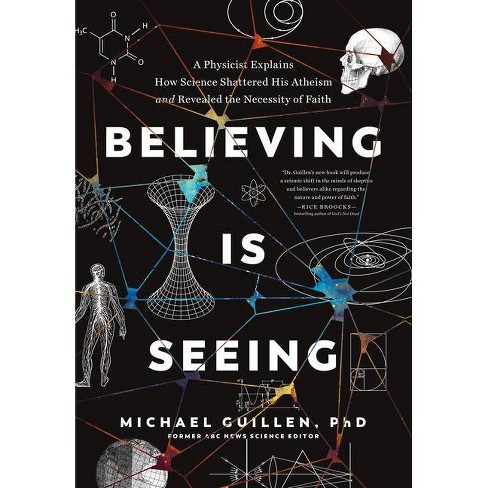
Michael Guillen, in his book, Believing is Seeing, reveals how logical and trans logical thinking are different tools, and each have a place in the intellectual toolbox. Logic is necessary to understand simple, “trivial” truths, but “profound” truths, he says, require trans logical thinking.
We err to apply logic to every problem. Simple matters are the province of logic, but complex matters require trans logic. As much as we might want to keep complex matters simple, we cannot gain insight into many complex matters without a willingness to go beyond the familiar confines of simple logic.
Guillen recognized the necessity to stretch beyond simple logic to more complex, trans logical thinking, among other things, in the realization that dark matter and dark energy make up 95% of the universe. In other words, 95% of the universe is invisible to us! (p. 9)
If we insist on limiting ourselves to things that we can see, touch, feel, smell, and hear, we must give up on 95% of the universe. If we want to explore outside the boundaries of what we can see, we need to adopt more robust, trans logical thinking.
Trans logical thinking is not anti logic, but it isn’t as linear as logic, and it may require holding things in tension that may seem contrary on their face. Classical physics and quantum physics are good examples of things we believe are both true, but which seem to be contradictory on their face.
If we are not willing to give up on 95% of reality, we must be willing to adapt. We must let go of our insistence that everything be reduced to what we can affirm with our senses and to what will fit into simple formulas and logical constraints. We need to think outside the box.
Guillen sees a parallel in the “stretching” that scientists must do to grapple with the unseen world at the edges of simple science and the revelation of the Bible of more “spiritual” things:
“’What no eye has seen,
1 Corinthians 2:9
what no ear has heard,
and what no human mind has conceived’ —
the things God has prepared for those who love him—
these are the things God has revealed to us by his Spirit.”
What the Spirit of God can reveal to us is somewhat similar to the stretching the scientist must do in his thinking to understand things like dark matter and dark energy, quarks, quantum entanglement and other mysteries of science that defy Aristotelian logic and conventional principals. For people who like to live with their feet planted solidly on the ground and with certainty anchoring their beliefs, the prospect of revelation by God’s Holy Spirit is like a black hole. We dare not venture too close for fear of being sucked into a black hole.
Yet, God not only invites us in; He insists that we venture close to understand Him.
“The Spirit searches all things, even the deep things of God. For who knows a person’s thoughts except their own spirit within them? In the same way no one knows the thoughts of God except the Spirit of God. What we have received is not the spirit of the world, but the Spirit who is from God, so that we may understand what God has freely given us. This is what we speak, not in words taught us by human wisdom but in words taught by the Spirit, explaining spiritual realities with Spirit-taught words.”
1 Corinthians 2:10-13
The difference between logic and trans logic in science and the study of the edges of the physical world have application to the metaphysical world in the encounter of the woman at the well with Jesus. I will lay out the similarities I see below.
Continue reading “Drinking Living Water & Embracing the Unseen: of Science and Faith”
 Navigating by Faith