God’s Purpose from Babylon to the New Jerusalem

I am inspired today to try to attempt to trace the sweep and arc of God’s plan as revealed in the Bible.


God had a purpose when he created the universe and put man in the center of it. This is what the Bible tells us. I believe God’s plan was not thwarted by Adam and Eve eating from the fruit from the tree of the knowledge of good and evil. God’s plan was not thwarted by Cain killing Abel, and God’s plan was not thwarted by the Babylonians constructing a tower to their own glory.

God is patient and long-suffering. He created His universe and called it good, but His plan is and always has been to perfect His creation.

God gave us the ability to go our own way, but God’s purposes will be accomplished despite the freedom God gave us.

God gave us the ability to create our own kingdoms, but God’s purposes are to invite all people to embrace His kingdom. He provides the way freely as a gift, but our kingdoms often look better to us, and our ways seem right in our own eyes.

This is a very simplistic view of the whole sweep of Scripture, from beginning to end, which I believe we need to see so we don’t miss the forest for the trees. Of course, only God has perspective to see and to make sense of all the trees in that Great Forest. But, He gave us His word so we can begin to catch a glimpse of God’s great plans.

I want to focus on the big picture today, to survey the sweep and arc of God’s plan as revealed in the Bible, but I am not going to start with the creation of the universe or in the garden. I am going to start in Babylon. After all, we all live in a spiritual Babylon today.

We read in Genesis 11 that the world had one language and common speech. The people moved eastward, found a plain, and they settled there.

Recall that God instructed Adam and Eve to fill the whole earth. Their descendants settled in Babylon, however, and they remained there contrary to that instruction. They didn’t want to follow God’s plan; they wanted to follow their own plans.

The people came together to build a city for themselves and “a tower that reaches to the heavens” to “make a name for themselves.” This is a description of human beings choosing to go their own way, rather than God’s way.

They were afraid of being scattered over the face of the whole earth because that is what God wanted: for them to fill the earth. Because they resisted they were afraid..

The people were unified in going their own way against God. Their unity in going their own way was an obstacle to God achieving His purposes. For this reason, God confused their language, and they scattered over the whole earth.

People do not do well with differences. We isolate. We become group-focused. We despise others who are not like us, and we have inordinate pride in ourselves and our own kind. THIS is the story of human history.

It is also the story of God working His purposes in the world He created to achieve his ends. We may have trouble following it, but I think it will come into better focus if we jump quickly to the end. Then we will fill in the middle. All of this is just a brief snapshot of what God has revealed.

Continue reading “God’s Purpose from Babylon to the New Jerusalem”

The Government Will Be on His Shoulder, But What Does it Mean that the Kingdom of God Is Now

How should Christians orientate themselves to the world in which we live and conduct ourselves in the political and governmental spheres of present life?

The following passage from the Prophet, Isaiah, isn’t just a platitude to recite at Christmas:

For to us a child is born,
    to us a son is given;
and the government shall be upon his shoulder,
    and his name shall be called
Wonderful Counselor, Mighty God,
    Everlasting Father, Prince of Peace.

Isaiah 9:6

Jesus has many names, but the one used (perhaps) the most is Lord. All authority on heaven and earth has been given to Jesus. (Matt. 28:18) Christians revel in that statement. In the next breath, after Jesus said this, he said:

“Therefore go and make disciples of all nations….”

Matthew 28:19

When we think of the authority and lordship of Jesus, we might jump immediately to the ultimate conclusion – of Jesus ruling and reigning at the right hand of the Father. When Jesus told the disciples that all authority had been given him, however, his instruction to follow does not take us where our minds might be tempted to go. He did command us to take over the government or set up a new government.

His charge to the disciples was to go to all nations and make disciples.

That is still his instruction at this time.

Perhaps, we can be excused for forgetting the last instructions he gave after almost 2000 years. Or maybe not…. He was pretty clear about it. We also have the following reminder from the Apostle, Peter:

“But do not forget this one thing, dear friends: With the Lord a day is like a thousand years, and a thousand years are like a day. The Lord is not slow in keeping his promise, as some understand slowness. Instead he is patient with you, not wanting anyone to perish, but everyone to come to repentance.”

2 Peter 3:8-9)

Of course, the government will ultimately be committed into His hands. (Is. 22:21) He will ultimately make a footstool of all his enemies. (Ps. 110:1) Jesus will ultimately sit on the throne with throngs of people proclaiming, “Holy, holy, holy. Lord God Almighty!” (Rev. 4:2)

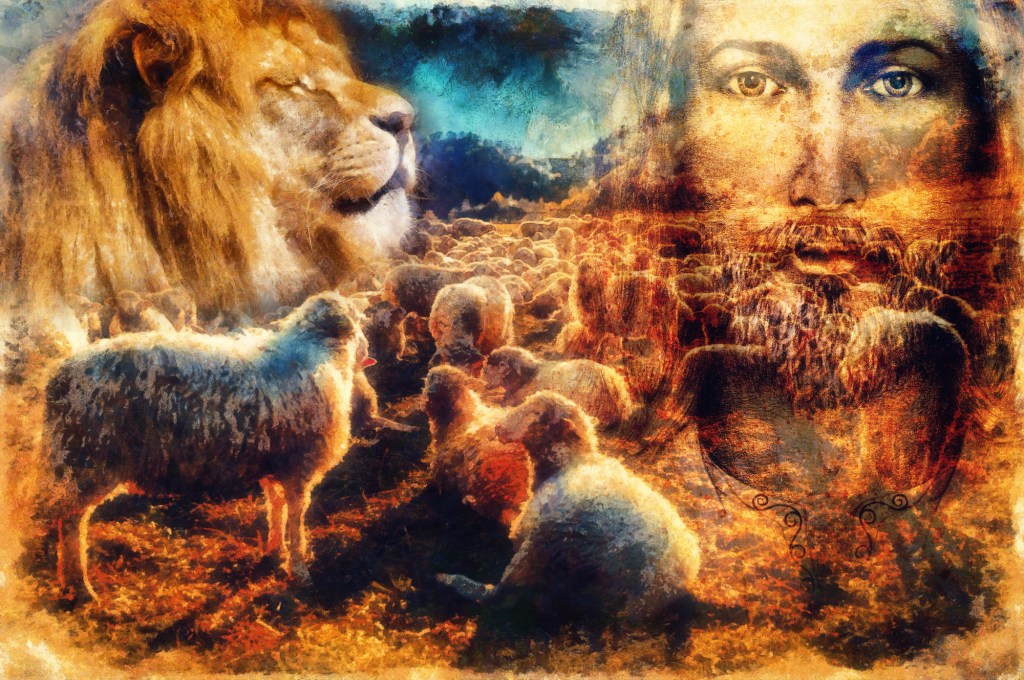
Jesus will be seen as the Lion of Judah and the Root of King David (Rev. 5:5) at that time with a sharp sword coming out of his mouth, striking down the the nations, ruling them with an iron scepter, and treading “the winepress with the fury of the wrath of God the Almighty!” (Rev. 19:15)

But, that time is yet to come. We aren’t there yet.

Even in John’s vision of this future time, the most common description of Jesus is as a Lamb (28 times). Jesus is first the Lamb who was slain, and that is the most prominent name he is given, even in the Book of Revelation.


We have yet to experience Jesus, the Lion of Judah, with sword in his mouth, a scepter in his hand, and a winepress at his feet. That time has not yet come.

Meanwhile, Jesus came not to Judge the world, but to save the world. (John 12:47) Jesus came not for the healthy, but the sick; and Jesus presently desires mercy. (Matt. 9:12-13)

Jesus is not yet the Judge, treading a winepress with the fury of the wrath of God Almighty; He is the Good Shepherd searching for the lost sheep. He is not presently in the business of condemning the world; he is currently in the business of seeking and saving the lost. (Luke 9:10)

So, we should be.

The charge that Jesus gave us – to go and make disciples of all the nations – is still our marching orders. It hasn’t changed.

No matter how close we think we are to the end, God is still currently in the mode of being patient, not wanting anyone to perish, but wanting everyone to come to repentance.

We are easily distracted by many things. We can be so obsessed about the past and we can be so forward-thinking that we forget about the present. We can be so focused on the end times that we do not understand the times in which we live.

We may be close to the end times, but we may yet be far off, by human reckoning. To God, a day is like a thousand years, and a thousand years is like a day. (2 Pet. 3:8) Jesus said we would not know the day or the hour. Most importantly, we are still in the times in which Jesus told us to make disciples of all nations.

He didn’t tell us to make enemies of the nations. He didn’t tell us to set up new nations. He didn’t tell us to take over nations. He said, “Go and make disciples of all nations.”

This, so far, is just a preface for talking about politics and government in the 21st Century. Yes, the government will be on the shoulders of Jesus, but what of the Kingdom of God now? How should Christians orientate themselves to the world in which we live and conduct ourselves in the political and governmental spheres of present life?

Continue reading “The Government Will Be on His Shoulder, But What Does it Mean that the Kingdom of God Is Now”