I previously wrote on the subject of the James Webb Telescope and the headlines claiming that recent discoveries call the Big Bang into question. (Is the Big Bang finally Over?) The Big Bang theory is a theory based upon the fact that we have an expanding universe, and the fact that we have an expanding universe suggests that it is expanding from a point in time. The Big Bang theory that the universe is expanding from a point of beginning some finite time ago is alive and well, but the standard model(s) developed to explain how the expansion we see is being called into question by the James Webb discoveries.
I didn’t go into technical detail about why the evidence for an expanding universe remains solid, mostly because I am not physicist, or even a “science guy”. I am interested in science and try to keep up with certain areas of science because they interest me, but I am not educated or trained in the sciences.
Today, however I heard an explanation for why the James Webb discoveries do not undermine the basic Big Bang principal, that the universe is expanding, that was simple and clear and worth repeating (if for no other reason than for me to remember it).
In conversation with Joe Rogan on his podcast, Stephen Meyer explains why the James Webb Telescope discoveries do not undermine the basic premise of the Big Bang theory. To understand this, we need to understand how the James Webb Telescope is constructed to observe matters in space further away from us than we have observed before.
We also need to understand the evidence for an expanding universe because the James Webb Telescope incorporates design elements that take advantage of the phenomenon that gives us proof of expansion in the universe. That evidence was discovered in the 1920s, and it provided the first evidence that the universe is expanding, and not static as was thought up to that point.
I will quickly explain that first evidence for an expanding universe. Then I will explain how the James Webb Telescope’s design is based on this evidence (thanks to Stephen Meyer in his conversation with Joe Rogan), and then I will explain how the success of the James Webb Telescope actually proves the basic Big Bang principal – that the universe is expanding.
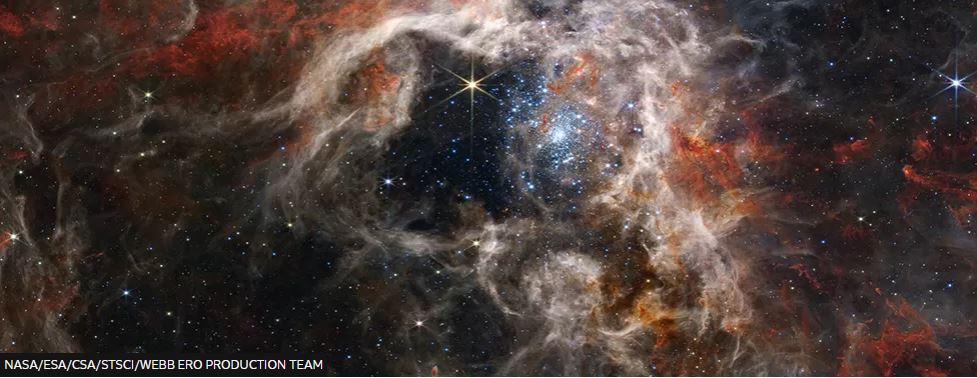
M74, nicknamed the Phantom Galaxy, as seen by the James Webb Telescope
In my daily reading today, I read these verses from the Letter to the Hebrews:
“In the beginning, Lord, you laid the foundations of the earth, and the heavens are the work of your hands. They will perish, but you remain; they will all wear out like a garment. You will roll them up like a robe; like a garment they will be changed. But you remain the same, and your years will never end.”
Hebrews 1:10-12 NIV
These words were written in the 1st century, and they recall the words in Genesis that were written many hundreds, maybe even thousands of years before:
“In the beginning God created the heavens and the earth.”
Genesis 1:1
The statements written in the letter to the Hebrews and in Genesis, long before that, were all written before the revelations of modern science.
We argue today over the passages in Genesis about the creation of the world, whether God did it in seven days or over seven periods of time. Some people say we should take Genesis “literally” (whatever that means), and other people say that the creation account in Genesis is simply poetry and should not be taken literally. There are many people in between, and many people who do not believe or take the Bible seriously either way.
Yet, whether these words are intended to be read as a literal, seven day creation event, seven periods of time, merely a poetic conception or otherwise, they express by faith an understanding that God created the world we live in – “the heavens and the earth”. They also expressed an understanding that God is greater than the creation He made, that God is timeless, and He will outlast the creation as it is and as we know it.
Whatever you believe about the description of creation in Genesis and elsewhere, the understanding is accurate: that the earth and the greater universe as we know it will not remain the same. It is subject to entropy governed by the Second Law of Thermodynamics. In poetic words, “[The Heavens and the Earth] will wear out like a a garment…. like a garment they will be changed.” In more philosophical terms, the Apostle, Paul, says:
“[T]he creation was subjected to futility….”
Romans 8:20
We don’t need to have a sophisticated scientific understanding of the Second Law of Thermodynamics to realize that the universe is, in a sense, winding down and wearing out, that it is “subjected to futility”. The earth, which is such an incredibly minute part of the universe, will not support the life that teams on it very far into the future.
We live in a very narrow band of time in which creatures such as ourselves can thrive on planet earth, sandwiched between ice ages and other inhospitable fluctuations and epochs space and time. Out time will pass like a flower that blooms one day and is gone the next in relation to the full space/time continuum.
Regardless of any Herculean efforts we give on our part to preserve the environment of this planet as we know it, the laws of the universe guarantee that life will no longer be supportable on planet earth, or anywhere in the universe for that matter, at some point in the future. It is inevitable.
It is remarkable to me that the writers of these ancient texts understood this fact by faith, though they had no hint of the science behind it. Knowing nothing of the Second Law of Thermodynamics, they understood nevertheless that this world will wear out.
They also had faith that the God who created it is the constant. Ignorant of the science, they nevertheless perceived and understood the reality of God, His creation and their place in the world.
Though modern science seems to reveal that our universe had a beginning, just as these ancient writings stated, many modern people who have the aid and benefit of science fail to see or acknowledge the creator. This is not a failing of science, though; it’s a failing of faith.
Though science provides many benefits, science is not essential for our faith or relationship to God. All the science in the world is not sufficient to gain us knowledge of God, as it necessarily rests on faith. At the same time, we can have none of the knowledge and understanding of science and still know God and our place in the world.
I love science, as it reveals the wonder of a universe that God made understandable and searchable by us. By faith we grasp all the reality we need to know, but science reveals majesty and wonder and appreciation of the greatness of our God all the more.
By faith, we also understand that God loves us. We understand that there is more to reality than the physical, space/time continuum. We perceive that God had a purpose in subjecting the creation to futility:
“For I consider that the sufferings of this present time are not worth comparing with the glory that is to be revealed to us.For the creation waits with eager longing for the revealing of the sons of God.For the creation was subjected to futility, not willingly, but because of him who subjected it, in hopethat the creation itself will be set free from its bondage to corruption and obtain the freedom of the glory of the children of God.For we know that the whole creation has been groaning together in the pains of childbirth until now.And not only the creation, but we ourselves, who have the firstfruits of the Spirit, groan inwardly as we wait eagerly for adoption as sons, the redemption of our bodies.”


 Navigating by Faith