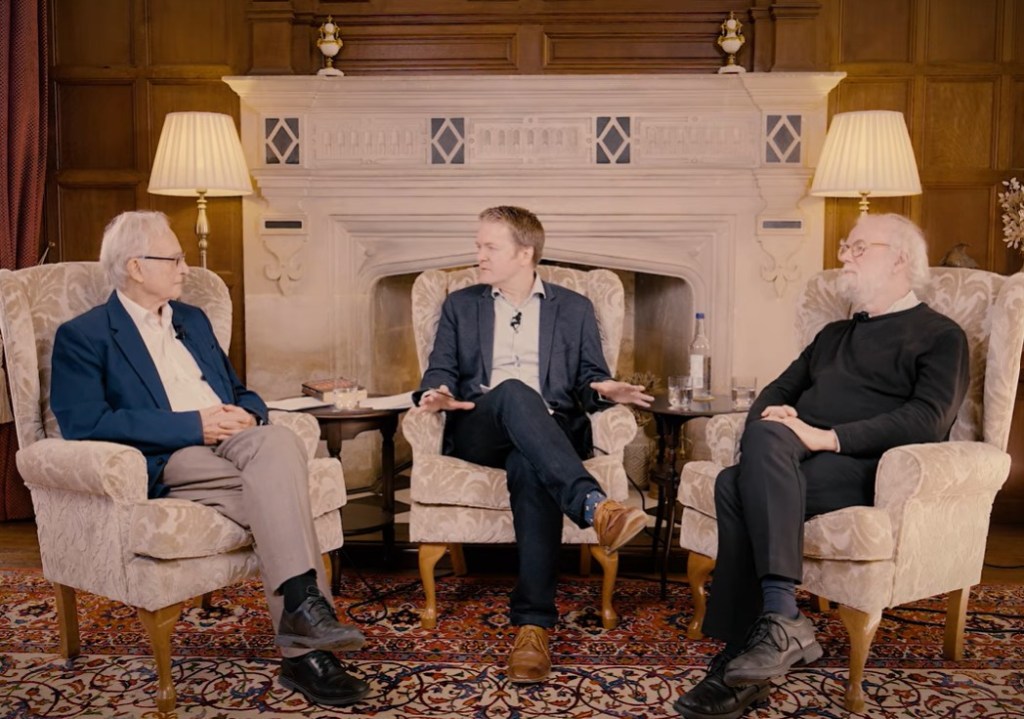
The first episode of the Uncommon Ground podcast with Justin Brierley is titled “What is Behind the Poetry of Reality?” The podcast features a conversation with Richard Dawkins and the former Archbishop of Canterbury, Rowan Williams. Dawkins of New Atheist fame has a purely materialist view of reality – maintaining that reality is comprised only of materials things that operate on their own without the aid of God or any immaterial thing.
The discussion is amicable and informative, if not predictable. Rowan Williams accepts the evolutionary paradigm, but believes in God – an immaterial, personal creator of the universe. They seemed to agree on the science. The only difference is that Williams believes there is a God behind the science and the universe.
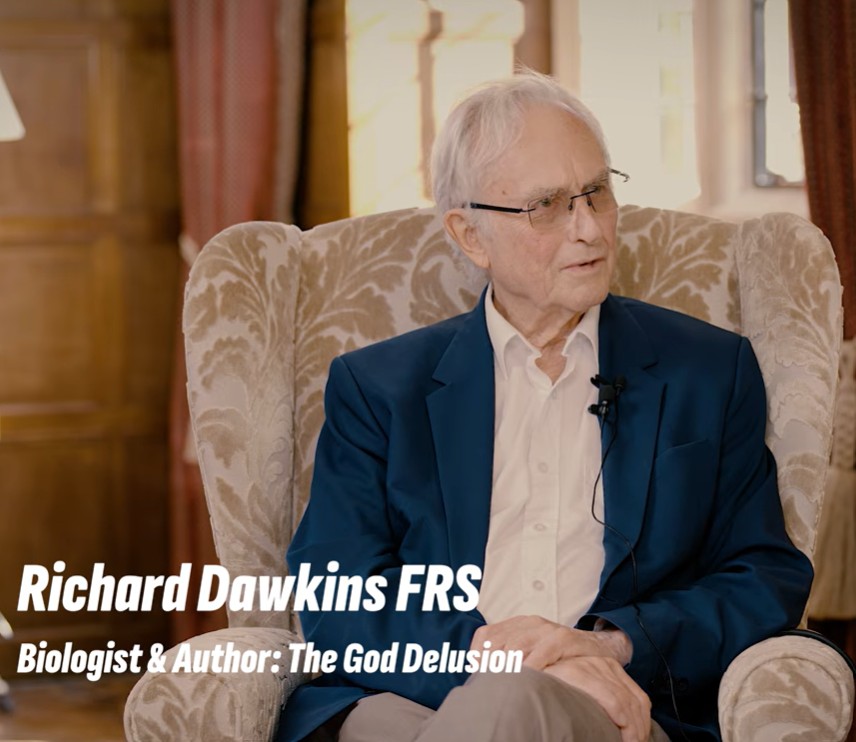
When Brierley asked Williams to summarize Richard Dawkins’ view of reality, Dawkins graciously conceded, “Rowan… understands so well that he can summarize what I think better than I can.”
Dawkins should be given credit for reading Williams’ recent book that was the backdrop for the discussion, but Dawkins admitted to being “baffled” by it.
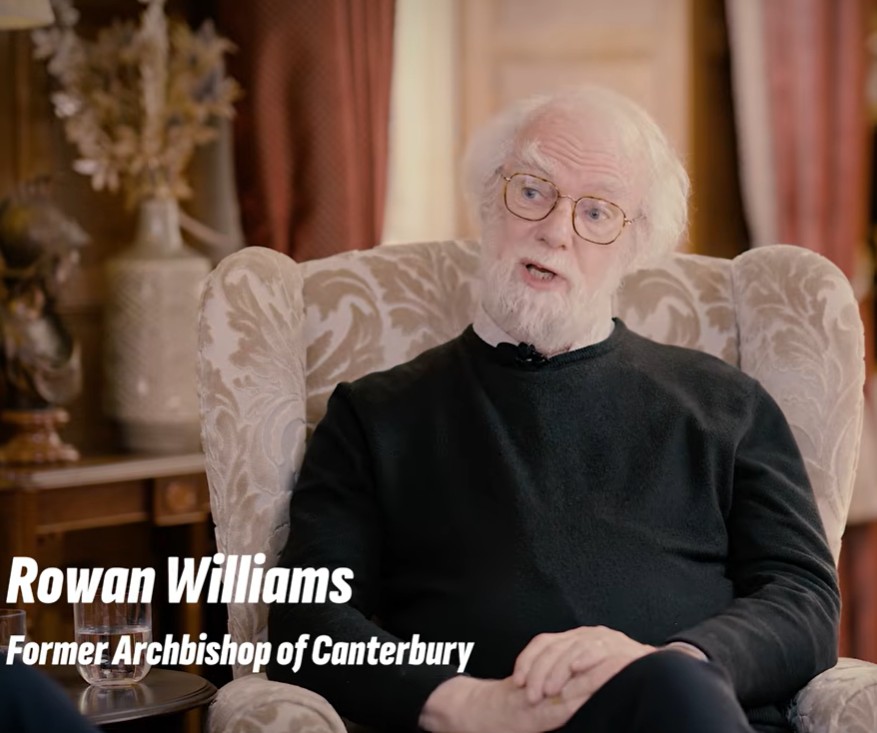
Dawkins was unable to provide a cogent summary of Williams’ view of reality. He succeeded only in criticizing Rowan’s view, and Dawkins conceded, “I think Rowan understands where I’m coming from much better than I understand where he’s coming from.”
This reminds me of C.S. Lewis, who says that the Christian worldview can take in science into account, but a view of the world limited to the constructs of science cannot take into account Christianity. One is robust enough to hold the other, but the other is not sufficiently robust to do the same. (I have provided the whole quotation in its context below.)
I will admit that the robustness of Christianity to be able to make sense of science does not necessarily make it true. Conversely, the limited scope of science that is unable to account for Christianity does not necessarily make it untrue. If reality truly consists of nothing but matter and natural processes, then the limitations of science are the limitations of reality itself.
I think that reality is not sufficiently explained by science, which is limited to natural explanations. I am also fascinated with Dawkins’ attempt to explain his own worldview as follows:
“I see the world as a very complex thing, like a clock or like a car or like a computer, and, and in the case of a clock or a computer or a car, I know how it’s made. It’s made by engineers with drawing boards and they… put together the parts and, and those parts all work together. [T]he equivalent of the engineer in the world of nature is evolution by natural selection.”
I am an English literature major and an attorney. In both disciplines, the ability to draw connections, and distinctions, and juxtapositions between and among word meanings and concepts is essential. Attorneys are professionals in comparing and contrasting facts and circumstances to be to argue (consistent with clients’ interests) that laws either apply in the same way or do not apply in the same way to similar but different sets of facts and circumstances. Perhaps, this why I noticed that Richard Dawkins made a category error. Or did he?
The LSAT that tests a person’s aptitude for law school includes a section on determining the best match between closely related words or concepts. These questions measure a person’s ability to categorize words and concepts, to associate with and distinguish them from each other. For instance, a test question might include the following fill-in-the-blank statements with sets of four potential answers:
A conductor is to orchestra like a _________ is to movie:
- A) Actor
- B) Director
- C) Script
- D) Producer
D (Producer) is the correct answer. The relationship is Artistic Leader to Entity. Just as a conductor interprets the music and leads the musicians to create a unified performance, a director interprets the script and orchestrates the cast and crew in creating a film. An actor would be the equivalent of a musician in the orchestra. The script is the equivalent of the sheet music, and the producer is the equivalent of the business manager in the box office.
Tired is to sleep as hungry is to _____________.
- A) Food
- B) Eat
- C) Kitchen
- D) Full
B (Eat) is the correct answer. Being Tired is a physical state that is resolved by the action of Sleep. The correct answer maintains the act of sleeping, and “hungry” is a condition that is satisfied is the corresponding act of eating that; to sleep satisfies the condition of being tired, and the act of eating satisfies the condition of being hungry. While food is needed to stop being hungry, food is a noun and not a verb. It is the subject (what we eat). “Kitchen” is where you go to sate your hunger – a spatial relationship, not an action, and also not a verb. “Full” is the result of eating – a consequence of an action and also not verb).
Richard Dawkins makes the same kind of associative mistake. The formula Dawkins proposes is this:
Clock is to engineer as the natural world is to evolution.
Evolution is a natural process. The associated natural processes for a clock, for instance, might include oscillation (harmonic motion), potential energy releases, gravity, and/or an escapement mechanisms:
- Oscillation (Harmonic Motion): The fundamental timekeeper. A pendulum swings back and forth, or a quartz crystal vibrates at a precise frequency (e.g., 32,768 times per second for quartz) to create a consistent beat.
- Gravity: In weight-driven (e.g., grandfather) clocks, gravity pulls down heavy weights to provide the energy needed to drive the mechanism.
- Potential Energy Release: A wound-up mainspring stores potential energy that is gradually released, powering the gears that move the hands.
- Escapement Mechanism: This device controls the release of power, allowing it to move forward in precise, consistent “ticks”.
Different kinds of clocks incorporate different natural processes:
- Mechanical Clocks: Use a mainspring (tension) or weights (gravity) combined with a pendulum or balance wheel for oscillation.
- Quartz Clocks: Use electricity from a battery to cause a quartz crystal to vibrate, creating a high-frequency, precise oscillation.
- Atomic Clocks: Use the electromagnetic oscillation frequency of atoms, such as cesium, when transitioning between energy states.
Clocks are designed and produced by an engineer.
The natural world comprises all the natural processes – including all natural processes incorporated into clocks. Evolution is one of those natural processes (though evolution is not associated with clocks).
Evolution is in the same category as other natural processes like oscillation (harmonic motion), potential energy releases, gravity, and/or escapement mechanisms. Thus, evolution is not to the natural world as an engineer is to a clock.
An engineer is not a natural process. An engineer is a personal agent with the capacity to conceive, design, and build a clock making use of natural processes. The clock incorporates some natural processes like the natural world incorporates all natural processes. A clock is not distinct from the natural world like an engineer with the capacity to act on the natural world.
The equivalent of an engineer would be a personal agent that conceives, designs and builds the natural world, making use of natural processes. Thus, the engineer would be the equivalent of God to the natural world – an agent with capacity to act on the natural world.
Of course, there is a difference between an engineer and God. An engineer is, himself, the product of natural processes, which may include the natural process of evolution. God is not the product of natural processes. All analogies break down at some point.
The concept of God is that of a personal agent who, unlike the engineer, is separate, distinct, and transcendent in relation to the natural world. God is not a product of the natural world at all. God is the unmoved Mover, the uncaused Causer, and the uncreated Creator.
But, that doesn’t resolve Dawkins’ category error. Evolution is, itself, a process with no personal agency. Engineers are the result of natural processes, but they are not natural processes. Engineers have agency to direct and redirect natural processes, to conceive and design things in accordance with natural processes, and to build things that incorporate those designs to make use of natural processes.
We don’t call the engineer’s ability to conceive, design, and build a supernatural process, but it is an interruption and redirection of natural processes to create something that would not occur if natural processes were left alone. As CS Lewis says, milk doesn’t spill on the floor and create a map of London.
Many people are confused by the introduction of the idea of supernatural processes attributed to God. Perhaps, God is like the engineer who interrupts and redirects natural processes to create something that would not occur if those natural processes were left alone. We call these things “supernatural” when we attribute them to God, but they may be nothing more than God acting on natural processes similar to the engineer.
But, I digress. There is mystery to God. God is not like the engineer in the sense that God is not product of natural consequences; but God is more like an engineer than evolution is like an engineer to the extent of the analogy – a personal agent manipulating natural processes for a designed result.
We intuit to God from the example of the engineer. We distinguish the engineer from a natural process like evolution because evolution is not a conscious agent.
On the other and, evolution does appear to produce adaption/change, but it does so in a different capacity. It is not personal. It does not conceive anything or design anything. Evolution acts on random mutations (at least on Darwinian evolution). Even if evolution is “directed” (per the modern synthesis), it acts according to natural laws that are impersonal and embedded.
Some people, like Dawkins, believe that humans do not have free will and, therefore, do not have true agency. They maintain that human beings merely dance to the tune of their DNA – meaning that we do not have the agency we think we do. In that sense, perhaps, engineers are more like evolution than I am willing to concede – nothing more than walking, talking natural processes in human form.
In that sense, Dawkins is not inconsistent with his assumptions. His assumptions, however, are a feedback loop that support themselves. Dawkins might say the same thing of the theist. Because we believe God exists, it all begins with God, and it all goes back to God. I would not disagree with that contention.
And, that brings me back to the initial thought, which is that Christianity is a worldview robust enough to incorporate and make sense of science, but science (alone) is unable to incorporate and make sense of Christianity. Christianity can contain science, but science cannot contain Christianity.
For me, God makes much more sense of the world than any other explanation I have heard for reality. On that score, I will leave you with the following words by CS Lewis from the lecture, “Is Theology Poetry?”
~~~~~~~~~
“The picture so often painted of Christians huddling together on an ever narrower strip of beach while the incoming tide of ‘Science’ mounts higher and higher corresponds to nothing in my own experience. That grand myth … is not for me a hostile novelty breaking in on my traditional beliefs. On the contrary, that cosmology is what I started from. Deepening distrust and final abandonment of it long preceded my conversion to Christianity. Long before I believed Theology to be true I had already decided that the popular scientific picture at any rate was false. One absolutely central inconsistency ruins it….
The whole picture professes to depend on inferences from observed facts. Unless inference is valid, the whole picture disappears. Unless we can be sure that reality in the remotest nebula or the remotest part obeys the thought laws of the human scientist here and now in his laboratory — in other words, unless Reason is an absolute — all is in ruins. Yet those who ask me to believe this world picture also ask me to believe that Reason is simply the unforeseen and unintended by-product of mindless matter at one stage of its endless and aimless becoming.
Here is flat contradiction. They ask me at the same moment to accept a conclusion and to discredit the only testimony on which that conclusion can be based. The difficulty is to me a fatal one; and the fact that when you put it to many scientists, far from having an answer, they seem not even to understand what the difficulty is, assures me that I have not found a mare’s nest but detected a radical disease in their whole mode of thought from the very beginning. The man who has once understood the situation is compelled henceforth to regard the scientific cosmology as being, in principle, a myth; though no doubt a great many true particulars have been worked into it.
After that it is hardly worth noticing minor difficulties. … More disquieting still is Professor D.M.S. Watson’s defence. ‘Evolution itself,’ he wrote, ‘is accepted by zoologists not because it has been observed to occur or … can be proved by logically coherent evidence to be true, but because the only alternative, special creation, is dearly incredible.’ Has it come to that? Does the whole vast structure of modern naturalism depend not on positive evidence but simply on an a priori metaphysical prejudice? Was it devised not to get in facts but to keep out God?
Even, however, if Evolution in the strict biological sense has some better grounds than Professor Watson suggests — and I can’t help thinking it must — we should distinguish Evolution in this strict sense from what may be called the universal evolutionism of modern thought. By universal evolutionism I mean the belief that the very formula of universal process is from imperfect to perfect, from small beginnings to great endings, from the rudimentary to the elaborate, the belief which makes people find it natural to think that morality springs from savage taboos, adult sentiment from infantile sexual maladjustments, thought from instinct, mind from matter, organic from inorganic, cosmos from chaos. This is perhaps the deepest habit of mind in the contemporary world.
It seems to me immensely unplausible, because it makes the general course of nature so very unlike those parts of nature we can observe. You remember the old puzzle as to whether the owl came from the egg or the egg from the owl. The modern acquiescence in universal evolutionism is a kind of optical illusion, produced by attending exclusively to the owl’s emergence from the egg. We are taught from childhood to notice how the perfect oak grows from the acorn and to forget that the acorn itself was dropped by a perfect oak. We are reminded constantly that the adult human being was an embryo, never that the life of the embryo came from two adult human beings. We love to notice that the express engine of today is the descendant of the “Rocket”; we do not equally remember that the “Rocket” springs not from some even more rudimentary engine, but from something much more perfect and complicated than itself — namely, a man of genius. The obviousness or naturalness which most people seem to find in the idea of emergent evolution thus seems to be a pure hallucination.
On these grounds and others like them one is driven to think that whatever else may be true, the popular scientific cosmology at any rate is certainly not. …
I was taught at school, when I had done a sum, to “prove my answer.” The proof or verification of my Christian answer to the cosmic sum is this. When I accept Theology I may find difficulties, at this point or that, in harmonising it with some particular truths which are imbedded in the mythical cosmology derived from science. But I can get in, or allow for, science as a whole. Granted that Reason is prior to matter and that the light of the primal Reason illuminates finite minds, I can understand how men should come, by observation and inference, to know a lot about the universe they live in. If, on the other hand, I swallow the scientific cosmology as a whole, then not only can I not fit in Christianity, but I cannot even fit in science. If minds are wholly dependent on brains, and brains on biochemistry, and biochemistry (in the long run) on the meaningless flux of the atoms, I cannot understand how the thought of those minds should have any more significance than the sound of the wind in the trees.
And this is to me the final test. This is how I distinguish dreaming and waking. When I am awake I can, in some degree, account for and study my dream. The dragon that pursued me last night can be fitted into my waking world. I know that there are such things as dreams; I know that I had eaten an indigestible dinner; I know that a man of my reading might be expected to dream of dragons. But while in the nightmare I could not have fitted in my waking experience. The waking world is judged more real because it can thus contain the dreaming world; the dreaming world is judged less real because it cannot contain the waking one. For the same reason I am certain that in passing from the scientific points of view to the theological, I have passed from dream to waking. Christian theology can fit in science, art, morality, and the subChristian religions. The scientific point of view cannot fit in any of these things, not even science itself. I believe in Christianity as I believe that the Sun has risen, not only because I see it, but because by it I see everything else.”

 Navigating by Faith