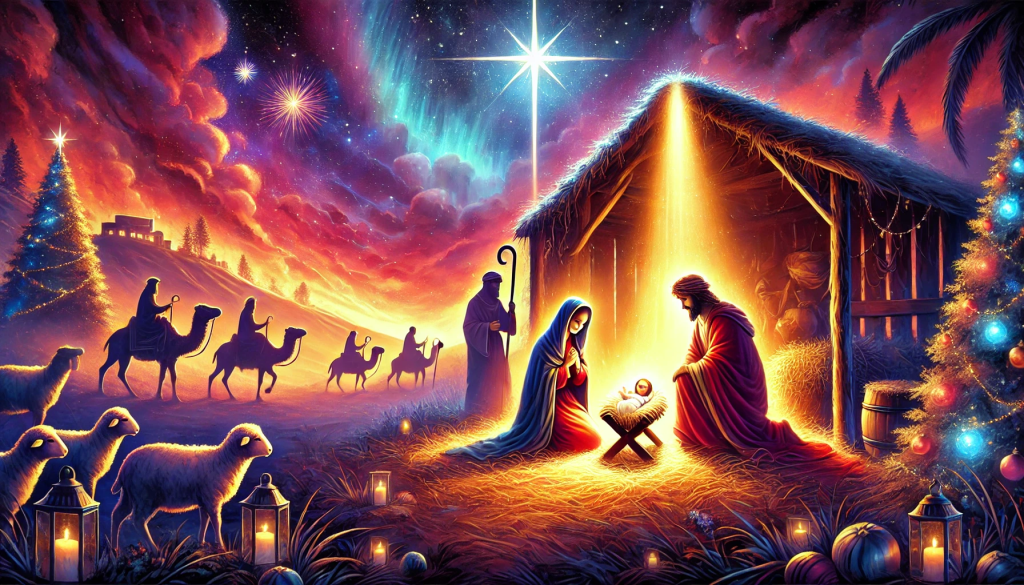
The words of the ancient prophet, Isaiah, are spoken often this time of year:
“For to us a child is born, to us a son is given, and the government will be on his shoulders. And he will be called Wonderful Counselor, Mighty God, Everlasting Father, Prince of Peace. Of the greatness of his government and peace there will be no end. He will reign on David’s throne and over his kingdom, establishing and upholding it with justice and righteousness from that time on and forever. The zeal of the Lord Almighty will accomplish this.”
Isaiah 9:6-7 NIV
These words were spoken many centuries before one, Jesus of Nazareth, was born in Bethlehem while his parents were in town for a census. This passage is full of triumph: “Mighty God”, an “Everlasting Father”, and “Prince of Peace”. “The government will be on his shoulders,” and he will “reign on David’s throne” – the “Lord Almighty!”
These words foretell of a mighty, conquering, benevolent God. (Benevolent after the conquering bit, of course). Human beings have always venerated and celebrated strength, and what could be more compelling to us than a conquering king (provided he is benevolent also!)
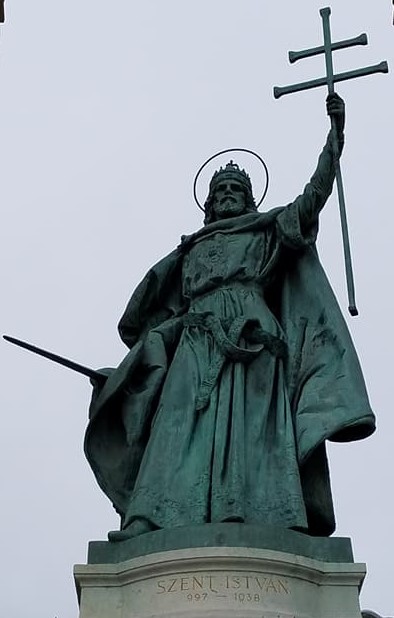
This is the way people view God and the world. This view of God inspired the crusades. It inspired many kings and nobleman through the ages like Stephen I, Szent István király. Born in 975, Stephen took the throne on December 25, 1000, and he became the last “grand prince of the Hungarians”, and he is the first King of Hungary.
I took the photos I have reproduced here when I was visiting my daughter in Hungary this time of year 6 years ago. The prominence of Steven and other kings in Hungarian lore is evident in the statuary around Budapest and in the stately basilica named after him that lies near the Danube in the center of the City.
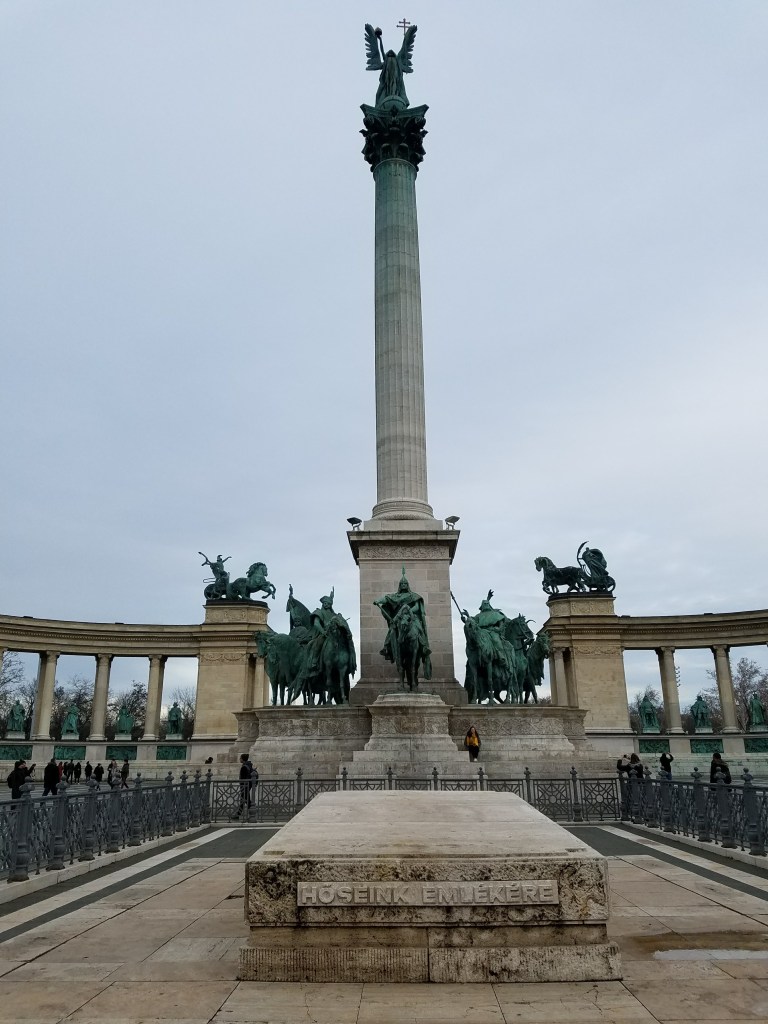
Stephen succeeded his father as a grand prince of the Hungarians, but he had to fight for the throne against his own extended family. He fought many wars against surrounding tribes and chieftains, including his own uncle. He “converted his uncle’s ‘country to the Christian faith by force’ after its conquest,” and he “encouraged” the spread of Christianity “by meting out severe punishments for ignoring Christian customs.” (See Wikipedia)
Many modern minded people with sensibilities trained over the last generation likely squirm (or fume) over stories like Stephen’s, as children are taught in grammar school to recoil at the “imperialism” of our Western/Christian forebears. The so-called “Christian nationalists” among us likely count Stephen a hero of the faith.
Indeed, Hungarians today proudly celebrate Saint Stephen as a national hero, but this celebration seems more focused on nationalistic pride than the spread of Christian faith – if faith can be commandeered by force. Stephen is hailed for unifying the tribal regions around him under his kingship, giving birth to the nation of Hungary.
That the nation was unified under a Christian flag seems to be more of a national identity than a statement of faith. While I was visiting, I observed that Hungarians did not appear, as a whole, to be a people of devout faith.
A 2017 poll reveals that Hungarians, indeed, are not very religious. While about 76% of Hungarians self-identified as “Christian”, only about 8% of Hungarians attended church services on a weekly basis, “placing Hungary among the countries with the lowest church attendance in Europe” (according to my very cursory research using Chat GPT).
While the notion of a king conquering in the name of Christ may be a source of national pride for some, it makes other people feel uneasy. It makes me uneasy.
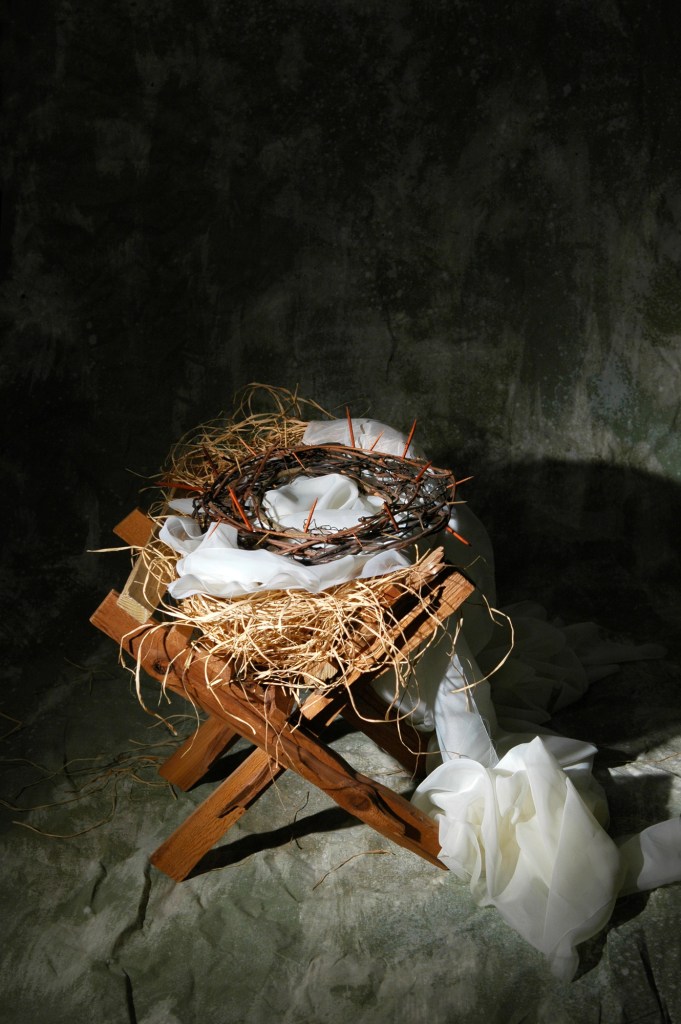
We celebrate at Christmastime the triumphal prophecies foretold by Isaiah of the Lord Almighty taking the government on his shoulders with zeal and reigning on David’s throne. Yet, this imagery contrasts with the images of the story of the birth of Jesus, born of a humble virgin in a lowly manger because they had no influence to make room for themselves anywhere else.
As this story goes, God incarnate was born in poverty, on the edge of the Roman empire, in the humblest of circumstances, to parents who were not even married. God came into the world as an infant, weak and vulnerable.
God is human form became a refugee when his parents fled to Egypt to avoid King Herod’s decree to kill the male babies in the region of Galilee. They returned after Herod’s death but moved to the more remote and neglected area of Nazareth where Jesus grew up in almost total anonymity apart from the small community of people who knew him.
These realities stand in stark contrast to the conquering and reigning king imagery of Isaiah and the images of kingly might we celebrate in people like Saint Stephen. We consider these paradoxical images this Christmas day, December 25, 2024, as we recall the birth of our Savior and Lord, Jesus, and what it all means for us.

Think about it: If God is God, he could crush the universe as easily as He created it, right? Many atheists and other skeptics reject the story and the idea of the Christian God with this thinking. If God is God, why does he seem so hidden?! Why does He seem so weak?
Some people rely on the fact that the God of the Bible doesn’t appear to be great and mighty as proof that He doesn’t exist. “If God is so great”, they say, “Why does evil exist?”
If God is so great, why do we live in a fallen world full of natural disasters and evil perpetrated by the people who live on this planet? If God is really great and really good, He would stop the evil, right? The fact that evil exists means that God is not good, or He is not great, or He simply does not exist.
This is the narrative of the skeptic, but we should consider the counter-narrative before we reject it. This counter-narrative makes more sense than the idea of the conquering kingly view that men have always celebrated and advanced.
If we are to believe the biblical narrative in its full sweep from beginning to ending, we should not that God has a grand plan. His plan, however, is not to dominate the world He created.
This story reveals that God did not desire automatons that He could wind up and set in motion to whir and whiz exactly as God designed – without life, without love. God desired a universe that sings to the tune God has orchestrated out of love, reverence, and gratitude to Him – not because it is designed to do nothing else, or because of compulsion and coercion that it can’t resist, but because of love for God and His creation.
The Bible is clear that God will prevail, and He will prevail through a Son who is from God, who was with God in the beginning, and through whom God created all things. (John 1:1-18) He will be the son to us who God has given who will reign as King forever as Isaiah foretold, but how he succeeds to that position is not how we might expect.
The story has almost become a trope in modern western thinking: Jesus lived a simple, humble life; he said some good things and did what people thought were miracles; his brief candle flickered and was snuffed out, however, when he attracted negative attention from the Roman government and was hung on a cross to die a publicly humiliating death.
We are, perhaps, so enamored or variously repulsed by the spectacle of the powers of imperialism and the exploits and oppression that have played out throughout human history that we miss what God is doing in this story. God entered into human history not with a display of human power but with a demonstration of God’s tender, self-restrained, and self-sacrificing love.
What looks like abject weakness is exulted in this story as God’s strength, which is love. By subjecting Himself to the very worst that human power can do, God in Christ Jesus rose above it.
Though He was God and could, certainly, crush all of humanity in one blow by the same power with which He created this universe, He willingly submitted Himself to all the power that human government can muster – the cruelest and most humiliating of public spectacles – and came out the other side as if to say, “Is this the best you can do?”
The account of the resurrection is the ultimate demonstration of the triumph of God who became man. This was not just a triumph over the greatness of human power, but of “powers and principalities” we don’t even see.
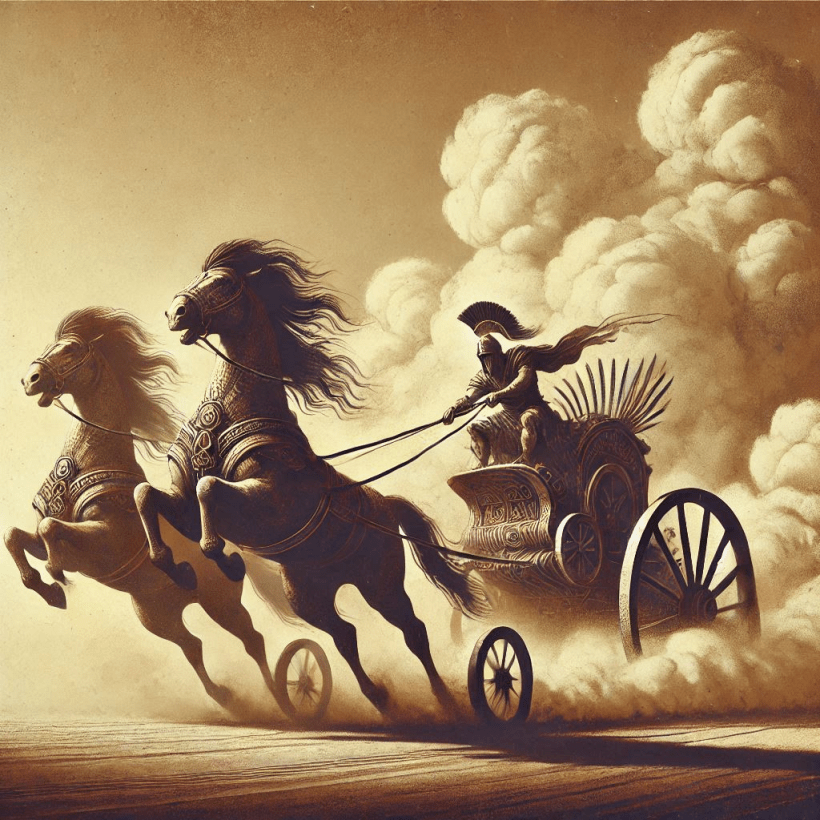
Humans stand on the vehicles of these powers and principalities like the fly on the housing of a chariot wheel in the midst of a race, saying, “Look at the dust I raise!”
Jesus did not simply gain victory over the Roman Empire in the 1st Century, AD; he gained advantage over all the unseen powers that act behind the scenes in this cosmic play that God is working towards His grand purposes:
“[H]aving disarmed the powers and authorities, he made a public spectacle of them, triumphing over them by the cross.”
Colossians 2:15
The true power of God is not found in the exercise of God’s ability to wipe out humans, the earth, and the universe that He made. His real power and strength lies in His self-control and His love for us and His creation.
“[Jesus, w]ho, being in very nature God, did not consider equality with God something to be used to his own advantage; rather, he made himself nothing by taking the very nature of a servant, being made in human likeness. And being found in appearance as a man, he humbled himself by becoming obedient to death— even death on a cross! Therefore God exalted him to the highest place and gave him the name that is above every name, that at the name of Jesus every knee should bow, in heaven and on earth and under the earth, and every tongue acknowledge that Jesus Christ is Lord, to the glory of God the Father.”
Philippians 2:6-11
The prophecy of Isaiah that we recall at this time of year will play out and become reality, but not in the way of typical human thinking – through conquest and force. God who became incarnate in Jesus exercises a power more disarming than that – a power that renders foolish the very notion of such human conceptions of power.
Against this power, the sin that dominates the world of humanity has no hold. People who have been crushed under the weight of this worldly dominion, are made to rise again as Jesus did, and death has no hold over them, just as death had no hold over Jesus.
This is hope we reflect on in wonderment at this time of year. God entered our human existence as vulnerable infant. Not just any infant: He entered the world as a baby in a lowly manger, born to unwed parents in poverty and squalor. He was displaced as a refugee until his family returned to a humble and quiet life in a remote corner of the world.
“The maker of all things laid down His scepter and bound Himself to the modest confines of a human body. He who had lived in eternity stooped to become subject to time. He who upholds the cosmos chose to be held in the arms of a peasant woman.”
A. W. Tozer
God lived in the anonymity of common humanity until the time for Him to set His life like a candle on a stand for the world to see. In a brief flare of modest influence that may never have been known outside a far flung region of the burgeoning Roman Empire, God’s stay as a creature in His universe ended abruptly.
“He was born in an obscure village, the child of a peasant woman. He grew up in another village, where He worked in a carpenter shop until He was thirty. Then for three years, He was an itinerant preacher. He never wrote a book. He never held an office. He never had a family or owned a home. He didn’t go to college. He never visited a big city. He never traveled two hundred miles from the place where He was born. He did none of the things one usually associates with greatness. He had no credentials but Himself.
Dr. James Allan Francis, from the sermon titled “Arise, Sir Knight!” (1926)
“He was only thirty-three when the tide of public opinion turned against Him. His friends ran away. One of them denied Him. He was turned over to His enemies and went through the mockery of a trial. He was nailed to a cross between two thieves. While He was dying, His executioners gambled for His garments, the only property He had on earth. When He was dead, He was laid in a borrowed grave through the pity of a friend.
Twenty centuries have come and gone, and today He is the central figure of the human race. All the armies that ever marched, all the navies that ever sailed, all the parliaments that ever sat, all the kings that ever reigned, put together, have not affected the life of man on this earth as much as that one solitary life.”
Today, we celebrate Jesus as God incarnate, the Lord and Savior of the world, who displayed a power that disarms all powers, and a love that sustains all loves. The hope of this incarnation in the life of humanity echoes in our hope of God’s incarnation in our own lives and the triumph over sin and death Christ achieved and offers as His gift to us.

 Navigating by Faith