
If Jesus was walking the earth today, as he did in the 1st Century, he might have said, “the kingdom of God is like an autostereogram.” Until recently, I didn’t know what an autostereogram is, and I am pretty sure they weren’t invented yet in the 1st Century.
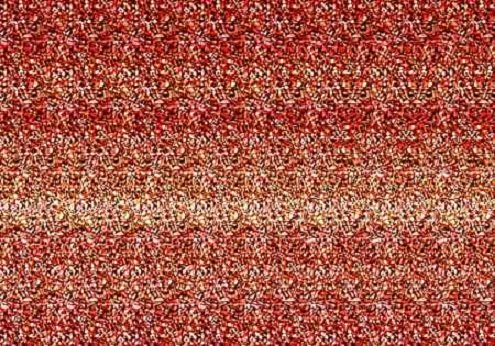
The image above is an autostereogram. It appears like a repeating, two-dimensional, abstract design, but it “hides” a three-dimensional image. It isn’t really hidden, but we must “look beyond” the two dimensional image to see it. Can you see the three-dimensional image? (Look to the end for help.)
Our eyes don’t naturally pick up on the three-dimensional object “hidden” in the abstract image. We have to “strain” to see it, though the image is right there in “plain sight”. In truth, straining isn’t the right way to see it. Relaxing is a better description of the “technique” for deciphering the 3D image the lies “behind” the 2D image.
I usually have to stare and stare at an autostereogram to see the three-dimensional object, and sometimes I give up impatiently. When I finally do see it, the image emerges. More aptly, it pops, out at me!
Some people who have eye conditions that inhibit their ability to see the three-dimensional images. If you can’t see them, you might be one of those people. (Or you might just be impatient, like I am sometimes.)
This web page on autostereograms provides the following instruction:
- Concentrate at a point in the middle of the 2D picture. Try not to get distracted by looking around the picture.
- Let your eyes relax and look through the picture rather than at it. You want to look at a point behind the picture. You will notice that the picture will go slightly out of focus. This is normal, and in fact, this is what you want to happen. For beginners, a useful way to start would be to look at pictures that have been framed. You can then learn to look beyond the picture by using your reflection as a guide.
- Once you notice the 3D image, it gets easier. Try to resist the temptation to refocus onto the 2D picture because you will lose the 3D picture if you do that.
People who have never been able to perceive 3D shapes hidden in an autostereogram find it hard to understand remarks such as, “the 3D image will just pop out of the background, after you stare at the picture long enough”, or “3D objects will just emerge from the background”. Until you see it, you can’t imagine what it is like.
A skeptic who can’t see the 3D image might be tempted to write it off as an illusion or the product of an active imagination. The reality of autostereograms with 3D images embedded into a flat, two-dimensional image, however, is fact. You can even generate your own autostereograms on the Internet.
Autostereograms and the inability to see the image within the image remind me of the teaching of Jesus on the kingdom of God. People who have gone from atheist or agnostic to believer often describe the switch in similar terms. Sy Garte, a highly intellectual bio-chemist by education and profession, described his experience of not being able to understand belief in God this way:
I found myself standing on the shores of a sea of mystery, certain that the waters hid treasures of beauty and goodness, but with no way to see them for myself.
(An excerpt from Sy Garte: Why I Believe in the Resurrection, commenting on his book in Peaceful Science, November 19, 2019) He recalled reading the Gospels when he still subscribed to materialism and atheism. At that point in his life, he read them only “to reinforce my atheistic scorn at the stupidity of Christianity, ” he said.
Back then I was focused on the magic, the contradictions, the naiveté of the ignorant who believed in scientifically impossible events like the resurrection.
Years later, no longer convinced that truth was bounded by the parameters established by materialism and atheism, Sy read the Gospels with an open mind. He “relaxed” his view, and this time, he saw the image within the image:
When I read the Gospels the second time, my mind was open, freed of the ideological certainty of atheism. I still saw the apparent contradictions, but now they appeared as evidence for truth, the kind of differences one would expect in true eyewitness accounts [citation omitted]. I still saw what looked like magic, but now it confirmed for me my new-found conviction that science is not the only pathway to truth. And now I saw the figure of Jesus Christ, and reading His words, I realized that God must have seen me standing on the shore, staring helplessly at the waves. Jesus Christ rose from those waters and held out His hand to me.
Sy Garte uses metaphoric language here. He didn’t actually see Jesus emerge or pop out of the pages like the hidden image in an autostereogram. The metaphor fits, though.
At one point in his life, Sy couldn’t even imagine what it would be like to believe in Jesus. Later, when he had relaxed his embrace of atheism and materialism, Jesus virtually leapt off the pages of the Gospels.
Sy Garte’s experience is far from unique. The lightbulb moment, the dramatic paradigm shift, is common to stories of conversion. The description Jesus gave for conversion, being born again, is beautifully descriptive of the experience many people have had who went from no faith to faith.
I recall one friend of mine who described that she suddenly realized she saw the world differently. As she gazed out over the landscape and told me it was alive in ways she never noticed before. In the most recent article I wrote, I described the conversion of an Afghan Muslim. He said recalled how he saw people differently after his conversion, saying that the difference was that he loved them.
These experiences are similar to suddenly being able to see the image inside the image of an autostereogram. Of course, the experience of “seeing” and understanding God, Jesus and the kingdom of God is much more dramatic, meaningful, and life changing. The autostereogram metaphor also makes some sense of the way Jesus described the kingdom of God.
Jesus said,
The kingdom of heaven is like a treasure hidden in the field…. (Matt. 13:44)
Some skeptics are critical of a God, they say, who would hide Himself. They say such a God would be deceptive, and who would respect a God like that? The Bible recognizes this “hiddenness” of implicitly in the statement that God shows Himself to humble, but not to the proud. Maybe God has a purpose in “hiding” Himself.
Jesus said,
The kingdom of God is not coming with signs to be observed; nor will they say, ‘Look, here it is!’ or, ‘There it is!’ For behold, the kingdom of God is in your midst. (Luke 17:20-21)
Though the kingdom of might be hidden, it is hidden in plain sight! Like an autostereogram, the kingdom of God is right here. You just have to “seek” it until you see it. If you are not looking for it, or you don’t believe it, or are not patient or persistent enough, you may not see it. But, that doesn’t mean it isn’t there.
Jesus said,
whoever does not receive the kingdom of God like a child will not enter it at all. (Mark 10:15)
As with an autostereogram, we have to “relax” to receive God’s kingdom. We have to give up control and trust (like children do) to receive it. We can’t come with pretenses and presuppositions because all we will see, then, are the things which we have already assumed in our minds and hearts.
Jesus,
I thank you, Father, Lord of heaven and earth, that you have hidden these things from the wise and understanding and revealed them to little children…. (Matt. 11:25)
God’s hiddenness, and the hiddenness of the kingdom, is purposeful. Scripture says, “God opposes the proud, but gives grace to the humble.” (James 4:6) Those who are wise in their own eyes will not see God or His kingdom because they are not orientated to see it.
Jesus described “entry” into the kingdom of God, perhaps most famously, this way:
Jesus answered and said to him, “Truly, truly, I say to you, unless one is born again he cannot see the kingdom of God.” (John 3:3)
In this sense, entry “into” the kingdom of God is existential (and experiential). It’s not just an academic adjustment or change in intellectual approach. It’s like being born over again and entering into a new world.
“Coming to faith” is a paradigm shift of an existential and experiential nature. When John Newton wrote those famous words, “I was blind, but now I see”, he was describing the vitality and depth of that paradigm shift. Like my friend who said she saw the world differently, and the Afghan Muslim who saw people differently, everything changes when we finally “see” it.
It’s like an autostereogram on metaphysical steroids. It isn’t just a static and repeating 3d image that emerges from the flat, two dimensional design. Being born again is the sudden (or emerging) awareness of a Living God active, but dynamic and transcendent, in His creation. and in your life! When Newton said, I was blind, but now I see”, he was saying that once I couldn’t see it, but now I do!
Jesus said,
My kingdom is not of this world. (John 18:36)
The 3D image in an autostereogram is part of the autostereogram, but it is distinct from the flat, two-dimensional image of the autostereogram. It is emergent from it.
This differs from the way the kingdom of God actually works. God is transcendent from His creation. He doesn’t emerge from His creation; the creation emerges from Him. We, however, are immersed in and part of the creation. The way we experience the kingdom of God is as if it is emerging out of the creation, but the reality is exactly the opposite.
Jesus cautions that His kingdom is “not of this world”. It is other-worldly. When we are looking for it in the world, we have a heard time seeing it because it is not of this world.
With an autostereogram, we cannot see the 3D image if we are staring at the component parts of two-dimensional image. We have to “look past it”. the 3D image isn’t to be found in details of the two dimensional image. We only see the three dimensional image when we look “through” or “beyond” the two-dimensional image.
This sounds a bit gnostic and occultist, but it isn’t. It’s no wonder that Gnosticism was an early threat to Christianity: the language of the kingdom of God lends itself to that kind of thinking, but that is a false trail.
The thought that a person must attain to some special knowledge or insight that only the elite can attain to is exactly the opposite of what is required to enter the kingdom of God. Rather, the kingdom of God is received like a simple child. It is hidden to the proud, the arrogant and the haughty, but it is revealed to the humble and childlike at heart.
The kingdom of God, in the end, is only somewhat like an autostereogram. No analogy is perfect. They all break down at some point. Perhaps, this is why Jesus provided many so parables. Especially about the kingdom of God. No analogy by itself (or altogether) is sufficient to describe a reality that is other worldly.
A parable (or other analogy) does not tell a truth so much as it helps a person to discover truth. Jesus did not spoon feed people with the truth about God and His kingdom; he invited them to explore it experientially.
God and His kingdom are available to those who seek, but only to those who seek with a pure heart. Only to people who sincerely desire to know God and His kingdom as they really are. God and His kingdom are not found by those with ulterior motives, unless those ulterior motives are stripped away in the process of seeking.
Most of us, I suspect, come initially with mixed motives. The motive to avoid punishment, the fear of being left out, and a desire for good things that might come from faith are impure motives. They are primarily selfish and self-centered.
God is ok with that, but He isn’t ok with us remaining selfish and self-centered. What parent doesn’t know how to provide good gifts to their children? How much more will the Father provide good gifts to those who ask? And, like a good parent, God is interested in us growing out of our childishness.
The truth is that we are all self-centered. We are all self-absorbed. If we remain focused on self and unwilling to focus on God and His kingdom, however, we will not find what we are looking for. God takes us as we are, but He isn’t content to leave us in that condition.
Parables and analogies, like that of a modern autostereogram, provide glimpses of what God and the kingdom of God are like, but only glimpses. They do not substitute for the real thing – the Living God who is here in our midst – if we could just see it.
We have to look past the parables, past the analogies, past the autostereogram, to see God and His kingdom and enter into relationship with Him.
If we aren’t careful, we can also find ourselves too easily focused back on this world. We can easily allow our eyes and our hearts to lose focus on Him and His kingdom, and to refocus back on ourselves and the things we can attain in this world. It is our natural tendency. It’s where our eyes and hearts gravitate if we stop seeking.
~~~~~~~~~
Postscript:
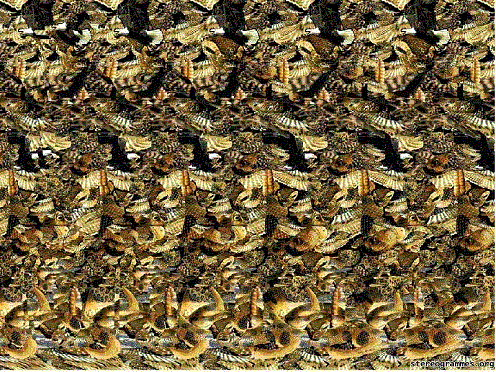
Following are some other autostereograms. I find it hard to “see past” the flat image. I have to stare quite awhile at the images to see the 3d images “hidden” in plain sight in them. It doesn’t come naturally or easy with me. How about you?


 Navigating by Faith
One thought on “The Kingdom of God is like an Autostereogram”