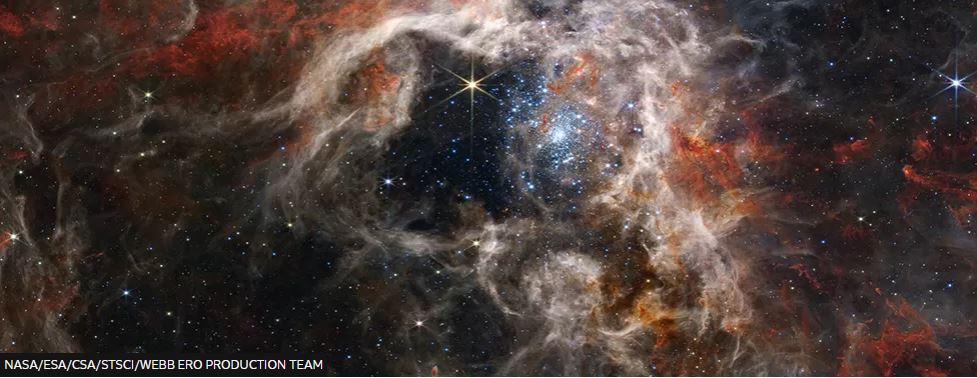
The Reports of the Death of the Big Bang Are Greatly Exaggerated

Why the James Webb Telescope discoveries do not undermine the Big Bang theory

I previously wrote on the subject of the James Webb Telescope and the headlines claiming that recent discoveries call the Big Bang into question. (Is the Big Bang finally Over?) The Big Bang theory is a theory based upon the fact that we have an expanding universe, and the fact that we have an expanding universe suggests that it is expanding from a point in time. The Big Bang theory that the universe is expanding from a point of beginning some finite time ago is alive and well, but the standard model(s) developed to explain how the expansion we see is being called into question by the James Webb discoveries.

I didn’t go into technical detail about why the evidence for an expanding universe remains solid, mostly because I am not physicist, or even a “science guy”. I am interested in science and try to keep up with certain areas of science because they interest me, but I am not educated or trained in the sciences.

Today, however I heard an explanation for why the James Webb discoveries do not undermine the basic Big Bang principal, that the universe is expanding, that was simple and clear and worth repeating (if for no other reason than for me to remember it).

In conversation with Joe Rogan on his podcast, Stephen Meyer explains why the James Webb Telescope discoveries do not undermine the basic premise of the Big Bang theory. To understand this, we need to understand how the James Webb Telescope is constructed to observe matters in space further away from us than we have observed before.

We also need to understand the evidence for an expanding universe because the James Webb Telescope incorporates design elements that take advantage of the phenomenon that gives us proof of expansion in the universe. That evidence was discovered in the 1920s, and it provided the first evidence that the universe is expanding, and not static as was thought up to that point.

I will quickly explain that first evidence for an expanding universe. Then I will explain how the James Webb Telescope’s design is based on this evidence (thanks to Stephen Meyer in his conversation with Joe Rogan), and then I will explain how the success of the James Webb Telescope actually proves the basic Big Bang principal – that the universe is expanding.

Continue reading “The Reports of the Death of the Big Bang Are Greatly Exaggerated”
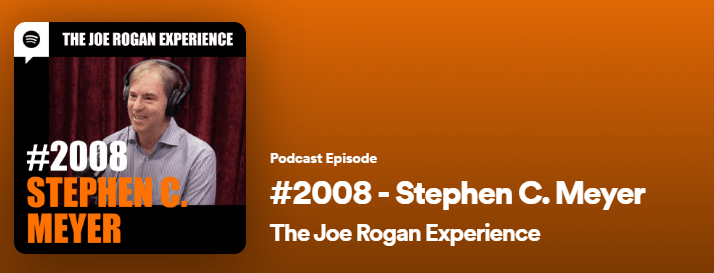
Joe Rogan Interviews Stephen Meyer on Intelligent Design

Joe Rogan tackles intelligent design


I am going to do something unusual (for me) today. I have listened to long podcasts and summarized them or focused on particular aspects of them. I have also read books and done the same.

Today, I am going to link to a long podcast without much comment. the podcast is the Joe Rogan Experience, the most poplar podcast available today. I am not really a Joe Rogan fan. I don’t often listen to his podcast. I am not sure I have ever listened to an entire episode, so this is a first for me.

Joe Rogan is unquestionably a curious and surprisingly intelligent interviewer. He can say some stupid things, but then (I have to confess) so can I. I suppose that combination of “common guy” persona, willingness to ask the “stupid” questions and challenge the status quo, and a modicum of intelligence is why he is so popular.

In the episode I am embedding below, Joe Rogan interviews Stephen C. Meyer, a “proponent” of “intelligent design”. The interview is particularly interesting because Joe Rogan tends toward people like Sam Harris, and Bart Erhman, and other materialists, atheists, and skeptics of religion.

Rogan isn’t just a Cretan (to use an old biblical word) as his popular persona might suggest. Though he clearly favors materialist explanations of the world, he asks good questions and gives his guests opportunity to explore contrary points of view. This is the case in the embedded interview that lasts for over 3 hours.

I am still working my way through it, but I have heard enough at the 50 minute mark to consider it worthy of putting it out there. Maybe I will come back to summarize or focus on particular aspects of the conversation. If you have listened to it (or are listening to it as I am), feel free to post your own comments.

Stephen Meyer is the author of the New York Times bestseller Darwin’s Doubt: The Explosive Origin of Animal Life and the Case for Intelligent Design and Times (of London) Literary Supplement Book of the Year Signature in the Cell: DNA and the Evidence for Intelligent Design. His many other publications include contributions to, and the editing of, the peer-reviewed volume Darwinism, Design and Public Education (Michigan State University Press, 2004) and the innovative textbook Explore Evolution (Hill House Publishers, 2007). His most recent book, Return of the God Hypothesis: Three Scientific Discoveries That Reveal the Mind Behind the Universe, is generating much discussion, like the interview embedded in this blog.

Meyer graduated from Whitworth College in Spokane, Washington, in 1981 with a degree in physics and earth science. He worked as a geophysicist before returning to academia at Cambridge University, to earn an M.Phil. in 1987 and a Ph.D. in 1991 in the Philosophy of Science. His doctoral thesis was titled “Of Clues and Causes: A Methodological Interpretation of Origin-of-Life Research.”