The Importance of Asking Tough Questions and Candidly Seeking Answers

Don’t settle for blind faith. Question and seek answers.


Today, I want to do something a little bit unusual. I find my inspiration in a question posed in a Facebook group, Seekers with Questions about Christianity. You will need to become a member if you want to find the post and the response thread that follows it. This is the question:

Hi can someone please help me understand this: If God doesn’t like the idea of concubines (multiple secondary wives), then why didn’t he tell his holy prophets so? Why did He give rights and laws regarding concubines instead of tell his prophets not to have concubines? He made so many rules and instructions so that people know how to please Him and do his will – so why not also add that he doesn’t like men having concubines? And if someone wants to answer that its a matter of embracing the culture of the time, God never changes, and we are never to conform to the world around us; we are supposed to be different to the world and cultures around us.

It’s a really good question! We should be asking questions like these. The culture in some Christian circles and churches discourages people from asking tough questions. Or worse: people are actually told not to ask these kinds of questions!

I believe God expects us to ask the tough questions, and He invites us to search out the answers. I also don’t believe doubt is the opposite of faith. A lack of trust in God is more like the opposite to faith. Our doubts often drive us to seek answers and to seek God who has those answers.

In some ways, I believe our certainty can be antithetical to faith. When we think we know all the answers, we can begin to trust in our own understanding more than we trust in God. We run the risk of a shallow, intellectual faith that is wooden and stiff when we value certainty over truth.

If we reach a point where questions are no longer important, we are likely to stagnate and grow spiritually cold and distant from the world around us that has questions. If we stop asking questions, we stop growing in our knowledge of God and stop maturing in our walk with Jesus.

Thus, I think we need to encourage questions, allow ample space for questions, and take them seriously. In that vein, I want to commend Daniel Mann, who is the administrator (or one of the administrators) of the Facebook group in which the question above was posed. He is also a fellow blogger. (See Mann’s Word)

Continue reading “The Importance of Asking Tough Questions and Candidly Seeking Answers”

An Invitation to Test and See Whether God Exists

The title of this piece is a bit of poetic license. I am combining the Psalmist’s challenge to “taste and see that the Lord is good….” (Psalm 34:8) with Paul’s admonition to “test everything”. (1 Thess. 5:21) The general thrust of these two verses is an invitation to seek God and truth and to test what we think we know.

Tasting suggests that we can experience that God is good, and testing suggests that we can measure, in some respect, that experience with God. While the existence of God is not susceptible to testing and measurement like we do with science in a laboratory or in physics (for many reasons), these statements are claims that we can in some sense measure, prove, and have confidence in our conclusions.

Both writers are talking about experience in these passages, something that is frowned upon as evidence in our modern, western culture. I will come back to that. First, though, I want to make some observations.

It should go without saying that tasting and testing requires some commitment to the process. Tasting is highly experiential. If we are going try to “taste” something, we have to engage in that process.

We cannot taste through another person’s experience. It requires our own engagement in the tasting, and that requires some willingness on our part to engage.

On the subject of being scientific about spiritual experience, we can and should listen to what others say who claim to have tasted that God is good. We can and should weigh the “results” and conclusions of various people who make these claims.

In that process, we could categorize, compare, and contrast the tasting and the testing and reach some conclusions purely on basis of the data collected. I have done that anecdotally for years, and I suspect I could find some more objective data pools of these largely subjective “experiences”. The larger the data pool, the more objective we can be in our analysis of them, though they are subjective for the individuals involved.

Tasting and testing, as we are challenged to understand it in the Bible, however, is more personal than that. We can study other peoples’ experiences for a lifetime and never really know what the experience is like in the “biblical” sense of knowing.

These thoughts today are inspired by the following quotation by CS Lewis from his seminal book, Mere Christianity:

“A man can accept what Christ has done without knowing how it works; indeed, he certainly won’t know how it works until he’s accepted it.”

The emphasis on accepting something without knowing how it works seems to run counter to the way we do science, but I don’t think it really is. We do a lot of science on a hunch without knowing whether we are right or wrong. We might call those hunches educated guesses. We don’t know whether a hunch or educated guess is right until we put it to the test, and we understand it better in the process.

Continue reading “An Invitation to Test and See Whether God Exists”

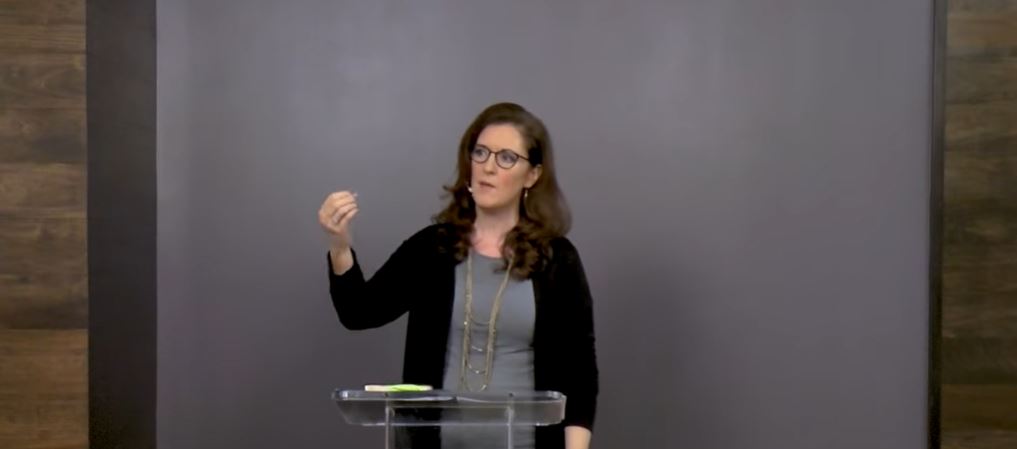
From Atheism to Faith: The Story of Mary Jo Sharp

“I really didn’t have a view of God, and I wouldn’t have thought to gain one or why a person should want to gain one. It just wasn’t on the radar”

Mary Jo Sharp grew up in a secular home. Her parents didn’t go to church. Her community in Portland, Oregon was post-Christian, and she didn’t even know people who claimed to be Christian.

She was aware of Christianity in culture, but she didn’t have any firsthand contact with Christian culture. Her parents weren’t’ religious, and they didn’t go to church.

Her father was a “huge Carl Sagan fan”, and she was influenced by his love for science, outer space and nature. She was influenced almost exclusively by a materialist worldview from a young age – the view that reality consists only of what we can see, hear, feel, touch, and taste in the material realm. (There is no other “realm”.)

Materialism was the theme that ran through the TV shows on science and nature that her father would watch. “This was the background that formed my view of reality,” says Sharp, “I really didn’t have a view of God, and I wouldn’t have thought to gain one or why a person should want to gain one. It just wasn’t on the radar”

She says she didn’t know that the materialist view is only one view among other views on the nature of reality. She says, “It’s just what I was exposed to.” She didn’t know any other way to view the world and reality.

The Christians she would later meet seemed “nice and innocuous”, but she predisposed to be wary of them from the exposure to Christianity on television. Her view of religion was also shaped by her knowledge of a cult at a compound in her area that attempted a bio-terrorist attack on nearby cities, using salmonella to poison people. Therefore, she says,

“I had a lot of misgivings about what religion was, who God is or was. I didn’t understand what religion was for. It seemed like the kind of thing people did because they were raised that way, and I wasn’t.”

Mary Jo Sharp was an atheist from as young as she can remember. Atheism to her was normative. She had a good life. Her parents loved her. She loved science. She loved music. She had no needs that might drive her to religion for comfort.

Her primary exposure to religion was in the myths of ancient religions. She says, now, that she had a kind of “chronological snobbery”, believing that she was more “progressed” than other people who still had vestiges of a religious faith. She felt her family was better than others who still clung to religious myths.

There was no crisis in her life. She saw herself as a good person. “I had it together,” she says, but one thing opened a door (just a crack) to the possibility that reality was more than she supposed.

She was becoming aware of the wonder of the world, and that wonder caused a subtle tension in her materialist assumptions. She felt wonder at sunsets and mountain ranges and music that she couldn’t explain on the basis of her view of the world as the product of random and meaningless matter and energy.

Things were about to change for her when a person she respected in her life gave her a Bible. She “didn’t receive it well”, but the timing was fortuitous because of the subtle questions that were beginning to occur to her prompted by wonder.

She didn’t have a source for answering the questions she had. She didn’t have philosophy training to help put her questions into context because her public school education did not include training in critical thinking or how to tackle the big questions of life.

Though she didn’t react well to the gift of a Bible she received one day, she read it. Reading the Bible opened her mind up to possibilities she hadn’t considered before.

She says, “I was really caught off guard because it wasn’t what I expected.” She was experienced in reading mythology from the Samarians, Greeks, Egyptians and Native Americans, but the Bible stood in contrast to those mythological writings. “As I was digging into the Bible, it was nothing like that…. It sounded more report-like.”

She realized, of course, that some portions of the Bible are poetic. Other portions of the Bible, however, like Luke, read like reports of factual things. Those portions of the Bible include many details of places, times, people, happenings, etc. On reading Luke, she recalls, “It sounds like he was just trying to report what was going on.”

That “shook” her because the Bible seemed to be written by people who were just trying to convey what happened. It didn’t read like mythological stories made up with the primary purpose of conveying moral lessons, as the writings with which she was more familiar.

Continue reading “From Atheism to Faith: The Story of Mary Jo Sharp”