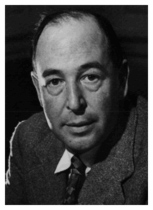
 The death of C.S. Lewis was eclipsed by the death of John F. Kennedy on the same date in history. Ironically, Aldous Huxley also died on that date in 1963. Unlike the overshadowing at his death, the life of C.S. (Jack) Lewis and the legacy of his writing and thinking endures. He is perhaps better known today than even during his life.
I have always been enamored of C.S. Lewis. He became a Christian in the secular environment of academic pursuit at Oxford. I became a believer in college in the same type of environment, though hardly of the same high academic and intellectual standard. His autobiographical book, “Surprised by Joy,” stands as a favorite book for me, and one which has become a waypost in my own life. It can be a tough read, not only for the enormous detail of classic and philosophical references, but for the somewhat self-indulgent inward looking preoccupation of the author – but, after all, it is an autobiography.
For me, the importance is not in what he did, but in his journey of thought. Lewis was an uncompromising thinker who diligently, methodically, and with integrity and brutal honesty, journeyed from childish religiosity, past the death of his mother, where the emptiness of religion without connection to the Living God is found to be wholly wanting. From there he careened to the opposite shore, finding comfort in the grim, cold world of materialism, exactly for the reason that no Cosmic Interferer dwells there to bother a fiercely independent soul.
Lewis was nothing if not driven to seek ultimate truth through the enormous volume of reading material that he devoured with relish. He traveled the path of logic and truth, tested by personal experience, through the various stages of his journey, which he described as a search for “Joy”. Lewis read the classics in the actual Latin and Greek and went from genre to genre and era to era tracing the breadcrumbs of literary history left by the greatest of the great writers. Through the cold air of atheistic materialism in his early twenties broke the warm sunlight of Christian thought from writers like G.K. Chesterton along with the fluorescence of the occult. From the unlikely combination of these sources, the possibility of the miraculous and magic pierced the hard shell of purely rational and materialistic thought. It was not long thereafter that Lewis abandoned the barren ground of atheism for the swampy soil of agnosticism.
Lewis says that he was tempted by the occult, but he was also fearful of it, like a person who does illicit drugs but has enough sense to know the line not to cross. He rejected that path even before finding his Destination in the same way he rejected physical lusts and other temptations. He found them ultimately to be counterfeit, substitutes for the real Joy of which he had gotten glimpses at different points in his life. This Joy became his measure for what he sought. He described it variously, but perhaps best, as a longing that in the longing was the most fulfilling of experiences one could know. It was for Lewis an inner compass pointing true North.
The new atheist has no prior claim to the ground Lewis Lewis already traversed with his academic mentors who were firmly and rigorously entrenched in rationalistic, materialistic thought. Peering through the prism of the greatest thinkers from every age, he found it ultimately one dimensional. Lewis trusted the “inner man”, the individual conscience and personal experience, guided as it were through the various veins of thought, testing each one in turn for dependability, harmony with the amalgam of ideas sifted through many ages and many thinkers and, not the least, as reflected through the natural world itself. Of this last strainer of thought, Lewis would echo the writer of Romans (1:20):
“For since the creation of the world God’s invisible qualities—his eternal power and divine nature—have been clearly seen, being understood from what has been made….”
From the abandonment of atheism for the more plausible, but uncertain, reality that there lies behind the veneer of this material world a Source of that Joy that became his fixed pursuit, Lewis journeyed into the realm of belief again, much the wiser and.
He does not spend a great deal of time describing his examination of the gamut of religions before landing on the steps to the House of the God of Abraham, leaving the impression that his pace from atheist to agnostic to Christian accelerated along the way, as if he found the guideposts clearly marked and the compass firmly fixed as he emerged.
Lewis does not spare himself in the chronicle of this journey. In fact, he is almost surgical, in the most intimate way, in his analysis of the various stages of his thought life, not holding back any information, however self-deprecating. In this way, Lewis demonstrates well the wisdom he gained along path: that the worst of the attitudes, and the furthest from God – the Source of Joy – is human pride.
His conversion is almost anticlimactic. He simply gives in one day to the only proposition left at the end of this long journey. Like the Psalmist who said, “Where can I go from your presence? Where can I flee from your spirit?” (Psalm 139:7), Lewis had nowhere else to go; the trail led to one Place only and only one: the God of Abraham, Isaac and Jacob – God the Father, God the Son and God the Holy Spirit.
Though some claim that Lewis never had a true conversion (and how would they know?), the rest of his life from this submission to God at the age of 31 bespeaks a man who came to rest solidly and squarely on the foundation of the Bible, the cornerstone of which is Jesus Christ. It became his defining Truth, the Compass for all future thought, and the filter through which the body of his written work clearly flows. That he wrote of fantastical creatures and magic and used imagery that is often accused of being occultist is a product of his enormous memory bank of all the great writings in history. He conjured up these things, like the classic and romantic writers – Milton and others, Christian or not – who borrowed from the same historic library of great writings.
These images are allegories, and Lewis was a master of allegory. For Lewis, the myths of all ages reflected truth, like shadows dancing on walls from the bright sunlight through prison bars, but the sunlight is Christ.
Of the fact that he brought all these images into submission to God, I have no doubt. This was the world Lewis knew, and this world of knowledge he used as a prism to show in radiant color the truth and the light of the Gospel – Jesus Christ, and him crucified, dead, buried and resurrected, the hope and salvation of all mankind to as many as will believe, offering grace for sin, life for death, having made the way for men to be made right and to have fellowship as sons and daughters with God the Father – the Source all Joy.
What Lewis learned early, and what led him on his journey, was not to settle for a false joy, which is merely a shadow of the real Thing. What he discovered is that the real Thing is not the joy, itself. The Joy he experienced resulted from close encounters with the Living God – catching glimpses of the Creator of heaven and earth – who reveals himself to the man who searches, who opens the door to the man who knocks, and who is found by the humble and submitted heart. The real Joy is found in God Himself. Joy, the experience, is only the shadow; God is the Source.
I recommend Surprised by Joy to anyone who likes C.S. Lewis or would like to follow his journey. Here is another take on this underrated classic by Dr. Bruce L. Edwards, English professor at Bowling Green: http://personal.bgsu.edu/~edwards/surprised.html; and for a collection of thoughts and essays on C.S. Lewis: http://personal.bgsu.edu/~edwards/lewisr.html.




 Navigating by Faith