The best scientific data and analysis that we have today leads to the conclusion that the universe we live in began a finite time ago. That understanding, however, was far from evident just 100 years ago. In fact, most scientists, then, believed the universe always existed (the Steady State Theory).
Evidence that suggested to the contrary, that the universe is expanding (and therefore had a beginning “point”), was not received enthusiastically. Even the people whose discoveries led to that conclusion resisted it. Einstein famously added a cosmological constant to his equations on general relativity to avoid that conclusion.
Such was the commitment in the scientific community to the “Steady State” theory: the theory that the universe always existed infinitely in the past.
Indeed, that evidence unfolded like a “big bang” that blew apart the previous scientific consensus. Thus, the “Big Bang Theory” theory of an expanding universe from a “point” of beginning was coined, perhaps, more for the effect it had on the scientific community than as a descriptor of the occurrence. (See Is the Big Bang finally Over?)
Though the evidence continues to substantiate the view that our universe is expanding (and therefore had a beginning a finite time ago), I have often been aware that science is provisional. Just when we think we know something, something else comes along to change the paradigm. The recent history of physics and cosmology is a case in point.
A primary reason that the Big Bang Theory landed so hard in the scientific community is because it challenged more than the accepted science. It challenged the prevalent worldview of the scientific community since the Enlightenment.
Since the days of Darwin (and even before Darwin), people in the scientific community had been advocating for separating science from religion. When Darwin proposed evolutionary theory (natural “selection” acting on random changes), the scientific community was more than ready to use that “key” to unlock what they viewed as the “shackles” of religion.
The Steady State Theory, that the universe always existed infinitely in the past, was the natural assumption of scientists based on a worldview with no God and no religion at the center of it. Life was good for the proponents of naturalistic materialism until the specter of a beginning to our universe (and the real possibility of a “Beginner”).
That many people have managed to keep that specter at bay despite the strong evidence that gets stronger as time goes on that our universe is expanding is a testament to the faith some people have in naturalistic materialism. Never since before the Enlightenment, however, has science been so harmonious with the Bible and belief in God.
Even so, I have often wondered: what if the paradigm shifts again? What if new evidence is discovered to upset the apple cart again? What if that new evidence begins to cut against the grain of the Big Bang Theory and reinvigorates the Static State Theory?
What if the new evidence shows what Einstein and most other cosmologists and physicists believed 100 years ago? That our universe is past eternal; that it is not expanding after all; or that the earth is expanding, but that the expansion is not proof of a “singularity” (beginning)?
Indeed, this is what many preeminent scientists have been trying to prove since the scientific world conceded the evidence of the apparent expansion and singularity of our universe.
Would Christians, like myself, and other theists simply cling to faith without evidence? Would we cling to our faith “in the teeth of the evidence”, as Richard Dawkins has charged?
I wasn’t sure before today. As I was listening to Return of the God Hypothesis by Stephen C. Meyer on Audible, an answer to my question began to materialize. I will attempt to summarize it.
I previously wrote on the subject of the James Webb Telescope and the headlines claiming that recent discoveries call the Big Bang into question. (Is the Big Bang finally Over?) The Big Bang theory is a theory based upon the fact that we have an expanding universe, and the fact that we have an expanding universe suggests that it is expanding from a point in time. The Big Bang theory that the universe is expanding from a point of beginning some finite time ago is alive and well, but the standard model(s) developed to explain how the expansion we see is being called into question by the James Webb discoveries.
I didn’t go into technical detail about why the evidence for an expanding universe remains solid, mostly because I am not physicist, or even a “science guy”. I am interested in science and try to keep up with certain areas of science because they interest me, but I am not educated or trained in the sciences.
Today, however I heard an explanation for why the James Webb discoveries do not undermine the basic Big Bang principal, that the universe is expanding, that was simple and clear and worth repeating (if for no other reason than for me to remember it).
In conversation with Joe Rogan on his podcast, Stephen Meyer explains why the James Webb Telescope discoveries do not undermine the basic premise of the Big Bang theory. To understand this, we need to understand how the James Webb Telescope is constructed to observe matters in space further away from us than we have observed before.
We also need to understand the evidence for an expanding universe because the James Webb Telescope incorporates design elements that take advantage of the phenomenon that gives us proof of expansion in the universe. That evidence was discovered in the 1920s, and it provided the first evidence that the universe is expanding, and not static as was thought up to that point.
I will quickly explain that first evidence for an expanding universe. Then I will explain how the James Webb Telescope’s design is based on this evidence (thanks to Stephen Meyer in his conversation with Joe Rogan), and then I will explain how the success of the James Webb Telescope actually proves the basic Big Bang principal – that the universe is expanding.
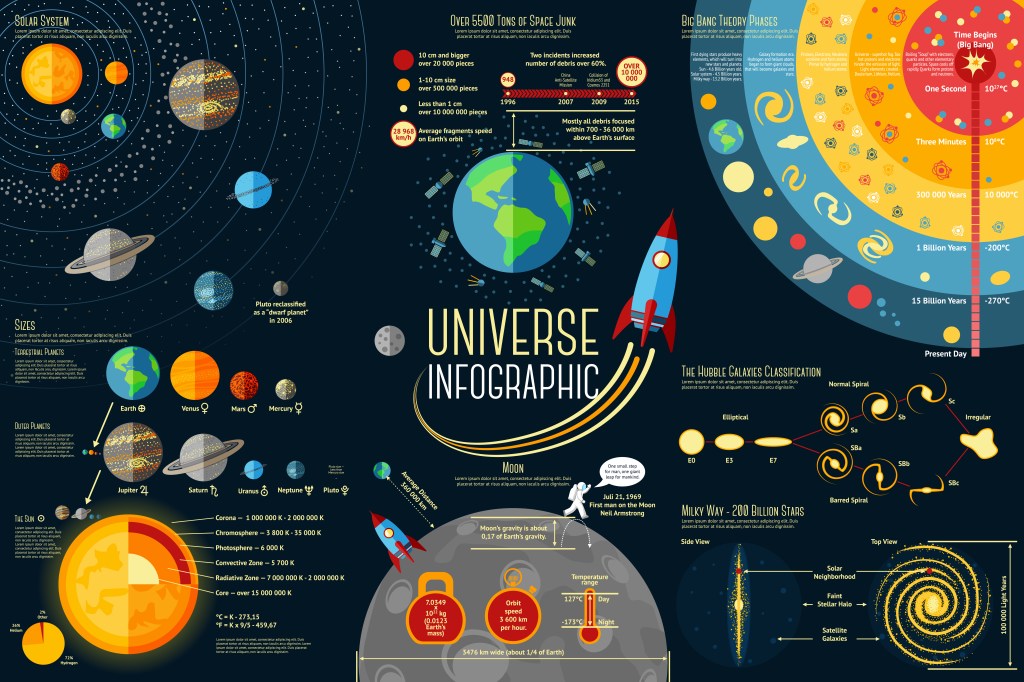
Set of Universe Infographics – Solar system, Planets comparison, Sun and Moon Facts, Space Junk made by man, Big Bang Theory, Galaxies Classification, Milky Way description. Vector illustration
The question that forms the title of this blog article is the subject of a recent video on YoutTube. I am embedding the video here so you can watch and listen for yourself. The suggestion, however, that the James Webb Telescope is disproving the “Big Bang”, is overstated. You might even call it clickbait!
Before launching into my thoughts on this, however, what is meant by the “Big Bang” needs to be defined. The terminology is credited to Fred Hoyle. When Hoyle coined the phrase in a 1949 a talk on BBC Radio, he was probably speaking tongue in cheek.
Hoyle (like most scientists of his age) had long believed in a steady state universe. The new evidence indicating that the universe is expanding was like a big bang to them. It rocked the long-held view that our universe is static and unchanging.
The laws of physics seemed immutable. Why wouldn’t scientists believe the universe was equally immutable?
That the evidence that the universe is expanding was unsettling to the accepted “science” at the time is an understatement. As Hoyle was describing the then recent discoveries and the theories that derived from that evidence, he said:
“These theories were based on the hypothesis that all the matter in the universe was created in one big bang at a particular time in the remote past.”
Because these discoveries came as a shock wave to scientists in the first half of the 20th Century. the term, “big bang”, may have been used to characterize how those discoveries were received!
The evidence that the universe is actually expanding raised the specter that the universe isn’t static, and it might even have had an origination “point”. This realization that the universe may have had a beginning wasn’t lost on scientists at the time, and it wasn’t eagerly received.
The term didn’t really “stick” until the 1970’s, and it isn’t really a good descriptor for what we (think we) know happened. It probably wasn’t a “bang” for instance, because no sound was likely generated. The history of the development of this evidence is interesting and can be found on Wikipedia.
The Big Bang does suggest a beginning to the Universe (to put it bluntly). This possibility, of course, has theological implications, another realization that wasn’t lost on scientists who largely viewed the universe through a materialistic lens. That possibility was largely downplayed then, and many scientists have continued to downplay that possibility.
We still don’t have evidence that reveals how the universe was formed. We can’t see back that far, and doubt exists whether we ever will be able to see back that far. As the Wikipedia article states: “[T]he Big Bang model does not describe how energy, time, and space were caused, but rather it describes the emergence of the present universe from an ultra-dense and high-temperature initial state.”
The current suggestion that the James Webb Telescope is disproving the “Big Bang” (the implication of an expanding universe with a “beginning”) comes from people who would like to downplay the implication of an expanding universe with a beginning, and it seems to be more wishful thinking than reality.
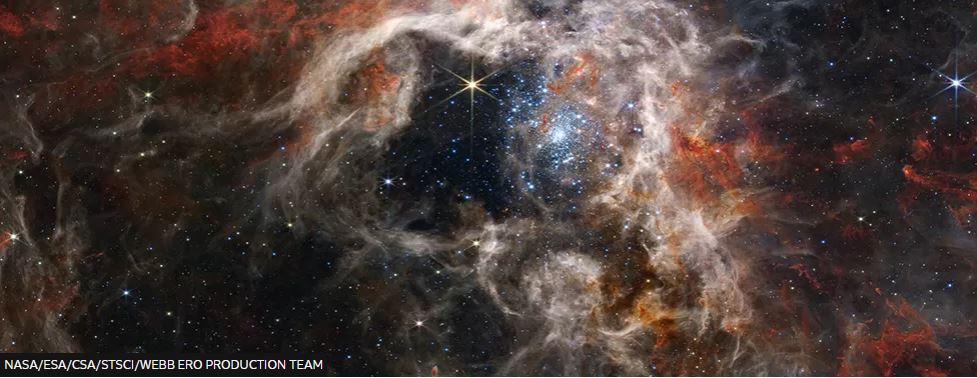
The James Webb discoveries fueling this resurgence in old thinking include images of old stars and galaxies that are more formed than they should be on our standard (Big Bang expansion) model of the Universe. The standard Big Bang expansion model is similar to the concept of evolution. If the universe expanded, it must have progressed from a simpler state to a more complex state.
Just as life began with a simple, self-replicating molecule and progressed to ever increasing complexity over a long span of time, the thinking has been that the universe must have developed in the same progressive sort of way. This is the paradigm that has driven much of modern science: that natural processes developed from the bottom up.
The new James Webb images reveal more highly developed stars and galaxies than we imagined would exist in the earliest stage of the universe on the standard model. The mature development of ancient galactic stars and star formations is surprising on the progressive view.
These images do not contradict the fact that the universe is expanding, however, and they don’t disprove the appearance of a “beginning”.
People are “surprised that things grew so quickly”. People are perplexed that stars and galaxies are so well-formed at such an early stage, when they would expect to find “fledgling” galaxies in more undeveloped states.
People are scratching their heads at the appearance of extremely small and extremely large galaxies in the early Universe because it does not comport with the progression of the expansion of the Universe as modern scientists have modeled it before the advent of the James Webb Telescope.
These observations have nothing to do with the evidence that the universe is expanding. A more accurate statement is that models for how that expansion occurred are being called into question: not the fact of expansion from “a point of beginning”.
The James Webb findings do not negate the evidence we have that our universe is expanding from some very dense “point”. If anything, the findings evoke even more theological implications, perhaps, than the standard Big Bang model.
The idea that the universe developed from simple to complex over time is difficult to maintain when stars, galaxies, and other formations in the farthest (and earliest) regions of the universe that we can see are so well-formed and “mature”. These things conjure up the specter that this evidence is more consistent with the idea of the universe being created than we previously thought.
Of course, we had clues that this should be not surprising to us: the standard expansion inflation model incorporates the assumption that an early, extremely rapid and short “burst” of expansion occurred, and this assumption was necessary to accommodate the short time frame in which the Universe appeared to have “developed” based on what we could see before the James Webb telescope. Perhaps, then, we shouldn’t be surprised to find even greater “development” at earlier stages.
We shouldn’t be surprised either that modern scientists who are committed to a materialistic worldview are struggling with these things. A materialistic worldview has colored modern science for a couple hundred years, at least.
A materialistic worldview was perfectly at home with the old static state view of the universe. It took a hit with the evidence that the universe is actually not static, but expanding from a point of beginning, though materialist thinking held firm, and most scientists have continued to hold to a strictly materialist position.
Stephen Hawking and Roger Penrose famously calculated “singularity” that “proved” the so-called Big Bang (that expansion necessitates a “beginning”). Vilenkin (and some other guy who I can’t remember, lol) determined that even a multiverse that is expanding would have to have a “singularity” (a euphemism, it seems, for a beginning).
So far, modern discoveries have continued to negate good reason to believe in a static universe (which theory was discarded after centuries of use when we found that our universe is expanding) or an oscillating or cyclic universe. Multiverse(s) seem to make sense theoretically, but we will likely never be able to prove it/them anymore than we are likely to see back before the “beginning” of this universe.
Scientists like Neil de Grasse Tyson, Hawking, and Penrose who are committed to finding explanations for these things that do not implicate a Beginner (a/k/a God), will likely continue to try to prove their point. Hawking spent much of the rest of his life after mathematically proving the “singularity” trying to get around “singularity” and its theological implications. Penrose (and Vilenkin) do not concede any theological implications either.
Nothing (much) has changed on that score, but the new james Webb images are certainly is producing some head scratching! Some scientists, like Hoyle, who were once very antagonistic about people drawing theological implications from cosmology have backed off their dogmatic stances. Penrose seems to concede the possibility of a legitimate “metaphysical” component to reality, though he “doesn’t go there” in his own thinking.
There certainly is a lot of head scratching going on, and these are interesting times. We may all be at the edges of our seats to learn where all of this will take us, though I strongly doubt that we will get definitive answers to our most fundamental questions, like the origin of the Universe in my lifetime – if ever.
The new discoveries do call into question the expansion models that scientists have developed, but they do not call into question the evidence that the universe is, indeed, expanding. The new discoveries do not align with they way scientists have believed the universe expanded, but the evidence that the universe expanded from a “point” of singularity remains solid.
The creator of the YouTube Channel, Science Uprising, does a good job with the production of Big Bang: Something from Nothing, both in the technical aspects of the video and its content. (Linked below in the body of this article) The mask is a nice, dramatic touch.
The mask has taken on a meaning of standing up to tyranny in countercultural circles, and that meaning is not lost in the video. Popular science promoters of the atheist stripe in recent years have been aggressive in trying to squelch the idea that faith and science can live together. This YouTuber is having none of it!
Indeed, the effort seems to have spurred on and inspired many believing scientists in recent years, like some of the people who appear in this video, pushing back against the New Atheist mantra. Not only do science and faith fit together like a hand in a glove; non-theism seems to be pulling at the fringes of credibility to walk back the determination that the universe had a beginning a finite time ago.
The so-called “Big Bang” or “singularity”, as Hawking called it, has proven problematic for the scientist who wants to remain a materialist. The implication of a Beginning from the fact that there was a beginning to matter, space, energy and time is a conclusion that Einstein didn’t want to face, though his theory of relativity suggested it.
He came around, and so have almost all scientists today, albeit reluctantly for many who thought that science buried God years ago. This is not to say that all scientists have come around to believe in God.
Hawking, who proved singularity mathematically, spent much of the rest of his life trying to avoid the inevitable conclusion that his math confirmed. Multiverses would be his answer, though they are no more provable by science than a creator.
Science hasn’t buried God. Science once was universally viewed as the study of the universe God created, and many scientists take that view, still, today. I know a number of atheists who became believers mainly through science. The dogma of the New Atheistm is turning brittle as time wears on.
These are just some of the things I think about as I view this short, but well done, video:
On a typical Sunday morning, I am contemplative, thinking about God, the nature of the world and other ultimate things. I have gotten home from church. The distant rumbling of thunder portends more rain to add to the buckets (more like vats) that came down earlier this morning. (We’ve had an unusual amount of precipitation in the Chicago area for about a year now.)
Though sunlight threatens to break through the clouds, despite the rumblings to the contrary, it’s a good day for reading and thinking.
In that vein, I read an article from Forbes magazine that came up in my Google feed: Ask Ethan: Can We Really Get a Universe From Nothing? Ethan, is Ethan Siegel, a Forbes contributor. He is an astrophysicist, author and “science communicator” according to the short bio at the end of the article.
It just so happens that I spent my Friday evening this week with another astrophysicist, Hugh Ross, a brilliant man who is a Christian, and also a man of science. In fact, it was science that led him to his belief in God. But I digress. (You can hear the story of how science led Hugh Ross to God in his own words here.)
My meeting with Hugh Ross isn’t really relevant to the topic, other than the fact that our conversation got me thinking about science and ultimate things, things that science doesn’t really address (or hasn’t yet answered). Does God exist? Where did the universe come from?
The article suggests an answer to one of those ultimate questions: where did the universe come from? It suggests that the universe didn’t really come from nothing – at least not the kind of nothing that we usually imagine when we think of nothing. It entices the reader with a title that suggests an ultimate answer, but it doesn’t deliver.






 Navigating by Faith