Is the Darwinian Paradigm Exploding?

The Cambrian Explosion isn’t the only evidence of the sudden appearance of life forms.

Alright, I admit the title of this short article is a bit provocative, but I got your attention. I would actually say the Darwinian paradigm is going through something more like an evolution. The explosions are not in the paradigm, but in the facts that have been slowly uncovered in the fossil record since Darwin championed the evolutionary paradigm.

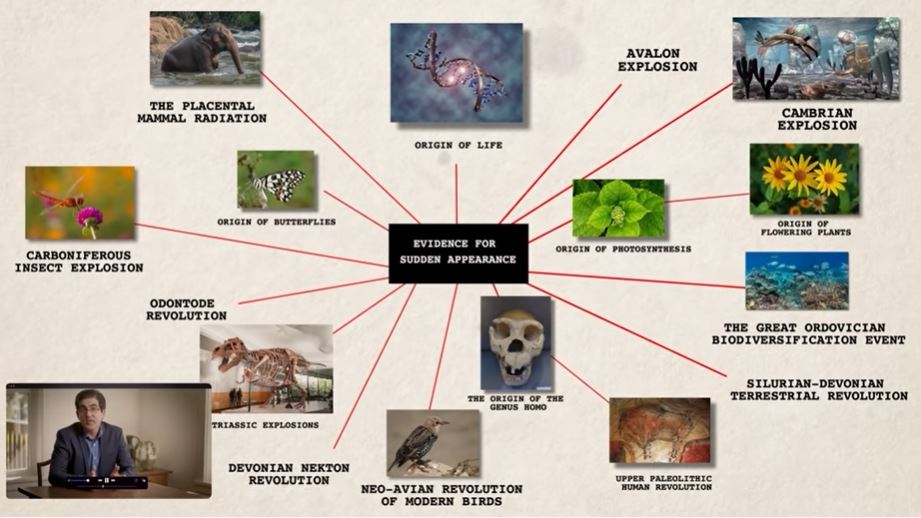
The short video at the end of this article produced by Science Uprising alludes to a number of “explosions” that elude a Darwinian explanation. Paleontologist Günter Bechly, summarizes,

“The phenomenon of sudden appearances in the fossil record is not just an exceptional case, but actually is a pattern that is found everywhere.”

The obvious example is the Cambrian explosion in which most of the phyla that exist today appeared in the blink of geological time, in a mere five to ten million year window. Charles Darwin, himself, acknowledged the problem the Cambrian Explosion posed for evolutionary theory, but he expressed confidence that future fossil discoveries would fill in the gaps and provide evidence of the precursors to the Cambrian life forms.

Since Darwin’s day, the gaps have not been filled by subsequent discoveries. Rather, the gaps have widened, as Stephen Meyer recounts in his book, Darwin’s Doubt. To make matters worse for the Darwinian paradigm, the Cambrian Explosion isn’t the only evidence of the sudden appearance of life forms. Other examples are numerous, including:

Technical scholarship is replete with the recognition of explosions (radiations or revolutions) of insects, fish, birds, dinosaurs, mammals, and the “big bang theory of human evolution” with no credible transitions in the fossil record. Many scientists, though continue to look for the precursors and clues to plug in the evolutionary gaps.

It seems that the evolutionary paradigm, which arose abruptly and transformed science overnight, is very slow in adapting to new information as it is uncovered. Not that we should be overly critical of the painstakingly slow progress. Science is slow and methodical with intention.

Explosions, though, such as the relatively sudden rise of Darwinian theory, may give way to equally sudden corrections, kind of like the mass extinction events that give way to new “radiations” or “revolutions'” in life forms. For more on the “time crunch” facing evolution, watch the short video that follows.

Clearing the Rubble of Hume in the Making of an “Unapologetic” Argument for God

Hume’s argument against miracles seems to be more of an exercise in satire than a sincere exercise in reasoning.

I have been trying to clear the way for an “unapologetic” argument for God. I am four articles in, and still making me way to the beginning. Standing in the way as I move forward is Hume’s standard of proof for miracles.

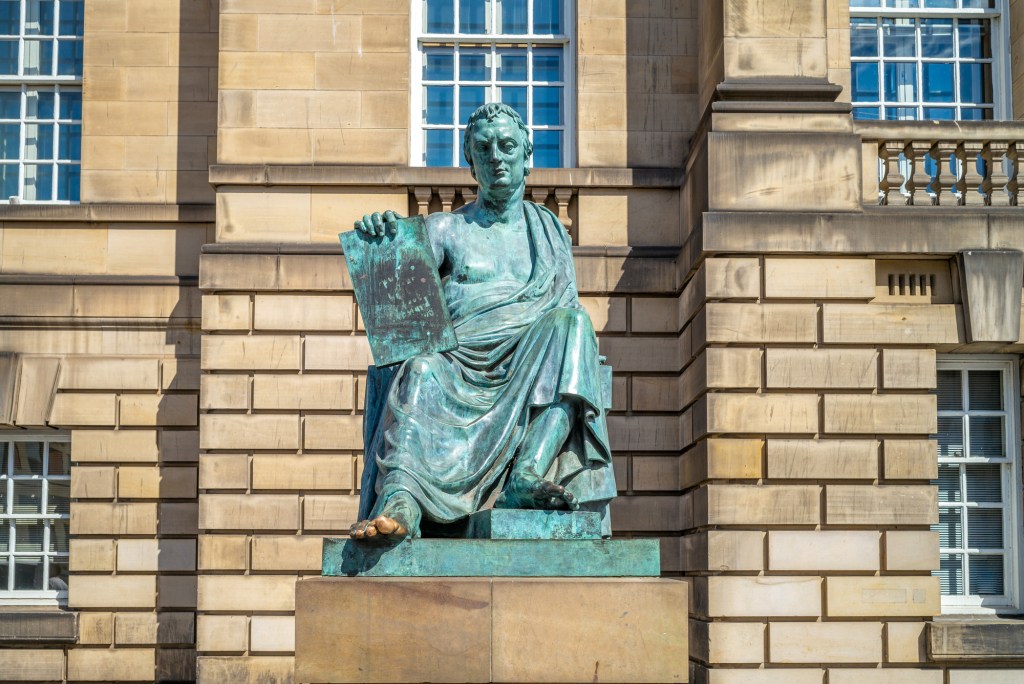
David Hume has had a profound influence on Western thought in the promotion of the Enlightenment view, which values human reason as the supreme measuring stick. Hume’s argument against miracles has been viewed as a gold standard among proofs that Christianity is not credible, especially to the extent that Christianity stands on the foundation of a miraculous event – the resurrection of Jesus.

Hume does not hide his antipathy for Christianity.[1] He calls the “Christian religion” a doctrine “so little worthy of a serious refutation … founded merely in the testimony of the apostles”. He labels belief in Christianity “arrogant bigotry and superstition”.

Hume speaks of the “greediness” with which “miraculous accounts” are received. He characterizes the “religionist” as “an enthusiast who sees no reality”, whose vanity is excited by strong temptations and self-interest to promote narratives he knows to be false for what he deems to be a “holy cause”. Hume accuses religionists of renouncing judgment by principle and losing grip on judgment by “passion and a heated imagination”.

Hume blames the popularity of religion on a “strong propensity of mankind to the extraordinary and the marvellous”. Hume’s disdain carries over from his view of “the generality of mankind” emerging from “ignorant and barbarous nations” who he says are fools … industrious in propagating the imposture” of the “supernatural and marvellous”, the “grossest delusions”, and “delusive prophecies”.

Hume rails on the religions “of ancient Rome, of Turkey, of Siam, and of China” equally. He lumps together the testimony of “a few barbarous Arabians” about Mahomet with “Titus Livius, Plutarch, Tacitus, and… all the authors and witnesses, Grecian, Chinese, and Roman Catholic, who have related any miracle in their particular religion”.

Me thinks he doth protest too much.

The standard Hume created to determine the veracity and credibility of a miraculous account contains the poison of his passionate convictions – a passion that smacks of the same kind of bias he accuses the “religionist” of committing. Yet, that standard has adherents today, perhaps because he reduces it to mathematical proportions that have the appearance of sacred science. Hume says,

“A hundred instances or experiments on one side, and fifty on another, afford a doubtful expectation of any event; though a hundred uniform experiments, with only one that is contradictory, reasonably beget a pretty strong degree of assurance. In all cases, we must balance the opposite experiments, where they are opposite, and deduct the smaller number from the greater, in order to know the exact force of the superior evidence.”

He acknowledges the importance of eyewitness testimony, but he imposes a standard on it that diminishes the value of any eyewitness testimony that contradicts widely established human experience. This seems reasonable on its face. “Marvelous” assertions are suspect; miraculous ones are even more suspect.

I think most of us can “go there” with him. On miracles, Hume says.

“A miracle is a violation of the laws of nature; and as a firm and unalterable experience has established these laws, the proof against a miracle, from the very nature of the fact, is as entire as any argument from experience can possibly be imagined.”

In one sense, Hume is merely acknowledging the nature of a miracle: it is a miracle that goes against (or seems to go against) the laws of nature that are commonly recognized and the weight of common experience. Nothing would be considered a miracle that was common to the experience of people, even if that experience is relatively uncommon among human experience. He reasonably says,

“There must, therefore, be a uniform experience against every miraculous event, otherwise the event would not merit that appellation.”

Hume, though, is not content to relegate miracles to the rarity they are by definition. He proceeds to define them out of the realm of possibility:  

“And as an uniform experience amounts to a proof, there is here a direct and full proof, from the nature of the fact, against the existence of any miracle; nor can such a proof be destroyed, or the miracle rendered credible, but by an opposite proof, which is superior.”

Perhaps, wanting to appear open-minded, Hume allows for some proof that might establish a miracle. The proof of a miracle, Hume says, must so weighty “that its falsehood would be more miraculous, than the fact, which it endeavours [sic] to establish”.

Even then, Hume says, such counter-balancing evidence only levels the scales; it doesn’t make the factual assertion of the miracle more likely than not (and rejection of the assertion of a miracle would be justified either way).


Hume says, the mere testimony that a miracle occurred should be dismissed out of hand unless the falsehood of the assertion would require believing the miraculous, itself.

Hume seems to assume the possibility of such corroborative evidence, but a simple application of math belies the lack of substance he saw in anything miraculous. Nil plus nil equals nil.

As Hume’s approach is a mathematical one, we can see by the application of math and the value Hume has given to the miraculous the impossibility of establishing proof of a miracle on Hume’s position. The likelihood of proof is nil.

Indeed, he sets his bar so high and makes the requisite proof so onerous that a miracle would be required to prove a miracle. Lest there be any doubt about the meaninglessness of Hume’s standard, he admits:

“I beg the limitations here made may be remarked, when I say, that a miracle can never be proved….”

Hume is saying that miracles cannot be proven by any amount or kind of evidence.

For this reason, Hume’s argument against miracles seems (to me) to be more of an exercise in satire than a sincere exercise in reasoning. I am surprised, therefore, that we take him at all seriously. To give further illustration and to remove all doubt about his pretense, Hume seems to beg the question in the following example:

“But suppose, that all the historians who treat of England, should agree, that, on the first of January 1600, Queen Elizabeth died; that both before and after her death she was seen by her physicians and the whole court, as is usual with persons of her rank; that her successor was acknowledged and proclaimed by the parliament; and that, after being interred a month, she again appeared, resumed the throne, and governed England for three years: I must confess that I should be surprized [sic] at the concurrence of so many odd circumstances, but should not have the least inclination to believe so miraculous an event.”

The fact that people still take him seriously, though the blunt force of his conviction seems stronger than his argument, is one reason I address him here.

Continue reading “Clearing the Rubble of Hume in the Making of an “Unapologetic” Argument for God”

How Not to Look for God: An “Unapologetic” Argument for God

In two previous articles attempting to make an “unapologetic” argument for God, I have just been ramping up to make the argument. I still haven’t gotten there yet, and I am still just getting started.

That’s right. I am still working on getting to the starting line. Maybe I will still get there.

I say, “unapologetic”, rather loosely, in case you are wondering.  I am not being apologetic in the sense of apologizing for anything. Apologetics has nothing to do with being sorry, of course. It means to provide a defense, and it specifically describes the effort of providing a defense for Christianity.

The word, apologetics, derives from the Greek word, apologia, which means “a speech in defense” or a “verbal defense” or a “well-reasoned reply”. The world is used in Peter 3:15 as follows:

“Always be prepared to give an answer [apologia] to everyone who asks you to give the reason [logos] for the hope that you have.”

I am using “unapologetic” as a kind of play on words. I am not giving a typical apologetic argument for the existence of God, and I am not being apologetic about doing that.

I previously made the observation that we all start with axioms, premises on which we support our positions for and against God, but we are incapable of proving those axioms. We consider them “self-evident”, but that is, frankly, just another way of saying that we can’t prove our starting premises” we have to assume they are true, and we go from there.

We take our fundamental premises on faith, essentially. This includes everyone, even in science.

As an example, consider the scientist, like a few I have heard, who says that science is the only way to know truth and all truths can be revealed by science. That premise cannot be scientifically proven. Therefore, you just must take it on faith.

Ironically, that statement is also self-contradictory. If science is the only way to know truth, and the statement itself cannot be proven by science, then even if it is right, it is wrong! (Echoing John Lennox here.)

I recently heard the astrophysicist, Michael Guillen, say similarly that science does not prove anything absolutely. As an example, he says we could posit that ravens are always black. Every raven the modern world has ever encountered and documented may be black, but that doesn’t mean that every raven that ever existed and every raven that will ever exist is always black.

To make the claim that all ravens are black is to go beyond science. We can only verify the blackness of all the ravens we can find and the ravens that other people have documented, but we can’t verify the blackness of the ravens that were never documented or the ravens that have not yet existed.

William Lane Craig talks about the philosophy of logical positivism championed by people like AJ Ayer in the 1940’s and 50’s. Logical positivism, or “verificationism”, as Craig calls it, was claimed that consideration of the existence of God is meaningless because it is not verifiable by the five senses. The book, Language, Proof and Logic, was a kind of “manifesto” of this view, says Craig,

Verificationsim was used by Ayer to nix anything metaphysical. According to this view, a statement is only meaningful if it is capable of being empirically verified. Since metaphysical statements are beyond the reach of empirical science, they cannot be verified. Metaphysical statements were, therefore, dismissed out of hand. According to Craig,

“Ayer was very explicit about the theological implications of this verificationism. Since God is a metaphysical object, the possibility of knowledge was ‘ruled out’ by our treatment of metaphysics. Thus, there can be no knowledge of God.”

Do you see the problem with this view? One only need ask, “Is that statement capable of being empirically verified?”

Ayer’s view was built on an axiom he could not prove, and which could not be proven by the methods he arbitrarily limited according to the premise he assumed. His view could not even stand up to itself!

Craig says the collapse of verificationism was “the most philosophical event of the twentieth century”. The verification principal was not only unscientific; it was self-refuting. “The statement, ‘You should only believe what can be scientifically proven cannot, itself, be scientifically proven.’”

In the previous “unapologetic” articles, I claim that we all have to take certain things on faith, especially our starting premises, which are the tools by which we view and explore the world, but not all of those starting premises are created equal. Some of them cannot even stand up to themselves!

But, enough of that. I need to get to the point of this article.

It seems axiomatic that, if one wants to determine whether God exists, and if one is sincere in making that determination, one will not start with a premise that will inevitably result in the logic that God does not exist.

Continue reading “How Not to Look for God: An “Unapologetic” Argument for God”

From Atheism to Faith: The Story of Mary Jo Sharp

“I really didn’t have a view of God, and I wouldn’t have thought to gain one or why a person should want to gain one. It just wasn’t on the radar”

Mary Jo Sharp grew up in a secular home. Her parents didn’t go to church. Her community in Portland, Oregon was post-Christian, and she didn’t even know people who claimed to be Christian.

She was aware of Christianity in culture, but she didn’t have any firsthand contact with Christian culture. Her parents weren’t’ religious, and they didn’t go to church.

Her father was a “huge Carl Sagan fan”, and she was influenced by his love for science, outer space and nature. She was influenced almost exclusively by a materialist worldview from a young age – the view that reality consists only of what we can see, hear, feel, touch, and taste in the material realm. (There is no other “realm”.)

Materialism was the theme that ran through the TV shows on science and nature that her father would watch. “This was the background that formed my view of reality,” says Sharp, “I really didn’t have a view of God, and I wouldn’t have thought to gain one or why a person should want to gain one. It just wasn’t on the radar”

She says she didn’t know that the materialist view is only one view among other views on the nature of reality. She says, “It’s just what I was exposed to.” She didn’t know any other way to view the world and reality.

The Christians she would later meet seemed “nice and innocuous”, but she predisposed to be wary of them from the exposure to Christianity on television. Her view of religion was also shaped by her knowledge of a cult at a compound in her area that attempted a bio-terrorist attack on nearby cities, using salmonella to poison people. Therefore, she says,

“I had a lot of misgivings about what religion was, who God is or was. I didn’t understand what religion was for. It seemed like the kind of thing people did because they were raised that way, and I wasn’t.”

Mary Jo Sharp was an atheist from as young as she can remember. Atheism to her was normative. She had a good life. Her parents loved her. She loved science. She loved music. She had no needs that might drive her to religion for comfort.

Her primary exposure to religion was in the myths of ancient religions. She says, now, that she had a kind of “chronological snobbery”, believing that she was more “progressed” than other people who still had vestiges of a religious faith. She felt her family was better than others who still clung to religious myths.

There was no crisis in her life. She saw herself as a good person. “I had it together,” she says, but one thing opened a door (just a crack) to the possibility that reality was more than she supposed.

She was becoming aware of the wonder of the world, and that wonder caused a subtle tension in her materialist assumptions. She felt wonder at sunsets and mountain ranges and music that she couldn’t explain on the basis of her view of the world as the product of random and meaningless matter and energy.

Things were about to change for her when a person she respected in her life gave her a Bible. She “didn’t receive it well”, but the timing was fortuitous because of the subtle questions that were beginning to occur to her prompted by wonder.

She didn’t have a source for answering the questions she had. She didn’t have philosophy training to help put her questions into context because her public school education did not include training in critical thinking or how to tackle the big questions of life.

Though she didn’t react well to the gift of a Bible she received one day, she read it. Reading the Bible opened her mind up to possibilities she hadn’t considered before.

She says, “I was really caught off guard because it wasn’t what I expected.” She was experienced in reading mythology from the Samarians, Greeks, Egyptians and Native Americans, but the Bible stood in contrast to those mythological writings. “As I was digging into the Bible, it was nothing like that…. It sounded more report-like.”

She realized, of course, that some portions of the Bible are poetic. Other portions of the Bible, however, like Luke, read like reports of factual things. Those portions of the Bible include many details of places, times, people, happenings, etc. On reading Luke, she recalls, “It sounds like he was just trying to report what was going on.”

That “shook” her because the Bible seemed to be written by people who were just trying to convey what happened. It didn’t read like mythological stories made up with the primary purpose of conveying moral lessons, as the writings with which she was more familiar.

Continue reading “From Atheism to Faith: The Story of Mary Jo Sharp”

What Near Death Experiences Prove, and What They Do Not Prove

What if reality consists of more than the natural, physical world?


I am interested in peoples’ stories. I can trace my interest in personal stories to my own experience of becoming a Christian and my own spiritual journey. I have found much common ground with other people who have had similar experiences. The story of spiritual journey (a “testimony”) is part of the fabric of the evangelical Christian tradition. The testimony is a test of sorts of the authenticity of the journey, of a real encounter with God that we call being “born again”.

A testimony is the most personal evidence for the existence of God for the person who claims to be a Christian, but it isn’t evidence in a scientific sense. It’s evidence that is easily discounted by the naturalist who relies only on science and empirical, measurable and falsifiable evidence.

It can also be problematic for the Christian community. There is a certain social, group pressure – unintended, or not – for every Christian to have “a testimony”. The more dramatic the better. The person who was “always a Christian” may feel a tinge of self doubt. The person whose story does not line up with more “typical” testimonies may feel out of step.

Personal stories are subjective, and the subjective nature of them engenders some natural and warranted skepticism.

Don’t get me wrong. The intimate and private nature of a personal experience with God is exactly the most compelling thing about it. Like the woman at the well who told everyone of her encounter with Jesus – “Come and see a man who told me everything I ever did!” (John 4:4-30) – the intimate and highly personal nature of the experience is what makes it so meaningful and convincing.

But personal encounter, ultimately, is meaningful and convincing mainly to the one who experiences it. It can’t be empirically verified, and it doesn’t carry the same weight with other people who don’t have the same intimate connection to the personal details.

Personal experiences are not bound by logical, rational or empirical factors. If we rely on personal experiences, especially to the exclusion of more “scientific” analyses, the highly subjective and personal nature of personal experiences can led a person down some questionable rabbit holes. We probably all know people who have been so influenced by their own personal experiences which, unchecked by some objective analysis, have led them onto some strange and questionable paths.

For the Christian, that objective analysis is Scripture, doctrine and tradition. For each religion, that objective analysis is some combination of that religion’s scripture, doctrinal corpus and tradition, and for the naturalist, that objective analysis is empirical evidence, proven theory and scientific analysis.

This is where NDEs get interesting. Continue reading “What Near Death Experiences Prove, and What They Do Not Prove”