The Top 10 Navigating by Faith Blog Posts in 2020

Who would have imagined what was in store for 2020 on January 1?

I summarize the year in review on the Navigating by Faith blog about this time every year by doing a top ten rundown of the most read articles. I will do the usual thing, though this has been, undoubtedly, an unusual year.

I appreciate the readers and those who left comments along the way. I hope I have provided some food for thought for those who have joined me on my journey of faith, some inspiration, some encouragement and maybe a challenge to consider things from different angles.

Who would have imagined what was in store for 2020 on January 1? The year began like any other, full of hope, renewed commitments and anticipation for better things ahead.

I renewed my commitment, for the second year, to read through the Bible from beginning to end. This time I would read it chronologically (using a plan in the YouVersion app). Those daily readings became the inspiration for many things I wrote in 2020, but current events commanded the most attention from readers of the Navigating by Faith blog.

Rumblings began to be heard sometime toward the end of January and into February coming from the east. They were things we had heard before: a new virus of uncertain origin. We’ve heard scary rumors of flu, Ebola and other viruses in the past, so I didn’t suspect this one would be different.

Neither did Donald Trump, apparently, to the consternation of a growing cry of the usual voices demanding that he “do something”. Trump shrugged them off. Many people, I believe, did the same because everything in the last four years had become a new reason to criticize Trump. Even people who don’t care for Trump were getting tired of it.

Patriotic cries of freedom mixed with knowing voices of concern and criticism of Trump’s nonchalance intensified as the northwest was hit with the first waves of the corona virus (now known as COVID 19). Governors began to step into the leadership vacuum with mixed reactions.

On March 16, 2020, the world where I live (Illinois) shut down in the midst of increasing confusion, warnings, consternation and angst. This was something new. Something that had not occurred in my lifetime.

Freedom, anger, fear and unbelief clashed as the pandemic hit our shores and spread. For many months, though, it seemed like more of a story from a distant shore…. unless you knew someone. Now at years end, most of us know someone who has had COVID, and many of us know people who have died from it.

In March, though, people struggled to come to grips with a government-ordered “lockdown”. Some people were incredulous. Others panicked. Some horded toilet paper. Others scoffed and protested.

Still reeling from the impact of a global pandemic, the world exploded in May when another black person died at the hands of police. The video of a white officer kneeling on the neck of George Floyd, ignoring pleas from onlookers to relent, triggered a national reaction of anger and protest.

The impact of those two things, the pandemic and racial unrest, can be seen in the articles and readership in 2020. Posts relating to current events make up four of the top five most-read articles and 60% of the top ten articles.

Readership also soared as the world shutdown. The blog generated more views in March 2020 than any month since 2012 when the blog began. Readership in every month (but one) since then has exceeded the readership in March. Five months set new records, with the most views occurring in November.

My friend who owns a record store says that 2020 will be up 10% over last year despite two and half months of being closed. I think the reason is the same as the reason for increase in readership of this blog: more people are spending more time at home reading and listening to music

The time we have been “given” is not necessarily a bad thing. We have an opportunity to reset priorities and refocus our lives on God, family and the important things in life.

When the world is safe to open back up, we will cherish people and community, live music and corporate worship. We need each other. We are meant for relationship with each other and our Creator. We will appreciate them all the more.

In the meantime, we wait for the New Year to bring long, cold months of isolation and longing. The spring thaw and summer warmth may never be more anticipated or welcome. I will continue to write, seeking God in the midst of our times. In the meantime, I look back over a year like no other in my lifetime.

Continue reading “The Top 10 Navigating by Faith Blog Posts in 2020”

Ten Reflections on 2020 and Three Things to do in 2021

If God isn’t our first love, we are putting other things first.

The writer of Ecclesiastes asserted boldly many thousands of years ago that “there is nothing new under the sun”. The ancient date of that statement has always been a poignant reminder to me that we aren’t as wise as we think we are for all our modern sensibilities. We struggle with the same basic issues that are common to humanity, despite our scientific and technological advances.

God stands enthroned over all of His creation. From His vantage point outside of space/time, He watches as His purposes unfold, including the groaning of creation as some of His crowning creation “seek Him, feel their way toward Him and find him”. (Acts 17:27)

We fit into His purposes by doing just that – to know God and to grow in the knowledge of God is the ultimate fulfillment of God’s purpose for us.

We easily get mired in the mundane concerns of daily life. Our future planning is often limited to the benefits we can obtain in our years in these jars of clay we call our bodies. We often fail to give full room for the eternity God set in our hearts. (Ecc. 3:11) We fail to allow the Holy spirit to have full sway in our hearts and our lives.

We are easily distracted and easily preoccupied by lesser things than our relationship with God the Father and His purposes.

I am forever grateful for the grace He has shown to us in the sacrifice He made for us that He has made a way for us to come to Him despite our frailties and sinful tendencies, and to continue coming to Him who receives us in Christ. I am more indebted to His mercy and grace now than ever before. His lovingkindness is truly new every morning.

As we watch the time closing out on 2020, looking backward, and straining forward, I am borrowing from another writer for my own ten reflections on 2020:

Continue reading “Ten Reflections on 2020 and Three Things to do in 2021”

A Christian Upbringing Doesn’t Necessarily Lead to Genuine Faith: Faith v. Culture

We don’t inherit a relationship with God from our parents.

Julie grew up in a Christian family and “gave her life to Christ” around 10 years old. She didn’t really know what it meant. It was just something she was expected to do.

This is the story of many people in the United States where Christianity is culturally favored, especially in some areas of the country. Christian upbringing, though, doesn’t make one a genuine Christian believer.

I wrote a blog article titled, God Has No Grandchildren, on this point. Christian faith is about relationship with God. We don’t inherit a relationship with God from our parents.

Julie’s story is an example of this. She wandered far from the roots of her Christian upbringing because she didn’t have relationship with God.

Christian faith is only real if it is genuine and personal. No one can make that connection with you but God, Himself. When He does, it changes everything.

Julie’s story is also an example of coming to genuine Christian faith, of being born again and becoming a child of God.

Everyone’s journey is a bit different. Some take many twists and turns, but God is always there, knocking on the door to our hearts, waiting for us to open up and let Him in.

When we do that – knowingly, meaningfully – He gladly meets us where we are. It isn’t anything we do, other than to open up and yield to Him as our Lord and Savior.

We don’t enter into relationship with God on our own terms. The terms are all His, but they are freely given to all who would receive Him.

“[T]o all who … receive him, who [believe] in his name, he [gives] the right to become children of God, … born, not of blood nor of the will of the flesh nor of the will of man, but of God.”

John 1:12-13

Following is Julie’s story in her own words:

If Julie’s story interests you, and you want to hear other stories of people raised in Christian homes, by Christian families and going to church, who come to realize that they are missing something, you can read other stories that get posted from time to time of people raised in Christian families who discover genuine faith in God.

A Journey from No Religion, to Christianity, to Atheism and Back Again

Atheism can be built on the power of belief as much as Christian faith is.

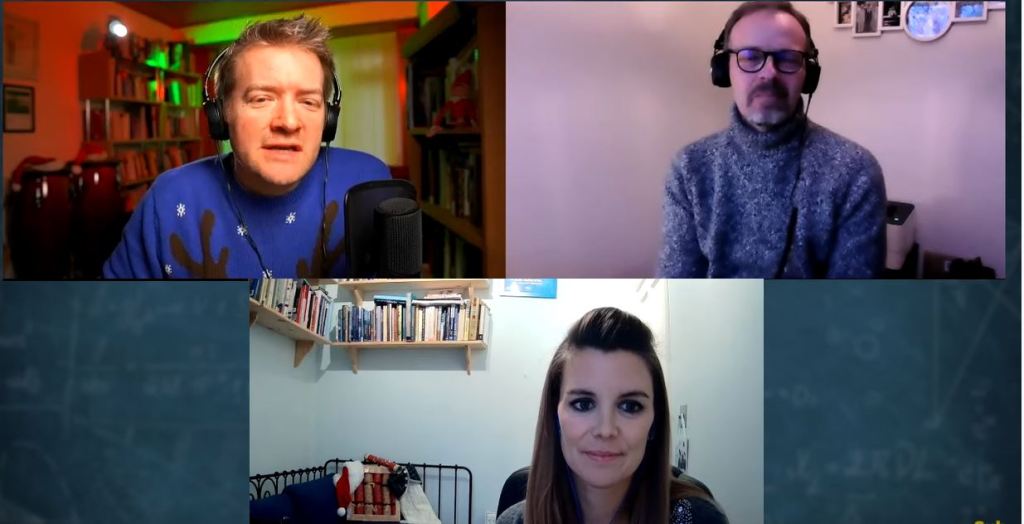
A listener to the Unbelievable! podcast wrote in to Christian Premiere Radio in the UK and shared his faith journey. He was invited in for an interview. His story is a modern tale.

Jim Thring grew up in a non-religious home. He didn’t know much about religion, which is a typical experience for people growing up in the increasingly post-Christian world that characterizes the UK in the 21st Century.

He became a Christian in college. It wasn’t something he set out to do. He didn’t go seeking for truth. Friends of his introduced him to Christianity. They invited him to believe, and he accepted the invitation.

Over the years, though, his faith waned. It became shallow and lifeless. He eventually walked away and became an atheist. He says his atheism become harder core when he came across the New Atheists and began reading their books and attending their lectures.

He was an atheist for almost a decade. He joined the British Humanist Association. He “rode the rhetoric” of people like Christopher Hichens and Richard Dawkins to justify to himself intellectually that he had made a sound decision.

As time went on, though, he began to question the rhetoric. Some of it seemed shallow. Many atheists were putting Christians down as “people who weren’t thinkers or rational at all”. It seemed as if they were simply against whatever Christians said. If Christians believed something, they were against it.

He remembered people he knew from years earlier who were “a lot smarter” than him who were still Christians. He began to soften in his atheism. He began to realize that reason, logic and rational thinking are tools available to more people than atheists, and they don’t inexorably lead to atheism.

He began to realize that a person can dismiss anything. Dogmatic people dismiss things out of hand, and atheists can be as dogmatic as believers.

Darren Brown talks about the “power of belief” as a stimulant. Jim would listen to that and think to himself, “Yeah! That’s what belief is, and now I am free from all that.” As time went on, however, he began to see that his atheism had a powerful stimulant behind it as well.

The maxim that “for everything there is a material explanation” is a very powerful belief. “It means that it doesn’t matter whatever evidence someone puts in front of you, it doesn’t matter what arguments, however well-constructed they might be, or how valid they are, you’ve got a reason to dismiss them.”

He began to be honest about where his atheism lay. Thus, he gradually began going to church again with his wife and spending time with her church friends. He began to take another look at Christian arguments.

At the same time, he sought to address the issues he had with origins, evolution and young earth. He wanted to take a different look at those issues from a different perspective, but he didn’t want a source that was just a “Christian institute”.

He came across John Lennox, the professor of Mathematics at Oxford, and read his book called Gunning for God: How the New Atheists are Missing the Mark. Lennox put those issues in perspective for Jim, but he also addressed the evidence that Jim thought were “knockdown arguments” against the Christian Faith. Lennox turned them around and applied them to atheism.

Jim’s deconstructed faith began to be rebuilt. Jim’s journey is an interesting one. To hear the whole story, I have embedded the interview below:

Many people have journeyed to faith from Atheism. You can listen to more stories of people who have journeyed from faith to atheism here.

J. Warner Wallace on the Limited Usefulness of Personal Testimonies

Experience and testimony can move people, but it doesn’t tell us whether something is true.

J. Warner Wallace, the “cold case detective”, has become a leading Christian apologist. He brings a unique perspective to the world of faith.

Having grown up in an atheist family, he didn’t come to faith until well into adulthood. He didn’t grow up in the church, obviously. The traditional focus on personal experience and testimonies in evangelicalism was not part of his background. He didn’t come to faith through experience or the influence of personal testimonies. For him, it was simply a matter of the facts.

Wallace observes that the most popular answer people give for being a Christian is that they were raised in a Christian family. The second most popular answer people give for being a Christian is some experience that demonstrates to them personally that Christianity is true.

Wallace criticizes these bases for Christian faith because Mormons give similar answers to explain their belief in Mormonism. The number one answer people give for being a Mormon is that they were raised in a Mormon family, and the second most popular answer is some experience that demonstrated for them that Mormonism is true.

Christians don’t think Mormonism is true, but their stories of coming to faith are the same as ours. Thus, Wallace concludes, experience can be a powerful thing, but it doesn’t necessarily settle the truth of the matter, and people who rely on personal experience are relying on a weak anchor to faith.

More important than experience is whether something is true.

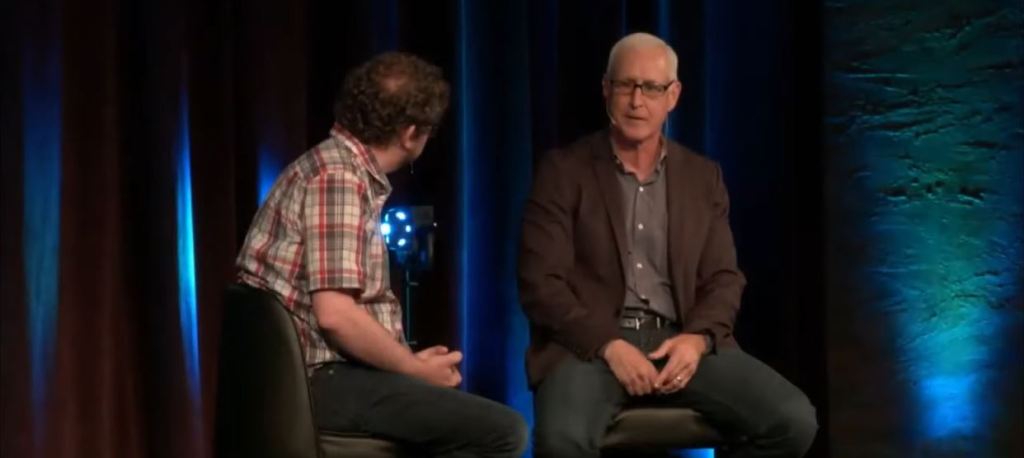
Wallace goes on to share his testimony in the short interchange linked at the end of this article with the caveat given above – don’t put too much faith in his (or anyone else’s) testimony. Still, we like testimonies, right?

Continue reading “J. Warner Wallace on the Limited Usefulness of Personal Testimonies”