
I am always excited to find new things in the Bible, which is a regular occurrence still, by the way, after 45 years of reading the Bible. I should add that many of new insights I find in my own reading (if not all of them), have been found before by others before me. I am always a bit surprised, but also amazed, that nothing is new under the sun.
The insight I want to share today is not one that I discovered on my own, but I have some thoughts to add as I meditate on it. This is the story of two nets in two boats piloted by Peter three years apart. We began with Peter’s introduction to Jesus in Luke:
“[1] One day as Jesus was standing by the Lake of Gennesaret, the people were crowding around him and listening to the word of God. [2] He saw at the water’s edge two boats, left there by the fishermen, who were washing their net. [3] He got into one of the boats, the one belonging to Simon, and asked him to put out a little from shore. Then he sat down and taught the people from the boat. [4] When he had finished speaking, he said to Simon, ‘Put out into deep water, and let down the nets for a catch.’ [5] Simon answered, ‘Master, we’ve worked hard all night and haven’t caught anything. But because you say so, I will let down the nets.’ [6] When they had done so, they caught such a large number of fish that their nets began to break. [7] So they signaled their partners in the other boat to come and help them, and they came and filled both boats so full that they began to sink. [8] When Simon Peter saw this, he fell at Jesus’ knees and said, ‘Go away from me, Lord; I am a sinful man!’ [9] For he and all his companions were astonished at the catch of fish they had taken, [10] and so were James and John, the sons of Zebedee, Simon’s partners
Luke 5:1-2, 4-9 NIV
Then Jesus said to Simon, ‘Don’t be afraid; from now on you will fish for people.” [11]So they pulled their boats up on shore, left everything and followed him.”
This, of course, is the story of Jesus calling Peter, James, and John to follow him and become fishers of men. The bolded language, “their nets began to break,” is the key to the insight.
The emphasis we often see in this story is the willingness of Peter to do as Jesus says and of these men to leave everything and follow Jesus, and that is a good emphasis indeed. This is best way to respond to God in the flesh (or in the spirit) when we come to realize His presence in our lives. Nothing we pursue in this is more important than giving ourselves, our careers, and our time to God!
Jesus called them to follow him and become fishers of men. He called them from their own pursuits and living for themselves to pursuing God living for God – to do His will and to accomplish God’s purposes, rather than their own careers and purposes.
The emphasis I see today, however, is something that might be noticed only in retrospect. The point is not readily noticeable at first, and that is part of the point of the lesson of Peter’s nets.
To gain insight into this lesson, we need to jump ahead three years, and we need to move over to John’s Gospel. The insight is not something we from Luke’s Gospel, which says something about the way God weaves together His revelation throughout Scripture in the amazingly intricate tapestry we call the Bible.
“Jesus appeared again to his disciples, by the Sea of Galilee [Galilee]. It happened this way: 2 Simon Peter, Thomas (also known as Didymus), Nathanael from Cana in Galilee, the sons of Zebedee, and two other disciples were together. 3 ‘I’m going out to fish,’ Simon Peter told them, and they said, ‘We’ll go with you.’ So they went out and got into the boat, but that night they caught nothing.
JOhn 21:1-11
4 Early in the morning, Jesus stood on the shore, but the disciples did not realize that it was Jesus.
5 He called out to them, ‘Friends, haven’t you any fish?’
‘No,’ they answered.
6 He said, ‘Throw your net on the right side of the boat and you will find some.’ When they did, they were unable to haul the net in because of the large number of fish.
7 Then the disciple whom Jesus loved said to Peter, ‘It is the Lord!’ As soon as Simon Peter heard him say, “It is the Lord,” he wrapped his outer garment around him (for he had taken it off) and jumped into the water. 8 The other disciples followed in the boat, towing the net full of fish, for they were not far from shore, about a hundred yards. 9 When they landed, they saw a fire of burning coals there with fish on it, and some bread.
10 Jesus said to them, ‘Bring some of the fish you have just caught.’ 11 So Simon Peter climbed back into the boat and dragged the net ashore. It was full of large fish, 153, but even with so many the net was not torn.”
The parallels in these two stories is hard to miss. They are fishing on the same body of water when they encounter Jesus. They had fished all night with nothing to show for it. When Jesus tells Peter to drop the net again, Peter does it, though it seems like a waste of time after an unsuccessful night of doing the same thing.

In both cases, Peter catches so many fish in the net that he cannot haul the net in. Peter needs the help of everyone to get the fish in. These things are symbolic, perhaps, of our need to be responsive to Jesus to accomplish the work we have to do and the need for the help of our brothers (and sisters) in Christ to to do it.
Interestingly, Peter (and the others) do not recognize that the man standing on the shore calling out to them is Jesus in John 21, though Jesus had already appeared to them after the resurrection (John 20). I have mused about the fact that the disciples didn’t recognize Jesus in previous articles (here and here), but that isn’t what captures my attention today.
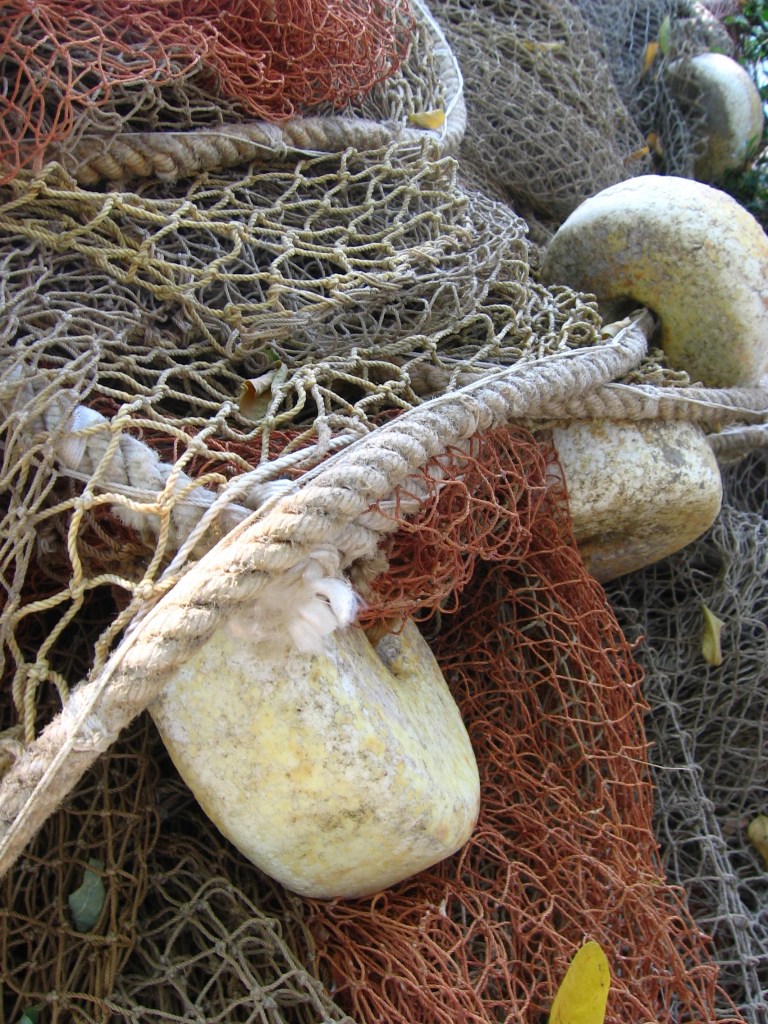
Today, I am focused on the nets. When Jesus met Peter and the Sons of Zebedee on the shore the first time, their nets were breaking and unable to contain the fish haul.
Three years later, after Jesus died and rose from the dead, Jesus used the same set of circumstances to reveal himself to Peter and the men he was with. This time, however, their nets didn’t break.
What a curious little tidbit. We wouldn’t even notice if we weren’t paying close attention, but it should cause to ask, “Why does John make a point of saying their nets didn’t break?” The significance seems to lie in the fact that their nets broke under the weight of the fish the first time they encountered Jesus, but they held up the second time, though there was so many fish.
A logical, fact orientated person might assume they learned their lesson from the first encounter, and they reinforced their nets. And, perhaps they did (though they left their nets and boats immediately to follow Jesus).
I don’t that is the (only) lesson for us to take away from these stories, however practical and sensible that answer might be.
Certainly, we should learn from our experiences and make adjustments. Instead of trying to haul the net right into the boat out in the sea (as they did in Luke 5), they drug the net to the shore where they were able to unload the fish in shallow water in John 21).
That is a practical lesson to take away, no doubt, but I think there is more to learn from these stories and the tale of the two nets.
For one thing, Jesus does not say anything to Peter (or the other men) about the fact that Peter had gone back to his career as a fisherman. This encounter took place after Jesus appeared to them, but Jesus did not reprimand Peter for going back to his livelihood. He didn’t say anything about it.
Jesus went on to remind Peter of his calling, to elicit from Peter his commitment (love) for Jesus, and to tell him to “feed my sheep.” John’s Gospel ends with this dialogue in which Jesus hints to Peter that this calling and commitment would result in his death (and not to worry about John, who might not suffer a similar fate). (John 21:15-23)
Peter may (or may not) have continued to fish for a living, but he was called to be the rock on which Jesus built his Church, to be a fisher of men, and to His sheep. Paul was a tentmaker, and Peter was a fisherman by trade, but God used them both in much more significant (and eternally lasting) roles for His purposes.
Not everyone can be a pastor or make a living in ministry. Even Peter and Paul had trade skills they could use to support themselves in furtherance of their callings.
We might be tempted to think that the difference between the net breaking in the first encounter in Luke to the net holding together in the last encounter in John is the difference in productivity in Peter’s given profession before and after, and I wouldn’t discount that possibility. The practical lesson of learning from experience doesn’t negate the “spiritual” lesson of God making us effective in what we do when are walking in right relationship with God, responding to His influence in our lives, and prioritizing the higher calling for which God has engaged us.
I still see something else in these stories and the tale of the nets, however. At the beginning, when Jesus called Peter (and James and John”, they couldn’t handle all the fish Jesus supplied them in their nets. It was more than they could handle. After three years of walking with Jesus in intimate relationship, they could handle what Jesus gave them.
This has spiritual application, and not just the practical application of learning from experience. We should not discount the lessons we learn from experience, but we should not miss the spiritual component.
In the context of being called as a fisher of men, Peter was not equipped to handle the harvest of fish (men) God would give him at the beginning. After three years of devotion to Jesus and being spiritually equipped by Jesus, with the help of the Holy Spirit, Peter was ready to handle the calling.
I don’t think we should assume that three years is the formula. It might take three years, or maybe two years, or maybe even ten years (or more). The point is that a person needs time in relationship with God to be equipped for the calling God gives a person.

The emphasis for Peter also changed. From being a “fisher of men” to “feed my sheep”, the initial calling changed and grew in scope and character. Having been a fisher of men, Jesus Peter changed his focus to shepherding the people “captured” by efforts of Peter (and the other disciples).
It wasn’t the efforts of Peter (or the other disciples), of course, that captured any one’s heart. It was the work of God who brought people into the net. Further, as some people sow seeds, and others water, it is always God who gives the increase.
We never get away from our dependence on God, whether it is being effective and productive in a profession or in ministry. God is the source of the fruit of our efforts.
God is the author of what we learn from our experiences. He is our guide in where to cast our nets. Our fruitfulness depends entirely on Him, and that is more true of our spiritual fruit than it is of the fruit of the work of our hands.

 Navigating by Faith