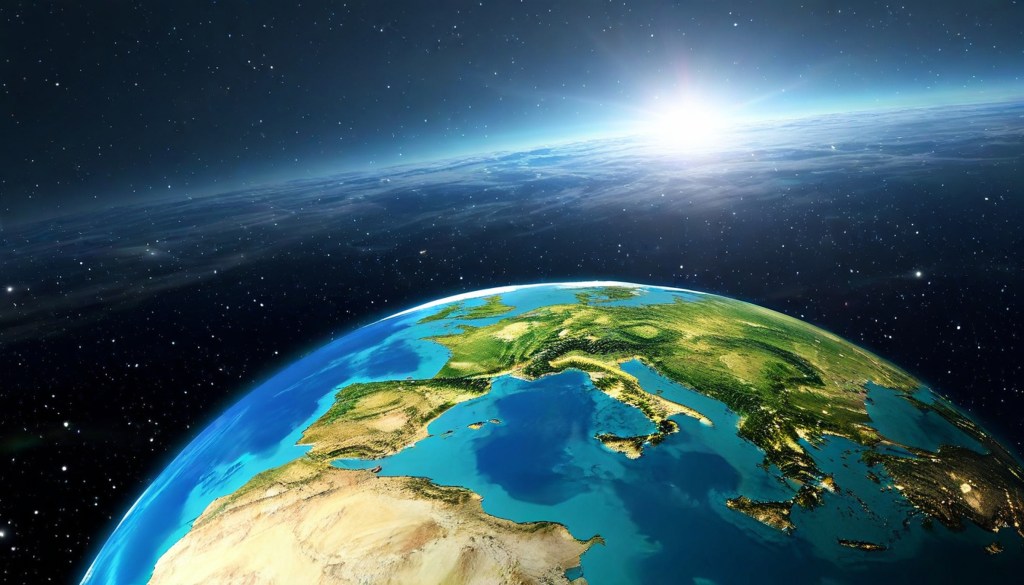
My thoughts are inspired by a Daily Galaxy article today, Astronaut’s ‘Lightbulb Moment’ in Space Reveals Humanity’s Biggest ‘Lie’s. Ignoring the obvious clickbait character of the title, I read the article, which is about the importance of perspective. A less sexy summary of the article might go like this: “Seeing the Earth from the vantage point of space provides a different perspective that should lead to a change in priorities.”
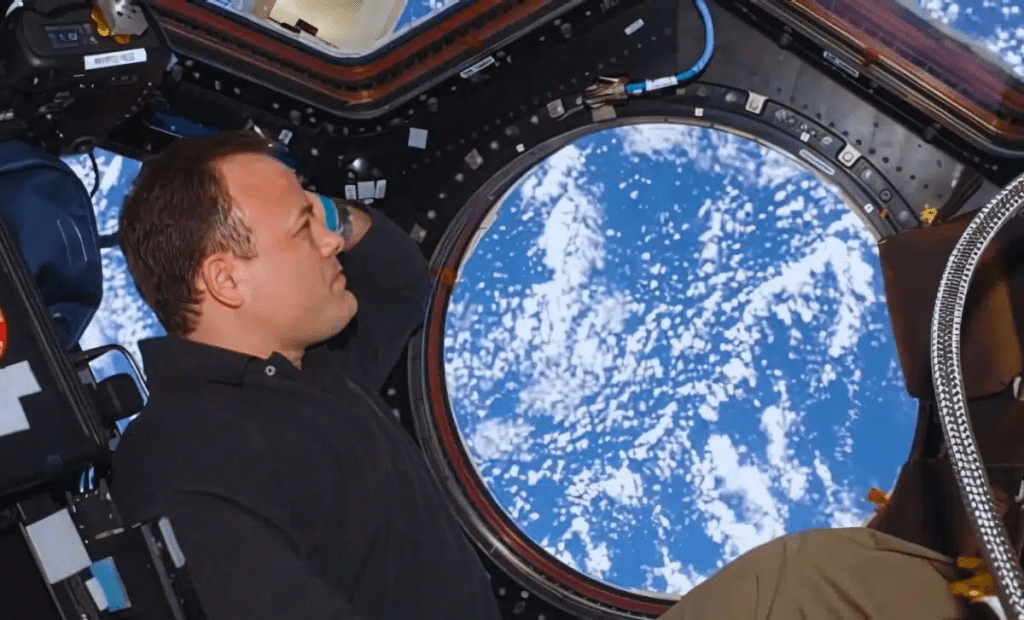
The photo associated with the article illustrates the idea of perspective: that an astronaut viewing the earth from space, seeing the earth from the perspective of distance, hits home in a way that few of us have experienced. This is a perspective few of us have the privilege of attaining. We can imagine what it is like to view the earth from this perspective, but actually viewing the earth from this perspective is more impactful than imagining it.
I can only speculate on this, as I have not experienced it. Even viewing the astronaut’s perspective in a photo, though, hits home in a different way than simply imagining it. This is because our perspective (where we sit in relation to a thing) matters.
Perspective is critically important for finite creatures such as ourselves because we view everything from “where we sit”. We necessarily have a limited perspective. Our perspectives are limited by our location in space/time, geography, and position.
Our perspectives are also limited by our sociology, culture, education, worldview, personal experiences and a host of other physical and metaphysical factors. Many of these factors are external to us (like sociology, culture, and education). Many of these factors are more internal to us, like worldview, experience, and individual psyches (for lack of a better descriptor).
Our perspective can “shift”, as the article states, as we change “location”, experience new things, and view things from a different “angle”. Thus, a change in vantage point provides a potential change in perspective – a change in how we view the world and prioritize things.
“Walking a mile in another’s shoes” speaks to the kind of shift we experience when we gain a different vantage point. Walking a mile in another’s shoes speaks to the impact of experiencing a difference of perspective, and not just considering it abstractly.
Ronald Garan, the astronaut identified in the article, “was struck by the stunning beauty and fragility of Earth’s thin atmosphere” as he viewed the Earth from the distance of space. The reality of the earth’s beauty and fragility is nothing new, but the actual experience of viewing the earth from such a distance hit him in a more visceral way than simply knowing these things intellectually.
Tethered to the small oasis of a space station on the edge of the infinitely vast regions of a dark, cold, and apparently lifeless universe, Garan was struck by the thinness of the Earth’s atmosphere that harbors all the living beings on its surface. Experiencing the small and vulnerable bubble we call Earth from the yawning chasm of space, Garan gained new appreciation of the need for humans to prioritize care and stewardship of this highly privileged planet.
Perspective and its impact on us is not just a matter of physical location. Another person sitting immediately next to Garan with the same view of Earth might have “missed” what Garan “saw” because perspective is more than just physical location.
Perspective involves what is going on in our hearts and minds, what we focus on and think about, our values and what is important to us. We don’t all the see same things in the same ways because each of us is uniquely “positioned” in the world – physically and metaphysically.
As I read this article, I can appreciate Garan’s perspective. I imagine that he views the world as an astronaut trained in the sciences. I assume he is a materialist (which could be a bad assumption, I admit). At minimum, he is trained in the materialist assumptions of modern science.
I view the world from my perspective as an attorney and a man of faith who believes in God. I see what Garan sees with the understanding that God is the Creator of the Earth and the universe that produced the Earth and human beings who inhabit the Earth as its caretakers.
Garan’s perspective motivates him to focus on prioritizing care for the Earth because of its fragile and vulnerable position in the universe. I can agree with him on the importance of prioritizing care for the Earth from his perspective as well as from my own perspective – from the perspective that God charges us with the care of this planet.
The biblical narrative gives us the perspective that God created this garden oasis out of the chaos of the greater universe, and He placed us in this lush terrarium we call Earth as His stewards to manage it and care for it – not just for our own ends but as fiduciaries of God. From where I sit, I can agree with Garan’s concern about how we should manage the world God entrusted to us – albeit from a different “place”.
In my view, the materialist’s hope is short-lived, like the flower that blooms for a day. He knows that life on earth is destined to die out. His is a desperate effort to hold on, knowing that mankind’s grip will ultimately fail. My hope to the extent that it is informed by my belief in God gives me a larger perspective.
Beneath the stars, o’er the hill,
The world seems vast and the air still.
And, down below, where rivers run,
The same sky holds a common sun.
A painter’s brush, a poet’s quill,
Reflect their view: there’s more to will.
For what you see, your lens may skew;
Your heart and mind effect your view.
A tower looms, a shadow cast,
From here, it’s small, from there, it’s vast.
To one, Eden; to another, hell,
The same shadow, a different tell.
Shift your angle, for truth unsealed:
Perspective’s more than what’s revealed.
It’s not the place or where you stand,
But how you hold your world in hand.
The stars by which we navigate,
A grand design? Or random fate?
A creator, God eternal?
Illusory lies infernal?
No grand design? No guiding hand?
No higher will? No good command?
The only creed: to self be true?
The path we walk is what we choose.
We toil to sow, to reap, to keep,
A garden bound for endless sleep.
Though roots may thrive, the end is clear:
The earth will wither, dry, and sear.
One sees a bloom, its colors bright,
Yet fleeting as the waning light.
A bloom that fades as it begins,
A fleeting joy, an endless pain.
Another tends with toil and strife,
Yet knows the bounds of mortal life.
She plant her seeds in love and grace,
For fruit that blooms in God’s embrace.
Thus, one may toil for fleeting gain,
While all they build dissolves in vain.
The other sows where time can’t sever,
A harvest bound to bloom forever.
Perspective makes a difference

 Navigating by Faith
You write so well and logically and compellingly. You did not provide a source for the poem at the end. Did you write it?
>
LikeLiked by 1 person
Kind of. I wish I could be more creative. I created a description of the poem I wanted in Chat GPT, and I kept playing with it until I thought it was ok.
LikeLike