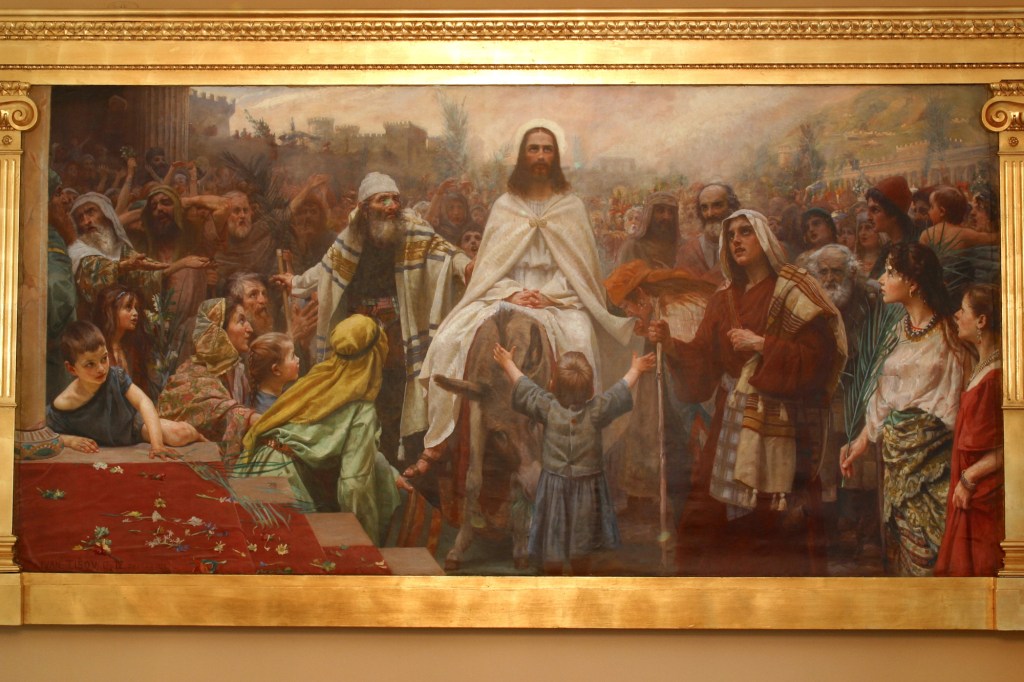
Episode 124 – Statement of Triumph – from the BEMA Podcast, with Marty Solomon and Brent Billings, inspires my writing today. It was the subject of discussion for the Saturday morning Bible study I have attended off and on with an exceptional group of men for several years.
The subject was Matthew 21:1-11. The chapter heading in the NIV translation (which would not have appeared in the original text, because there were no chapter headings in the original text) is “Jesus Comes to Jerusalem as King.”
This is usually how we read it: a “triumphal” entry. We celebrate Jesus entering Jerusalem as a king. It was triumphal, but not perhaps in the way we tend to think about it. Certainly, not in the way the fledgling followers of Jesus perceived it when they witnessed it.
Marty Solomon sets the stage in the podcast. He emphasizes that Jesus rode into Jerusalem on a donkey. It was during the week of Passover, an unusually tense time in this region of the Roman world. The uneasy tension existed at that time in that region because it was home to the only group of people in the Roman Empire who refused to worship the Emperor.
The Jewish people were stubbornly true to their God. Even so, Rome allowed the Jews to have their own ruler, Herod the Great. Herod was powerful in his own right, but he was happy to rule alongside the Romans, and the Romans accommodated him to maintain stability in the region.
Even so, this small piece of real estate was problematic for Rome. It sat at the crossroads of the earth. The Hebrew people long inhabited it, but they were a headache for Rome because of their entrenched religious traditions and unabated worship of their God.
When Herod the Great died, three of his sons took over different areas of the land Herod ruled as a vassal of the Romans. Herod Philip ruled the north (Caesarea Philippi). Herod Antipas ruled the middle region, and Herod Archelaus ruled in the south (Judea).
Archelaus only lasted two years, so Rome brought in its own ruler, Pontius Pilate (the Roman Bulldog), to maintain Rome’s control over the region. Pilate didn’t live in the sacred City, Jerusalem. Pilate lived in Caesarea Maritime (Caesarea, By the Sea), a city built by Herod to honor Caesar.
The week of Passover would have been a particularly tense time in Jerusalem because Jews from all over gathered there to celebrate the feast that remembered their great deliverance and triumph over the superpower of an earlier time, Egypt. The last thing Rome wanted was for this celebration to become a rally for rebel Jews fueled up with wine and the legend of their former deliverance.
If there was any holiday that might make the Romans nervous in Judea, it was Passover. Zealots were always stirring up trouble, and Passover would be an opportune time for a Jewish revolt against the Roman rule of this territory that the Jews long held out as their own. After all, the Jews still believed this land was to be theirs again based on their understanding of prophecies about a military coup to be led by a messiah (savior) in the line of their once great King, David.
Every year at this time Pontius Pilate would head south from Caesarea down the coastal road to Joppa. He would head east from Joppa to make his way into Jerusalem. Pilate would enter Jerusalem from the west. He traveled with great pomp and a show of force, with an army of soldiers, trumpeters, heralds, banners, and pronouncements. Pilate would lead the way on a white stallion symbolizing Roman conquest and rule.
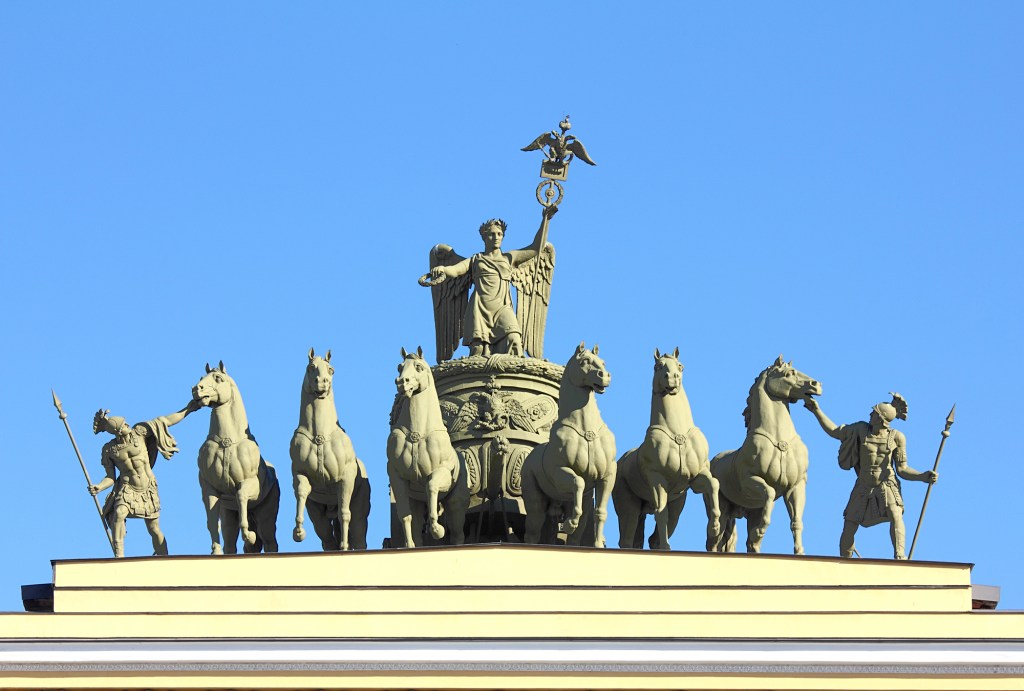
This show of power, of course, was intentional.The article, In Through the Back Door, September 24, 2022, by Terry Gau describes these yearly processions made by Pilate into Jerusalem at the beginning of Passover week. John Dominic Crossen and Marcus Borg, memorializes the historical context in their book, Last Week, setting the stage for the final chapter of Jesus’ ministry on earth. The procession is described this way:
“Traditionally, Pilate paraded into Jerusalem on the first day of Passover Week, entering the west gate – the front gate – with legions of chariots, horses, and foot soldiers, dressed for battle and armed with swords and spears. Rome’s authority would not be questioned. The majesty with which Pilate enters the front door of the city was meant to inspire awe and fear, respect and obedience.”
Marty Solomon imagines it this way:
“You could have heard him coming from miles away. The message he wanted to send to the Jews was clear. ‘Don’t even think about it! Keep everything under control, or Rome will crush you!’”
BEMA Podcast, Episode 124
Pilate would stay in Herod’s palace in Jerusalem for the week until the festivities ended. Then he would go back to Caesarea. He wasn’t there to celebrate, though. He was there to ensure things didn’t get out of control and to keep the peace.
During one Passover week under the rule of Pontius Pilate in Judea another procession took place. It may have even happened on the same day at the same time that Pilate was entering the City from the west. This procession took place on the east side of Jerusalem where Jesus, riding on a lowly, young donkey with a small, rag tag bunch of unarmed disciples entered through the east gate – the back door to Jerusalem.
“This parade was just as carefully staged as Pilate’s entry into Jerusalem. It was a counter-procession, a different vision of what a Kingdom should be, a subversive action against the powers that ruled Jerusalem. Jesus’ humble, yet triumphal, entry into Jerusalem stood in contrast to the magnificence and brutality on display at the opposite end of the city. Jesus brings peace, while Pilate brings a sword.”
In Through the Back Door
This was the backdrop for episode 124 of the BEMA Podcast and of our discussion. I sit writing at a temporary table with one chair left in my house that is all but cleaned out and being readied for sale. My future is uncertain as I recount one of the most pivotal times in human history and the dealings of God with man and its meaning for us, today.
The contrast of the two processions is not captured in the biblical text. We read in the Gospels of only one “triumphal entry” into Jerusalem. It occurred, as the biblical account notes, to fulfill what was spoken through the prophet, Zechariah:
“Say to Daughter Zion,
‘See, your king comes to you,
gentle and riding on a donkey,
and on a colt, the foal of a donkey.”
Matthew 21:6 (quoting Zechariah 9:9)
The celebratory and hopeful crowd that witnessed this humble procession shouted:
“Hosanna to the Son of David!
“Blessed is he who comes in the name of the Lord!
“Hosanna in the highest heaven!”
Matthew 21:9 (quoting Psalm 118:25-26)
Marty Solomon describes the two entries into Jerusalem as a showdown that would not go unnoticed by the people in Jerusalem. In fact, the text affirms that the significance was not lost on them. We know that because they grabbed palm fronds, put them on the road in front of Jesus, and waived them as he rode by.
We do this today at the time of Passover, which is the time of year in which this event took place. Significantly, however, palm fronds were not associated with Passover.
Palm fronds were associated Jews with the Feast of Tabernacles. (See Sukkot, The Feast of Booths (known to some as the Feast of Tabernacles)) This is a tip off to what the people of the time understood. They viewed this humble demonstration by Jesus as a tip off of his coming triumph. To understand why, we need to do a little digging to understand what was going on.
We have to go back to Zechariah to understand the significance of the palm fronds. Zechariah ends with references to the Feast of Tabernacles. (See Zechariah 14:3-5) It speaks of the Lord standing on the Mount of Olives to fight against and conquer the nations that oppressed God’s people. Zechariah ends with the imagery of all the conquered nations of the earth going up annually to Jerusalem “to worship the King, the Lord Almighty, and to celebrate the Festival of Tabernacles.” (Zachariah14:16-19)
The imagery of the Messiah coming from the Mount of Olives east of Jerusalem to conquer the nations of the world is what was being celebrated by the people when Jesus rode into Jerusalem from the Mount of Olives on the foal of a donkey. Jesus seems to be signaling them to see him as the Messiah foretold in Zechariah – coming to conquer.
The dual processions of Jesus coming from the east and Pilate coming from the west suggests the possibility of a showdown, and the people show their understanding of that potential by gathering palm fronds to signal back that they understood the significance of what Jesus was doing.
The people didn’t fully understand the plans God had, however…. I am not sure we understand much better then they did.
In the minds of the people, Jesus was signaling that he was coming to fight for them, that he was coming to rescue them from the Roman Empire and establish the God’s rule over all the nations. They expected that he would make Rome and all the nations bow to him.
By gathering palm fronds, placing them on the road, and waving them, they were signaling back to Jesus that they understood the significance of this imagery. They shouted back to Jesus the words of Psalm 118, which are recited in the Feast of Tabernacles: “Hosanna!” (Come, Lord, save us!) “Hosanna in the highest!
Marty Solomon notes that some scholars believe the triumphal entry occurs during the Feast of Tabernacles because of the palm fronds and reference to Zechariah and Psalm 118. Most scholars, however, place the triumphal entry at the time of Passover because of the Scriptural descriptions of the time. This makes what Jesus did even more interesting.
Passover recalls the time when God passed over the Hebrew households marked with the blood of slaughtered lambs on their doorposts, as Moses instructed. God spared the Hebrew families whose doorposts were marked with blood, as His curse wiped out the firstborn of the Egyptians. This final act of God convinced Pharaoh to let the Hebrews leave Egypt. Thus, Passover celebrates God’s miraculous rescue of the Jews from slavery in Egypt, freeing them from Egyptian captivity.
When Jesus rode into Jerusalem on a donkey, the people wanted the triumph associated with the Feast of Tabernacles, but Jesus was setting the stage for the triumph of the Passover lamb. Jesus was the Passover Lamb. He was coming to be slaughtered for the rescue and salvation of the Jews and everyone who would believe in him.
Thus, we see a different kind of contrast. This was not the contrast of triumphal processions, but the contrast between the expectation of the people and the actual plan and purpose of God.
The contrast in processions and expectations finds a parallel in the contrast of kingdoms. We don’t just see a contrast between the Roman kingdom and the Jewish kingdom; we see a contrast between the kingdoms of this world and the kingdom of God.
The kingdoms of this world are driven by power (empire), but Jesus came to introduce the kingdom of God, which is not of this world. It is a kingdom characterized by shalom.
If we move over to Luke’s version of the triumphal entry, we get another, more intimate perspective of this event. As Jesus drew near the city of Jerusalem, the reaction of Jesus tells the real story:
“And when he drew near and saw the city, he wept over it, saying, ‘Would that you, even you, had known on this day the things that make for peace! But now they are hidden from your eyes. For the days will come upon you, when your enemies will set up a barricade around you and surround you and hem you in on every side and tear you down to the ground, you and your children within you. And they will not leave one stone upon another in you, because you did not know the time of your visitation.’”
Luke 19:41-44
Jesus looked out over Jerusalem and wept, because the people do not understand. They wanted a warrior Messiah to vindicate them and set up a Jewish kingdom in this world that would rule with worldly power, but Jesus came to usher in God’s kingdom that is not of this world – a “world” marked by shalom.
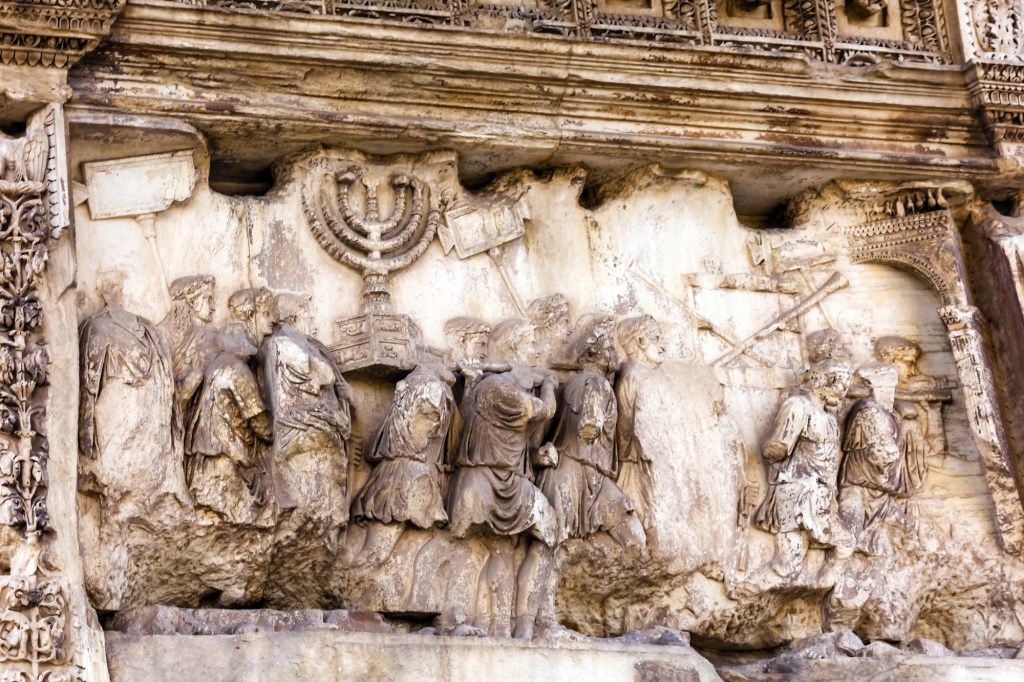
Poignantly, palm fronds were associated with the Zealots in 70 AD. According to the historian, Josephus, the Zealots carried palm fronds in their revolt against the Romans at the time of the Feast of Tabernacles. (See Book VII, Chapter 5 of “The Jewish War”) Perhaps, they were trying to accomplish what they thought Jesus failed to do. Instead, they provoked Rome to besiege Jerusalem.
In 70 AD, the things prophesied by Jesus when he wept over Jerusalem came to pass, and these things occurred during the Feast of Tabernacles. As the Zealots were waving palm fronds in their revolt of power against Roman power, they were crushed, and the Temple was reduced to ruins.
The prophets are very difficult to understand. Reading through Zechariah today as I have thought through the triumphal entry story, I find it hard to understand myself. I want to read the words literally and in chronological order, when it seems that God is getting at something else. It seems he was sending messages to His people, hoping that they would make the right connections and eventually understand God’s purpose as it unfolded.
As Jesus seems to indicate, he knew they wouldn’t get it. At least not in the moment. They picked up the right signals, but they didn’t understand God’s actual plans – that the Messiah would be led like a sheep to the slaughter where he would give up his life for the world – for all who would believe in him.
The people who waved palm fronds at Jesus believed that Jesus was their long-expected Messiah. Of course, he was! They believed that this was the time when God would re-establish the throne of David over the land of God’s promise, they were wrong. It wasn’t – not yet.
This is what they had waited for and patiently endured for generations to see, but God had other plans first. He had plans by which all people in the world – Jews and Gentiles alike – could be rescued from much more than the powerful kingdoms of the this world. Jesus offered salvation from sin and from death itself!
They ultimately rejected Jesus less than a week after the triumphal entry because he didn’t meet their expectations. They understood the imagery Jesus was signaling to them, but their expectations didn’t match God’s actual plan. At the beginning of the week, they were hailing Jesus as their Messiah. By the end of the week, they were calling for his crucifixion as a common criminal.
We have the benefit of hindsight. We can see that the expectations of the people were wrong. We know that Jesus did not come in the flesh to conquer the nations, at least not in the way that people wanted him to. Not in the way the people of his time expected.
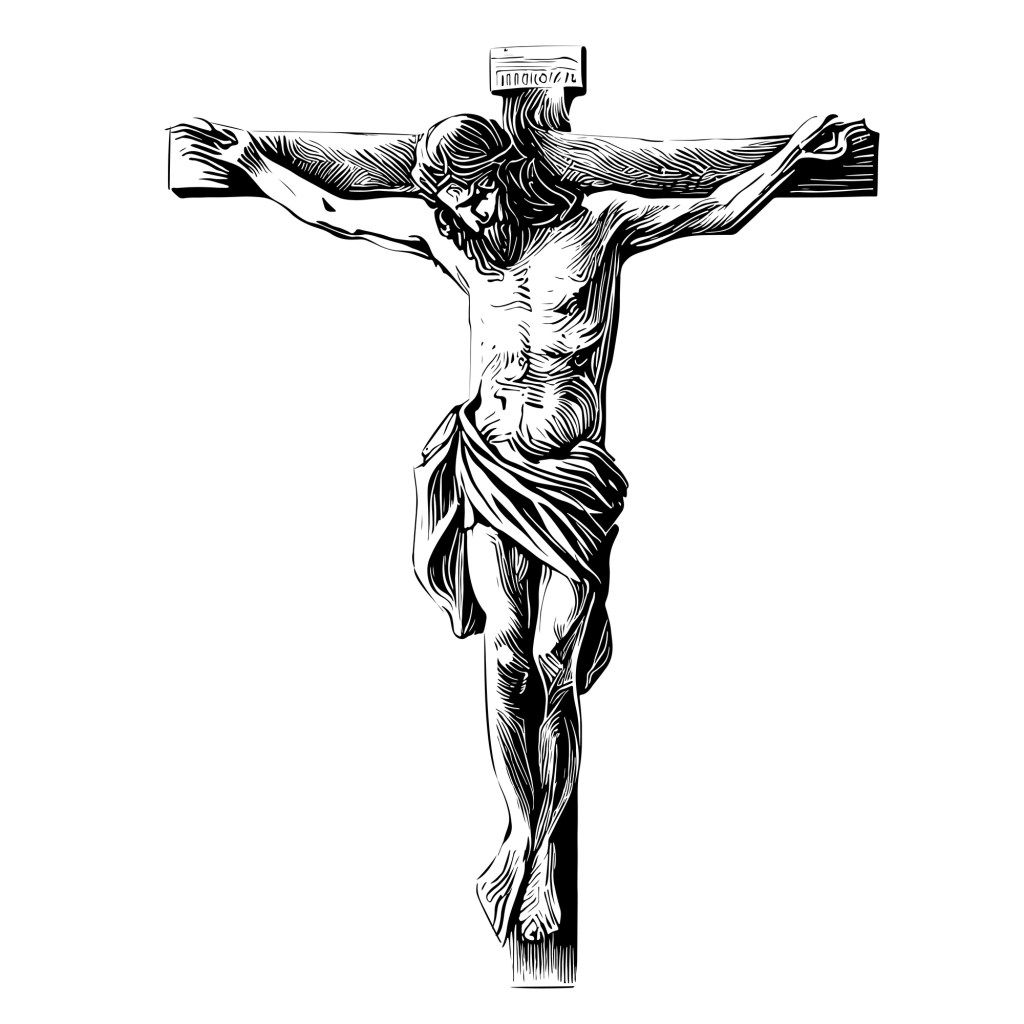
Jesus came to die, as a sacrificial lamb. He came to die for the sins of God’s people, the nation of Israel. But not just for Israel, He came to die for the sins of the people of all the nations of the earth.
We should be careful here. We shouldn’t think we are any better in our understanding then they were. We still tend to think in terms of empire/power. We think that God’s kingdom can be advanced on earth through the exercise the power of empire. I don’t think I am going out on a limb to say that the Christian infatuation and devoted embrace of Donald Trump is an example of this same tendency.
God’s plan was never simply to rescue one chosen people out of all the nations of the Earth. His plan was always to bless all the nations of the Earth through his chosen people. He made that clear in the first promise God gave to Abraham:
“I will make you into a great nation,
and I will bless you;
I will make your name great,
and you will be a blessing.
I will bless those who bless you,
and whoever curses you I will curse;
and all peoples on earth
will be blessed through you.”
Genesis 12:2-3
We tend to focus on the first three promises in God’s pronouncement to Abraham, and we tend to gloss over the last one – “All the peoples on the earth will be blessed through you.” It is clear, though, that God’s intention was to bless all the peoples of the earth from the beginning.
Abraham’s descendants carried the torch, so to speak, of God’s plan. They preserved the books of Moses, the Writings, and the Prophets, but they did not fully understand what God was actually doing and planned to do in the earth. I have come to see that such a lack of complete understanding is pretty typical for human beings – and no wonder – because we are finite creatures.
The people in Jerusalem during Passover week leading up to the crucifixion of Jesus didn’t understand what God was doing. The disciples didn’t even understand until after the death and resurrection of Jesus.
James and John wanted to call down lightning on people who failed to be hospitable to Jesus, but Jesus rebuked them. (Luke 9:54-55) Peter tried to rebuke Jesus when Jesus informed them he would be crucified, but Jesus called him on the carpet for it. (Matthew 16:22-28)
These reactions tend to be our reactions also in similar circumstances. We still struggle to understand. We still struggle in our unrelenting desire for conquest, power, influence, and control in our politics and culture wars in the United States.
Jesus did not conquer with a display of might over power. He conquered by submitting to death on the cross. He conquered by rising from the dead, and he promises to come again – at the end of the age – to judge the living and the dead. Only then will all things be put to right, and then all nations – every tribe, people, and tongue – will submit to Jesus (Rev. 7:9) in the kingdom of God that will be established in the earth. (Rev. 21)
God’s ways are higher than ours. His plans are not our plans. God is doing something new in all the Earth. He is redeeming mankind. He is doing this through the agency of people, though we do not completely understand.
Sometimes, we need to be rebuked as Jesus rebuked his disciples for wanting to call down fire. We should understand better than they, because we have the benefit of hindsight. We have the Holy Spirit, yet, we continue to think that the way forward in this world is through worldly power, revolt, and conquest.
Jesus told us to follow him. Power and empire is not the way God engages the world, and it is not the way that we should engage the world. When we engage the world on the world’s terms – with power and empire – we are crushed as the Jews were crushed by the Romans.
Jesus said the world will hate us as it hated him, but we must continually be reminded that the way forward is the cross. The prophecies of Zechariah promise that the Messiah will conquer the world, but God will do it in His time and in His way.
In the Book of Revelation that gives us a glimpse of the end of the story, it is Christ the Lamb of God who accomplishes this. Christ is the Lion of Judah, but He conquers as the Lamb of God, and we participate with Him in that conquest in our suffering as we are faithful as His salt and light in the world, spreading the Gospel – the good news – to the poor, the oppressed, the blind, and the captives. (Luke 4)
“’Weep no more; behold, the Lion of the tribe of Judah, the Root of David, has conquered, so that he can open the scroll and its seven seals.’
Revelation 5:5-6
And between the throne and the four living creatures and among the elders I saw a Lamb standing, as though it had been slain….”
“And I heard every creature in heaven and on earth and under the earth and in the sea, and all that is in them, saying,
Revelation 5:13
‘To him who sits on the throne and to the Lamb
be blessing and honor and glory and might forever and ever!’”
Thus, we see the bigger picture when we lift our eyes to the end of the story as shown to the Apostle John in Revelation. The fascinating clash of the peoples’ expectations and God’s actual plan that we see in the triumphal entry stands as a signpost to us as we look look forward to strain to see the bigger picture and understand that God is working out His plans in the world, but not always as we want or expect, and we need to keep our eyes on the details of His instruction to us in the meantime.

 Navigating by Faith
2 thoughts on “A Tale of Two Processions, Two Kingdoms, and the Triumph of God”