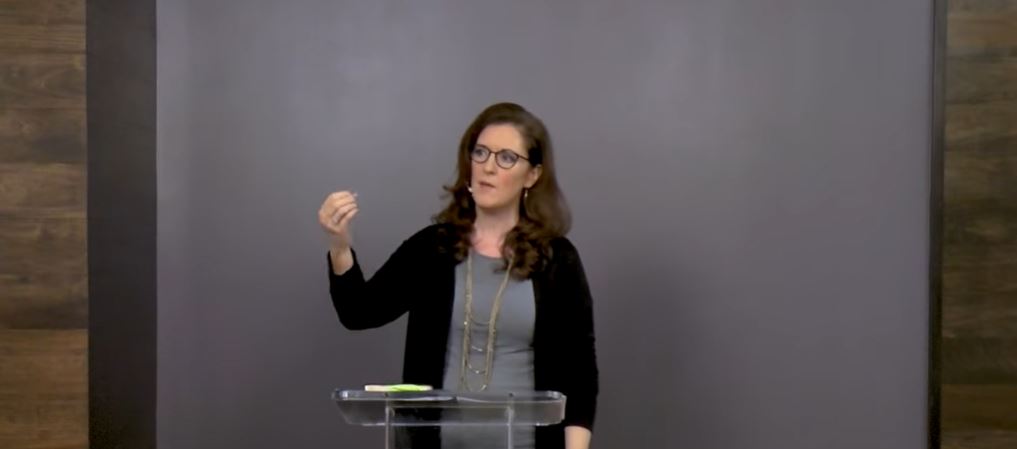
Mary Jo Sharp grew up in a secular home. Her parents didn’t go to church. Her community in Portland, Oregon was post-Christian, and she didn’t even know people who claimed to be Christian.
She was aware of Christianity in culture, but she didn’t have any firsthand contact with Christian culture. Her parents weren’t’ religious, and they didn’t go to church.
Her father was a “huge Carl Sagan fan”, and she was influenced by his love for science, outer space and nature. She was influenced almost exclusively by a materialist worldview from a young age – the view that reality consists only of what we can see, hear, feel, touch, and taste in the material realm. (There is no other “realm”.)
Materialism was the theme that ran through the TV shows on science and nature that her father would watch. “This was the background that formed my view of reality,” says Sharp, “I really didn’t have a view of God, and I wouldn’t have thought to gain one or why a person should want to gain one. It just wasn’t on the radar”
She says she didn’t know that the materialist view is only one view among other views on the nature of reality. She says, “It’s just what I was exposed to.” She didn’t know any other way to view the world and reality.
The Christians she would later meet seemed “nice and innocuous”, but she predisposed to be wary of them from the exposure to Christianity on television. Her view of religion was also shaped by her knowledge of a cult at a compound in her area that attempted a bio-terrorist attack on nearby cities, using salmonella to poison people. Therefore, she says,
“I had a lot of misgivings about what religion was, who God is or was. I didn’t understand what religion was for. It seemed like the kind of thing people did because they were raised that way, and I wasn’t.”
Mary Jo Sharp was an atheist from as young as she can remember. Atheism to her was normative. She had a good life. Her parents loved her. She loved science. She loved music. She had no needs that might drive her to religion for comfort.
Her primary exposure to religion was in the myths of ancient religions. She says, now, that she had a kind of “chronological snobbery”, believing that she was more “progressed” than other people who still had vestiges of a religious faith. She felt her family was better than others who still clung to religious myths.
There was no crisis in her life. She saw herself as a good person. “I had it together,” she says, but one thing opened a door (just a crack) to the possibility that reality was more than she supposed.
She was becoming aware of the wonder of the world, and that wonder caused a subtle tension in her materialist assumptions. She felt wonder at sunsets and mountain ranges and music that she couldn’t explain on the basis of her view of the world as the product of random and meaningless matter and energy.
Things were about to change for her when a person she respected in her life gave her a Bible. She “didn’t receive it well”, but the timing was fortuitous because of the subtle questions that were beginning to occur to her prompted by wonder.
She didn’t have a source for answering the questions she had. She didn’t have philosophy training to help put her questions into context because her public school education did not include training in critical thinking or how to tackle the big questions of life.
Though she didn’t react well to the gift of a Bible she received one day, she read it. Reading the Bible opened her mind up to possibilities she hadn’t considered before.
She says, “I was really caught off guard because it wasn’t what I expected.” She was experienced in reading mythology from the Samarians, Greeks, Egyptians and Native Americans, but the Bible stood in contrast to those mythological writings. “As I was digging into the Bible, it was nothing like that…. It sounded more report-like.”
She realized, of course, that some portions of the Bible are poetic. Other portions of the Bible, however, like Luke, read like reports of factual things. Those portions of the Bible include many details of places, times, people, happenings, etc. On reading Luke, she recalls, “It sounds like he was just trying to report what was going on.”
That “shook” her because the Bible seemed to be written by people who were just trying to convey what happened. It didn’t read like mythological stories made up with the primary purpose of conveying moral lessons, as the writings with which she was more familiar.
She also realized the Bible is more than a superficial guideline for life. She realized it is a story of how humans had failed to do what was good the way God intended for them to live, and they brought evil upon themselves thereby.
More poignantly, the story made sense to her about why there is good and evil in the world. It resonated with her sense that morals mattered. It echoed her intuition that right and wrong, justice and injustice, have basis in reality and fact.
The biblical narrative describing how evil got into the world and that evil is not what people are intended for made sense to her in light of “human experience”. The biblical narrative provided a plausible explanation for the reason that people have a sense of right and wrong. She realized,
“If humans are the problem, if they are the ones who brought the evil into the world, and they are the ones who are constantly engaging in [evil], then they are also not the solution.”
If human beings are the problem (and not the solution), it makes sense that God, Himself, needed to come into the world to fix the problem. She began to understand who God is and why Jesus was necessary as revealed by the biblical narrative. She understood also how this God could be trusted by people.
While the logic of the biblical story rang true to her, she didn’t know how to deal with it. At this time, she was leaving her home environment informed by atheistic materialism and going off to college. She was only beginning a journey toward faith, but she had a long way to travel yet. The materialism she had always assumed and on which she relied to define the reality of the world was deeply ingrained.
You can hear the interview I have summarized to this point at The Side B Podcast – Mary Jo Sharp linked here. The interview continues on with the rest of her journey to faith.
The stories of how atheists changed from a materialistic worldview to a spiritual worldview intrigue me. I have begun to “collect” YouTube versions of those stories by various people, both well-known and not so well-known, at Journeys to Faith – Atheist.
If you want to listen to Mary Jo Sharp tell the rest of her story in more detail, and why the journey to faith was difficult for her, you can watch her tell the story below. She came into faith with great hope, but her experience didn’t match her expectations. She became disappointed and began to doubt until she realized that hypocrisy didn’t negate the truth.

 Navigating by Faith
Reblogged this on Talmidimblogging.
LikeLike