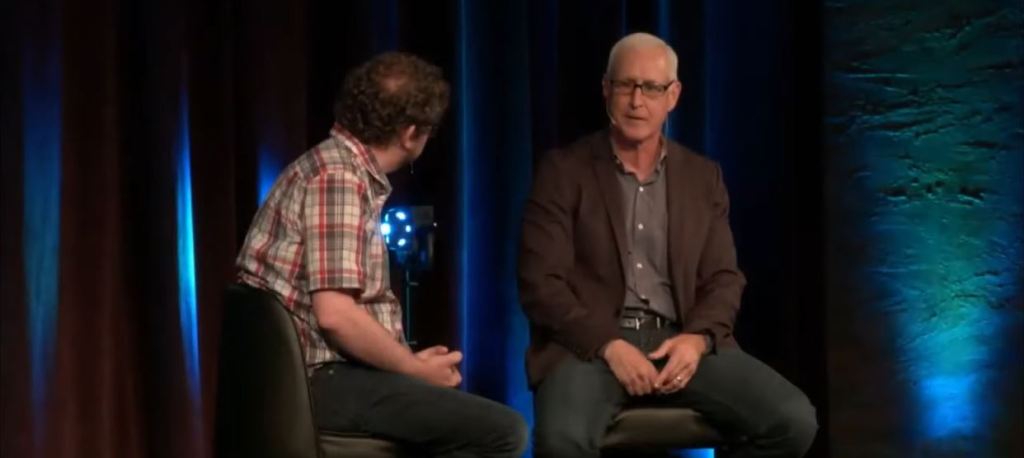
J. Warner Wallace, the “cold case detective”, has become a leading Christian apologist. He brings a unique perspective to the world of faith.
Having grown up in an atheist family, he didn’t come to faith until well into adulthood. He didn’t grow up in the church, obviously. The traditional focus on personal experience and testimonies in evangelicalism was not part of his background. He didn’t come to faith through experience or the influence of personal testimonies. For him, it was simply a matter of the facts.
Wallace observes that the most popular answer people give for being a Christian is that they were raised in a Christian family. The second most popular answer people give for being a Christian is some experience that demonstrates to them personally that Christianity is true.
Wallace criticizes these bases for Christian faith because Mormons give similar answers to explain their belief in Mormonism. The number one answer people give for being a Mormon is that they were raised in a Mormon family, and the second most popular answer is some experience that demonstrated for them that Mormonism is true.
Christians don’t think Mormonism is true, but their stories of coming to faith are the same as ours. Thus, Wallace concludes, experience can be a powerful thing, but it doesn’t necessarily settle the truth of the matter, and people who rely on personal experience are relying on a weak anchor to faith.
More important than experience is whether something is true.
Wallace goes on to share his testimony in the short interchange linked at the end of this article with the caveat given above – don’t put too much faith in his (or anyone else’s) testimony. Still, we like testimonies, right?
Wallace’s testimony starts with his father who was an atheist who believed Christianity to be a “useful delusion”. He wasn’t opposed to it because he felt it influenced people to be better people than they might be if they didn’t believe it. Wallace adopted a similar view.
His wife grew up nominally Catholic, but she began to become interested in Christianity after they had been married for awhile. When his wife asked him to accompany her to church, he went because he wasn’t opposed to Christianity. He just didn’t believe it was true.
The sermon on that day he accompanied his wife to church challenged him. The pastor claimed that Jesus was “the smartest man who had ever lived” and that all of western culture is grounded on the moral teaching of Jesus. The pastor claimed that just two sermons of Jesus effectively changed the world.
Wallace was not just an atheist. He was a cold case homicide detective, who made a living deciphering and following evidence to its logical and best conclusions. The pastor’s statement about Jesus prompted him to buy a Bible and determine for himself how Jesus rated as a moral thinker.
Wallace immediately noticed that the Bible “had the texture of eyewitness statements” to it. The fact that the Gospels don’t “agree ” on all details with each other was a profound revelation to him, because he knew from experience that witness statements never agree with each other. All witness statements have variations to them.
At a crime scene, the first instruction he gives to the officers who are there is to separate the witnesses. If the witnesses aren’t separated, they will talk, and their testimonies will begin to sound the same. He doesn’t want to give them time to harmonize their testimonies so the variations are preserved for him to figure out.
Wallace says the variations create “the most robust puzzle” to put back together. The fact that the Gospel accounts vary from each other intrigued him because he knew to expect variations in eyewitness accounts. It is a hallmarks of actual, eyewitness testimony, as opposed to manufactured accounts. Therefore, the Gospels had the ring of truth” to them.
This led him to examine the Gospels as he would examine eyewitness statements to a crime. The more he examined them, the more they appeared to be reliable as eyewitness testimonies.
In this context, the accounts of people seeing Jesus risen from the dead “changed everything” for Wallace. He doesn’t go into other details of his study or the conclusions that he reached that led him to believe Christianity is true, but eyewitness evidence is what broke it open for him.
At the same time, Wallace is concerned that we live in a world today that is “absorbed with personal experience”. Testimonies of people are treated as the greatest form of evidence. As a result, when prominent people who have great testimonies walk away from the faith, their “deconstruction” can be devastating to people who have relied on the their stories.
When faith is based on the transformational power described in a personal testimony, and the person on whose testimony we have grounded our own faith walks away from it, the result can be catastrophic. (I note this shows the inherent unreliability of relaying on hearsay evidence – in this case, someone else’s experience).
For these reasons, Wallace holds that personal testimony is the wrong foundation for faith. Wallace says we need to focus on “what happened, and is that true”.
What happened to Jesus of Nazareth is more important than what experience any of us have had. Our experiences don’t change whether Jesus came out of the grave. If there is good reason to believe it happened, our experiences are ultimately irrelevant. The only thing that really matters is whether the death and resurrection of Jesus is true.
This position might be the parallel of Paul’s insistence on “knowing only Christ and him crucified” when he came to the Corinthians. He said this because they were divided on whether to follow Paul or Apollos. Paul was making the point that the personalities of the people presenting them the Gospel were secondary and incidental to the most important thing: Jesus and him crucified (and risen again).
The same can be said of personal testimonies and personalities today. While testimony and personality may be powerful tools for moving people to consider the truth of Christianity, the truth of Christianity is the key – not a testimony or a charismatic personality.
I have heard Bart Ehrman, the well-known New Testament scholar and atheist (or agnostic), describe his own story of faith and of losing faith. He was originally attracted to faith by a charismatic youth leader in high school. He made a profession of faith in that youth group and considered himself a Christian.
When he got into post graduate school and began studying the Bible critically, his faith gave way to the academic challenges. He went from believing it was all literally true to believing none of it. The grounding of his faith on a charismatic leader and experience as part of the youth group were shaky foundations (in addition to the wooden literalism that was unable to bend with the pressures of academic discipline).
Wallace, as a skeptic, says he didn’t care about the stories of modern people. The stories of the Gospel accounts were different, but only in the way in which eyewitness testimonies are judged and weighed by a detective trying to get at the truth of what happened. These were not testimonies of spiritual experiences (though some spiritual experience was shared in the telling). They were accounts of people who saw Jesus and related the facts of what they saw.
From the “robust puzzle” of the varying accounts, a picture emerges that (for Wallace) rang true – true enough anyway not to dismiss it out of hand.
I resonate somewhat with Wallace in this thinking, but not completely. My personal experience was compelling in my journey to Christianity. Reasoning was part of the process (I was in college), but the way way Scripture applied to my own life and its resonance with my own experience were significant factors. I would say that Scripture, intuition, and experience combined in my early Christian formation.
The reasoning gained more importance for me as time went on. For me, believing in Christianity is not a matter of a killer argument; it is a matter of weighing all of the evidence and finding it compelling as a whole.
The death and resurrection of Jesus is certainly at the center of it. As Paul says, if Jesus didn’t rise from the dead, our faith is in vain. But it isn’t limited to evidence for the resurrection.
The fact that we can put our faith in concrete assertions that occurred in history and which have some historical grounding is huge. But facts are just facts without personal experience. If it doesn’t affect or change my life in any experiential way, can it really be true, ultimately?
Experience is part of, but not entire the foundation of, belief. Experience can lead us astray by itself. Individual experience is not a firm anchor for objective truth, but truth that we cannot experience has little real impact on us.
Faith must be rooted ultimately in a more certain foundation than just personal experience, but I am not sure we can (or should) discount our personal experience. As proof, perhaps, Wallace was compelled by his own personal experience and “encounter” with the Gospels. Of course, his experience is tailored around and focused on his own personal history – which is why it was compelling to him. And, perhaps, that is the same reason why it may not be as compelling to someone else.

 Navigating by Faith
I agree – if Christ had not died and been raised from the dead, my experience would be based on an illusion and lie. Experience needs to go hand in hand with reason and evidence. Thank you.
LikeLiked by 1 person