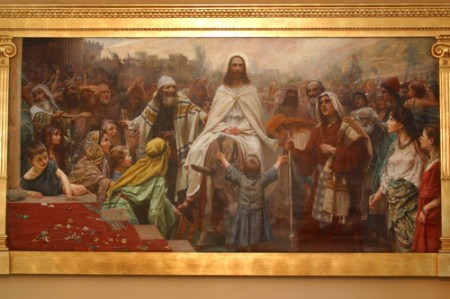
Today is Palm Sunday. This is the day we celebrate the “triumphal entry” of Jesus into the City of Jerusalem. He rode into the city on a donkey. Many hundreds of thousands were gathered in Jerusalem for the coming Passover. John tells us that people gathered in expectation of seeing Jesus because of the word that he had raised a man (Lazarus) from the dead days before. (John 12:17-18)
As Jesus entered the City, people lined the streets with palm branches. They threw their cloaks on the road in front him, and they hailed him with. This is Luke’s account:
As he went along, people spread their cloaks on the road.
Luke 19:36-38
When he came near the place where the road goes down the Mount of Olives, the whole crowd of disciples began joyfully to praise God in loud voices for all the miracles they had seen:
“Blessed is the king who comes in the name of the Lord!”
And here is John’s account:
The next day the great crowd that had come for the festival heard that Jesus was on his way to Jerusalem. They took palm branches and went out to meet him, shouting, “Hosanna!” “Blessed is he who comes in the name of the LORD!” “Blessed is the king of Israel!”
John 12:12-13
As we celebrate Palm Sunday today, we know the story of Jesus is about to take a very dramatic, tragic turn for the worse. The triumphal entry of Jesus into Jerusalem is not the precursor of celebratory times. Ominous clouds are looming on the horizon.
The incongruity of this joyous moment days before Jesus will be crucified is sobering. He was hailed King of the Jews by an adoring crowd days before a jeering crowd yelled, “Crucify him!” Most sobering of all is the likelihood that many people in those crowds were the same people.
What happened?
First Century Judea was ripe for the appearance of a Messiah. It was foretold by the prophets, and the time was right. Many self-proclaimed messiahs had already come and met their untimely demise. Such was the atmosphere of those times. They people were not any less expectant for those failures.
The Hebrew word, “Messiah” means “anointed one”. The term initially referred kings anointed with oil by a prophet recognizing and memorializing God’s choosing and their divine authority. The line of kings, however, ended at the Babylonian exile, and the idea of an “anointed one” took on a new meaning thereafter. (See What sort of saviour or messiah was Israel expecting according to diverse Old Testament traditions?)
In this way, an Anointed One or Messiah came to represent a future agent of God that would save and restore the glory of Israel.
“The idea of a restored monarchy from the line of David, and a reunified kingdom, emerges in Hosea 3:4-5, which was written about the time of the fall of the northern kingdom of Israel to Assyria. Hosea says ‘the children of Israel shall return and seek the Lord their God, and David their king.’ The suggestion of a future David is continued by Jeremiah writing to those in exile in Babylon in Jeremiah 30:8-9 and by Ezekiel, writing at the same time, in Ezekiel 34:23-24. Both passages refer to a David of the future as being the king or prince.
By Robert Atki, August 22, 2011
….
“when trying to understand the mindset of pre-Christian Jewish expectation, there is a progression of thought evidenced in Old Testament writings of first a continuation of the Davidic dynasty, of anointed kings, who would rule over Israel. This then develops at a time of national crisis, during the exile to Babylon, into an expected Messiah figure who would lead Israel into period of restoration, with the Temple rebuilt, the land cleansed and a messianic age of shalom, worshiping the true God.”
This expectation (or impatience waiting for it) likely fueled the Zealot Movement that began about the time Jesus was born (6 BC) and was in full swing during the life and ministry of Jesus. The Zealots were a political movement that sought to incite rebellion against Roman rule. There were a “fourth sect” of Judaism according to historian, Josephus, that promoted allegiance to God alone and urged a violent overthrow of the Roman occupiers. (See Wikipedia)
The Jewish people in the 1st Century had been waiting over hundreds of years for this expected Messiah, and they were tired of Roman rule in their Promised Land. Indeed, there was a certain “Messiah ‘fever’” afoot at the time of Christ as hinted by Gamaliel, the Jewish head of the Sanhedrin, the ruling religious council. (See Did the Jews Expect a Messiah?)
“Some time ago Theudas appeared, claiming to be somebody, and about four hundred men rallied to him. He was killed, all his followers were dispersed, and it all came to nothing. After him, Judas the Galilean appeared in the days of the census and led a band of people in revolt. He too was killed, and all his followers were scattered.” ()
Acts 5:36-37
This was the context in which Jesus arrived on the outskirts of Jerusalem, mounted a donkey and began to ride into Jerusalem, crowded with people at the time of the Passover. His reputation had gone before him as an authoritative teacher (Matthew 7:28-29) and performer of miracles, signs and wonders (John 3:2), and he had just reportedly raised a man from the dead.
People believed Jesus was the Messiah they had been awaiting. This is why they yelled “Hosanna” (meaning “Save us” or “Savior” (Wikipedia)) and “Blessed is the king who comes in the name of the Lord!”
Some have suggested that Judas betrayed Jesus in the garden to hasten the confrontation between Jesus and the Roman authorities. He didn’t seem to betray Jesus for the money, because he threw the coins away. (Matthew 27:3-5) Judas may have believed Jesus was the Messiah, and he may have thought he was instigating the conflict that would result in Jesus overthrowing the Roman government.
Indeed, this was expectation of the Jewish people: the Messiah would reestablish the throne of David and rule forever. Even Peter was armed for conflict and ready for a fight. He drew his sword in the garden when the Roman authorities came to take Jesus away. (John 18:10-11)
But, Jesus told Peter to put it away. Jesus didn’t protest. He didn’t even resist. Instead, he became like a sheep led to slaughter.
Consider the enormous disappointment the followers of Jesus must have felt. Jesus was the hope they had been waiting for centuries for. Instead of rising up, seizing control of Jerusalem, and overthrowing the Romans, Jesus went like a docile sheep with the guards to his eventual humiliating, public death.
The Lion of Judah was nothing but a lamb, and that was hard to take.
When Jesus didn’t act like the Savior people expected, they turned on him. Pontius Pilate, the Roman leader, didn’t know what to do with Jesus. He had broken no Roman law, yet Jesus was there before him to be crucified. In exasperation, he turned to the crowd:
“What shall I do, then, with Jesus who is called the Messiah?” Pilate asked.
Matthew 27:22-23
They all answered, “Crucify him!”
“Why? What crime has he committed?” asked Pilate.
But they shouted all the louder, “Crucify him!”
Jesus didn’t fight, and he wasn’t the Messiah they hoped for. He seemed like another false hope. At least, previous Messiah wannabees made an attempt to fight. Jesus didn’t even do that!
The last hopes of 1st Century Jews were quashed when the Temple was destroyed in 70 AD, and the Jews were routed and driven out of Jerusalem. Meanwhile, the followers of Jesus took a different and completed expected course.
They were bitterly disappointed, of course. They scattered. Only some of the woman stuck around to watch Jesus in his suffering. The men slunk off into the shadows. The hunkered down together in the aftermath.
Then, everything changed! Within days, they were out in the streets of Jerusalem boldly proclaiming that Jesus, the Messiah, had risen triumphantly from the dead!
They didn’t take to the street with swords. They took to the street with the message of a risen Messiah. They did not mount any organized opposition to the Roman rule. They preached the kingdom of God, like Jesus did, in self-sacrificial humility and gentle boldness
As days, weeks, and months turned to years, this small group of rag tag men and woman did not relent or wane in their boldness and the message they delivered, though they were subjected to persecution and some of them even to death, just like their leader.
Amazingly, these disappointing beginnings led to a worldwide revolution of the message Jesus spoke that continues to this day.
People who expected a conquering King of the Jews continued on with their hope of an earthly establishment of Jewish rule until the Romans quashed their hopes, destroyed the temple, massacred its defenders, and drive the rest out of Jerusalem. Meanwhile, the followers of Jesus who claimed he rose from the dead grew stronger, and their numbers rapidly and steadily increased, and the persecution only seemed to fan the flame of their passion to share their message..
Today people are still tempted to look for temporal answers to physical circumstances and difficulties, and many turn away from Jesus, disappointed when the temporal answers they look for are not provided. When our expectations are driven by the here and now, and not by the ever after, we aren’t likely to find our answers in Jesus.
In truth, however, the kingdom of God that Jesus preached begins in the here and now. It’s just a different kind of answer than we might be seeking.
The kingdom of God that takes root in our hearts is the kingdom Jesus preached – the seed of eternal life, God in us, the hope of glory. He offers salvation from our sins, from our sinful selves, and the promise of life everlasting with the Father. We gain the seed of that reality through the Holy Spirit, an internal witness to the reality of which Jesus spoke.
The seed continues to be planted today in the hearts of people around the world, and the kingdom of God Jesus proclaimed, which is not of this world, continues to grow. It takes root in the lives of people who are forever changed to live in self-sacrificial for God and others. It is not found in swords or overcoming earthly kingdoms; it is found in transformed people

 Navigating by Faith