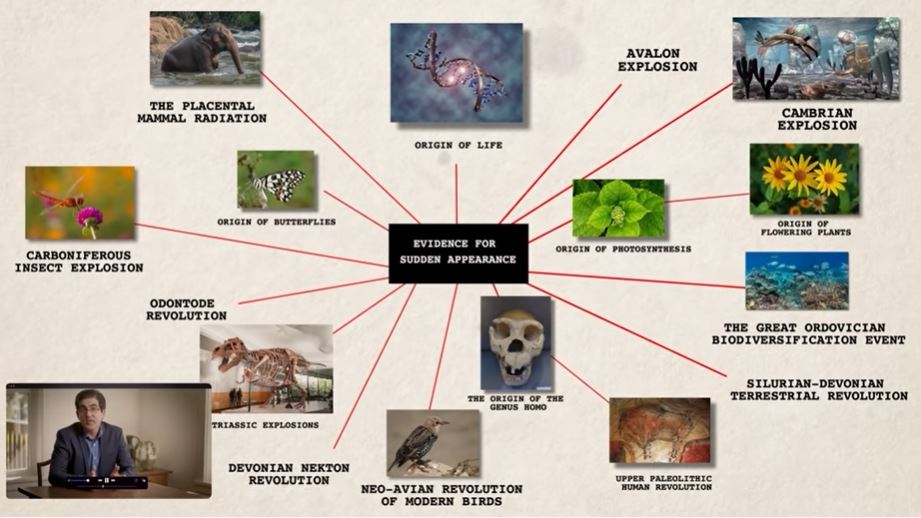
Alright, I admit the title of this short article is a bit provocative, but I got your attention. I would actually say the Darwinian paradigm is going through something more like an evolution. The explosions are not in the paradigm, but in the facts that have been slowly uncovered in the fossil record since Darwin championed the evolutionary paradigm.
The short video at the end of this article produced by Science Uprising alludes to a number of “explosions” that elude a Darwinian explanation. Paleontologist Günter Bechly, summarizes,
“The phenomenon of sudden appearances in the fossil record is not just an exceptional case, but actually is a pattern that is found everywhere.”
The obvious example is the Cambrian explosion in which most of the phyla that exist today appeared in the blink of geological time, in a mere five to ten million year window. Charles Darwin, himself, acknowledged the problem the Cambrian Explosion posed for evolutionary theory, but he expressed confidence that future fossil discoveries would fill in the gaps and provide evidence of the precursors to the Cambrian life forms.
Since Darwin’s day, the gaps have not been filled by subsequent discoveries. Rather, the gaps have widened, as Stephen Meyer recounts in his book, Darwin’s Doubt. To make matters worse for the Darwinian paradigm, the Cambrian Explosion isn’t the only evidence of the sudden appearance of life forms. Other examples are numerous, including:
- The origin of life, itself,
- the origin of photosynthesis (see Thinking Twice about the Evolution of Photosynthesis),
- the Avalon Explosion (see Wikipedia (“The Avalon explosion appears similar to the Cambrian explosion in the rapid increase in diversity of morphologies in a relatively small time frame”)),
- the Great Ordovician Biodiversification Event (GOBE), (see Wikipedia (characterized by “taxonomic diversity explosions”))
- the Silurian-Devonian terrestrial revolution,
- the Devonian Nekton revolution (see The Palaeozoic colonization of the water column and the rise of global nekton (“the rapid occupation of the water column by independent radiations of swimming animals”)),
- the Odontode Explosion (See The Odontode Explosion: The origin of tooth-like structures in vertebrates (attempting to explain “the thorny controversy of how teeth arose in evolution”),
- the carboniferous insect explosion (See Insects of the Oxygeniferous (“The number of insect families increased from 1 or 2 to more than 100 during the Carboniferous, and many of the insects were huge, and no one has been able to say exactly why.”)),
- the Triassic explosion,
- the origin of flowering plants See The origins of flowering plants and pollinators (addressing the “abominable mystery” of “the surprisingly rapid rise and early diversity of flowering plants”)),
- the origin of butterflies,
- the Neo-Avian revolution of modern birds (See A new time tree reveals Earth history’s imprint on the evolution of modern birds (addressing the “big-bang model of avian diversification”)),
- the Placental Mammal Radiation (See Evolutionary Models for the Diversification of Placental Mammals Across the KPg Boundary (addressing “the timing of the placental mammal radiation” which is “a longstanding problem in evolutionary biology”)),
- the origin of the genus homo, and
- the Upper Paleolithic Revolution (See What Was The Upper Paleolithic Revolution? (describing the “significant behavioral changes” in the development of modern humans over the 40,000-year flash in a pan time period in the Late Stone Age)).
Technical scholarship is replete with the recognition of explosions (radiations or revolutions) of insects, fish, birds, dinosaurs, mammals, and the “big bang theory of human evolution” with no credible transitions in the fossil record. Many scientists, though continue to look for the precursors and clues to plug in the evolutionary gaps.
It seems that the evolutionary paradigm, which arose abruptly and transformed science overnight, is very slow in adapting to new information as it is uncovered. Not that we should be overly critical of the painstakingly slow progress. Science is slow and methodical with intention.
Explosions, though, such as the relatively sudden rise of Darwinian theory, may give way to equally sudden corrections, kind of like the mass extinction events that give way to new “radiations” or “revolutions'” in life forms. For more on the “time crunch” facing evolution, watch the short video that follows.



 Navigating by Faith