“If God is real, then He can be known.” This is the assertion made by Dr. Sharon Dirckx, who has a PhD in brain imaging from the University of Cambridge and has held research positions at the University of Oxford and the Medical College of Wisconsin. Dr. Dirckx does not say this lightly.
Dirckx grew up in a secular household, asking questions like “Why can I think? Why do I exist? Why am I a conscious being?” as a child. She was impressed with the “awareness of my own existence, of my own consciousness.” These questions led her on a lifetime quest.
Dirckx knew she wanted to be a scientist as a teenager. Her biology teacher gave her the book, The Selfish Gene, by Richard Dawkins. That book set the course of her thinking as a child “that we are just gene machines, that there’s just the material and that’s all that it means to be a human being.” She absorbed a materialistic worldview from Dawkins and the people around her.
“I arrived at university to study biochemistry assuming that we were material beings and that science and God were not compatible.”
Making Sense of Science and Faith – Sharon’s Story, By Sharon Dirckx, Jana Harmon,on September 13, 2024 Sharon Dirckx, eX-skeptic, Side B Stories, CSLI Podcasts, Jana Harmon
Dr. Dirckx achieved her dream of becoming a scientist, but her path deviated from the materialism she assumed and absorbed as a teenager. She is now the author of several books and a frequent speaker on the subject of faith in God. You can listen to her story on the eX-skeptic podcast embedded below.
I want to pick up and run with her statement: If God is real, then He can be known. I agree with her, but I believe many people make the mistake of thinking that God can be known on their terms. We make the mistake to think that if God exists, He exists within our own purview and within the limitations we experience as human beings that we can control on our terms.
He doesn’t. When we are talking about the creator God who made the universe, and all that is in it, including human beings and all of material reality, we are talking about a God who is transcendent. He is the uncaused causer and the uncreated creator. He is not found in his creation as if He was a component of it.
Such a God is said to be “outside” of the space/time continuum. The concept of such a God includes a spaceless, timeless, immaterial reality that is not contained within or limited by the material world.
Some quantum and theoretical physicists speak variously of consciousness that collapses the wave function of particles, Platonic or Mathematical Realism that imagines immaterial mathematical forms underpinning material reality, and Philosophical Idealism that imagines consciousness or mind-like properties out of which the material world emanates. These are non-theistic attempts to get at the idea that the material world is contingent, and immaterial reality is the fundamental building block of and force behind the universe and reality.
The most robust of these conceptions is the theistic one pulled out of the text of the 60 some writings by 40 some authors compiled in the work we call the Bible. If God is real, and He created the universe as these writings claim, with all of it’s immensity, and if He created life, including humans, He is completely different (Other) than us: God is transcendent.
Yet, people have always had some sense of this transcendent reality. Religious expression is among the oldest of the traces of human history we can find in the archaeological and written records we are able to find from our ancestors.
While we may tend to assume that all primitive humans believed in a panoply of Gods animating the material world, evidence exists to suggest that primitive people from diverse corners of the world believed in one, Creator God. This monotheistic conception of God may, in fact, by the oldest form of religious belief.
Perhaps, the pagan gods that inhabit the material world seem more accessible. They might make demands on our behavior, but they have no province over the thoughts in our minds, our wills, and our hearts.
That we would have a hard time finding a transcendent God and making sense of him is understandable. Imagine a living being the size of an electron viewing a human being from an electron’s vantage point: How does an electron-sized being make sense of a human being – or anything above the quantum level, for that matter?
The difference between a human being and a transcendent, creator God is much greater then the difference between an electron-sized being and a human being. For one thing, they are both part and parcel of the same material reality. The biblical conception of God understands that God transcends the material world.
To quantify this difference, we might imagine a human being compared to the infinitely vast space of the universe. Now add in the bit about God being completely “Other”: spaceless, timeless, and immaterial.
I maintain that such a God would need to reveal himself to us. How could we know such a God unless He revealed Himself to us?
I have written about this before. God must “stoop” to us to make himself known. We cannot “ascend” to Him.
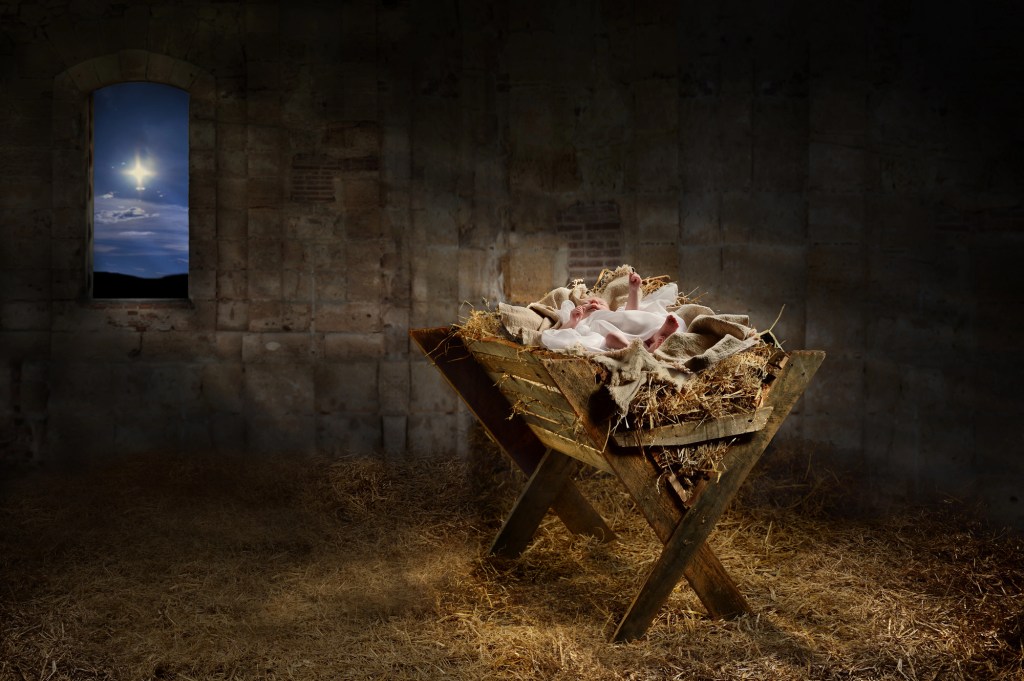
The Christmas story enters into the discussion here. The Christmas story is about God entering into human history in the form of a human. The Christmas story is the claim that God became one of us and walked among us, and revealed himself to us in flesh and blood through the person of Jesus.
The Christmas story and the Easter story are the bookends of this claim. Jesus shows us that, by rising from the dead, in human flesh, we have the same hope. His ascension spells a new beginning because Jesus said that he was leaving us with something called the Holy Spirit. The Holy Spirit is God’s presence with us (and in us when we yield to Him).
Indeed, we do not approach such a God on terms that we devise. We must approach Him on His own terms.
The prophecies about Jesus in the Hebrew scripture claimed that God would be with us. Thus, Jesus is called Emmanuel, which means God, with us.
God with us in human form, though, not adequate for revealing Himself to the whole world. While God in the form of a man contends with the limitations of flesh and blood, God’s Holy Spirit does not have such limitations.
These ideas are not foreign, even to people in the ancient world. They are not unique to Christianity. To the extent that other people have sensed things like this, we can say that they are part of the fabric of the universe that God created.
The Old Testament, in Psalm 139, speaks to the idea that God is present everywhere and that God is intimate with everyone to the point of being able to count the hairs on each person’s head and the thoughts that each person thinks before they are even spoken. Such a God knows the thoughts and the intents of our hearts, even the ones we hardly acknowledge or recognize in ourselves.
The apostle Paul famously quoted pagan poets when he said, “‘[I]n [God] we live and move and have our being.’ and, ‘We are his offspring.’” (Acts 17:28) Thus, even pagan thinkers are able to grasp the reality that God is intimately imminent with us in the world He created.
In “emptying Himself of all His glory” and becoming man (Philippians 2), God became approachable. In leaving His Holy Spirit, God remains approachable to all who would seek to know him. Thus, God promised from of old through Moses:
“[I]f you seek the Lord your God, you will find him if you seek him with all your heart and with all your soul.”
Deuteronomy 4:28
So the prophets also said:
“You will seek me and find me, when you seek me with all your heart”
Jeremiah 29:13
And so, Jesus reaffirmed this great promise:
“Ask and it will be given to you; seek and you will find; knock and the door will be opened to you. For everyone who asks receives; the one who seeks finds; and to the one who knocks, the door will be opened.”
Matthew 7:7-8
The reality of God that is revealed in the Bible is that God is both transcendent and imminent. He is massively “Other” than us as revealed by the incredible vastness of space in the universe He created. Yet, he is intimately imminent with us, unhindered by the limitations of space/time and the material universe He created.
As we celebrate Christmas story, we celebrate God with us, Immanuel – God who is imminent, the transcendent God who makes Himself known to us. This is the idea that God, if He is real, can be known. Perhaps, no one conveyed these ideas as well as Thomas Aquinas:
“God is in all things, not as part of this universe, but as an agent is present to that upon which it works. God is very Being by His own essence, so created being must be His proper effect. Just as to ignite is the proper effect of fire, God causes his effect in things not only when they first begin to be, but as long as they are preserved in being. But being is innermost in each thing, and most fundamentally inherent in all things. Hence, it must be that God is in all things and innermostly. He is above all things by the excellence of His nature, yet He is in all things as the cause of being of all things.”
From Summa Theologica, by Thomas Aquinas (Paraphrased by John Dickson)


 Navigating by Faith
The implication of God for me, is so immense that I have an almost automatic piece of software within me that seeks to contend with his conception in a way that I can cope with – otherwise I think the conception would be too much.
For me then, God is best conceived when I am sailing my boat. He is present in the wind, in the currents and the waves, the delicate balances between atmospheric and barometric pressure that makes sailing possible. And God is present when these conditions don’t align and it is then that I have to contend with Him in order to steer my boat safely to shore. These moments are in no way random. They are the moments where I know I am being tested and when I feel His presence most acutely.
LikeLiked by 1 person