
I did not decide to vote until I approached the turn off to head to my home from my office. I wasn’t excited about voting this time, and I put off the decision to vote until the last second. A sense of obligation convinced me to make the short detour to my local polling place.
Even so, I punted on my vote for a president. I couldn’t pull the switch for red or blue. I just didn’t have it in me.
I know I am not alone in the way I felt this election season. A Relevant Magazine article published October 8, 2024, reported on survey results indicating that 41 million Christians did not plan to vote in this election. They are my tribe, and I was one of those 41 million.
A dialogue with a long time friend (who probably doesn’t see the world as I do) about why the election results turned out as they did inspired me to do some post-mortem review of the election. I chose a trusted source for that analysis: Bari Weiss, a former NY Times reporter who has established her own news outlet, the Free Press.
I spent some time today listening to the latest podcast episode on Honestly, with Bari Weiss, Why Trump Won. Bari Weiss is lesbian and liberal. Her panel of experts included a transgender woman, Brianna Wu, and her conservative representative was Batya Ungar-Sargon. Senior Editor of the Free Press, David Svadnik rounded out the panel.
I like to say, “Truth is truth”, and I appreciate people who are able to put aside their agendas and biases and speak to truth. We all have them (agendas and biases), but there is something highly valuable about the effort to cut through those personal values that motivate us and be honest about the way things really are.
Bari Weiss started the discussion with statistics from CNN exit polls that show Trump won about 13% of black voters in 2024 (up from 8% in 2020), and Trump won 45% of Latino voters (up from 32% in 2020.) She noted that Trump improved on his 2020 votes almost everywhere.
This seems to be at the center of the story of this election. Weiss says, “It’s indicative of a massive countrywide political realignment.” It was a “Republican landslide”, and the question we should be asking is, “Why?”
Weiss asks, “[W]hy Democrats lost so dramatically and decisively”, and “[H}ow Trump’s comeback happened, despite an impeachment, being found guilty of sexual assault, and 116 indictments….” It seems a bit mind boggling (personal agendas aside). These are fair questions.
Weiss turned to the CNN exit polls to begin looking for some answers. As reported in the Anatomy of three Trump elections: How Americans shifted in 2024 vs. 2020 and 2016, by Zachary B. Wolf, Curt Merrill and Way Mullery, CNN November 6, 2024, the story has some real surprises.
We shouldn’t be surprised that more women voted for Harris in 2024, and more men voted for Trump in 2024, but that isn’t the story. That is certainly part of the story, but the whole story would be lost of we stop there.
We need to contend with the fact that more women voted for Trump in 2024 than women voted for Biden in 2020, and fewer women voted for Harris in 2024 than voted for Biden in 2020. These shifts are noticeable enough to be meaningful. We might expect that more men voted for Trump than voted for Biden, but the dual shift in the female vote is a significant marker.

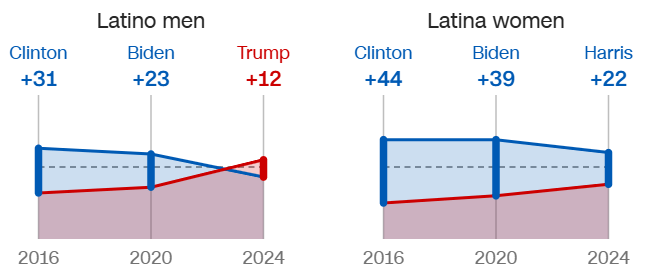
The shift is even greater in among the Spanish-speaking minority. The exits polls show that more Latinos and Latinas voted for Trump in 2024 than voted for Trump in 2016 and for Biden in 2020 by a significant margin.
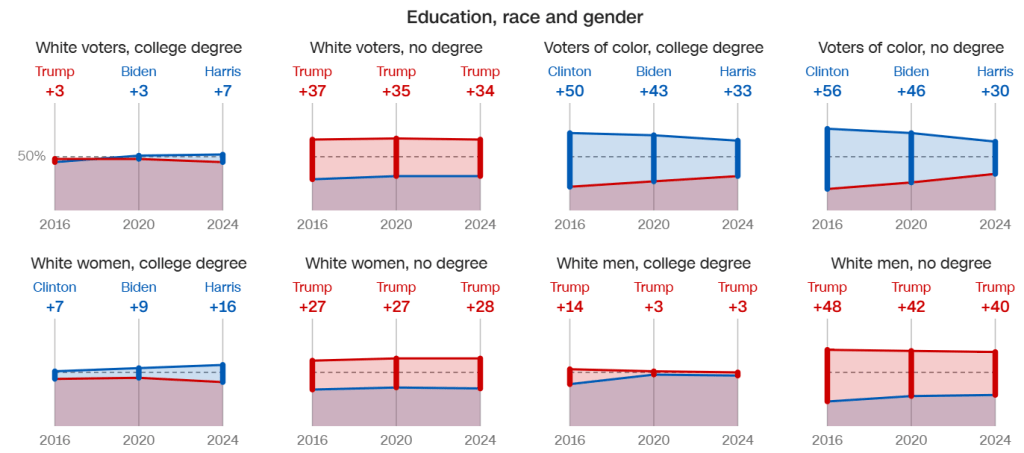
Contrary to what might seem plausible, Trump’s margin in the vote of white men has shrunk since 2016, and the margin in the vote of white women has grown. Again, these changes are slight, but meaningful.

Batya Ungar-Sargon says, “The narratives of who is a Democrat and who is a Republican have been totally shuffled.” Batya Ungar-Sargon. But why?
Sargon theorizes that the strategies evident in the two parties provide some explanation. “The thing that the Democrats did to lose and the thing that Donald Trump did to win are the same thing”, she says.
“Donald Trump picked up the Democrats long abandoned pro-labor policy agenda around the economy…. These are not two distinct things that happened…. Trump got the Democrats old base, the multi-racial working class, because he picked up the Democrats’ old agenda: strong border, limit the supply of labor and protect wages, tariffs, trade war with China, ‘Let’s put American workers first, American labor first, … a strong manufacturing base, no more wars.’ The Republicans cast themselves as the anti-war party, and … Kamala Harris … brought Liz Cheney on board to campaign for her.”
Cheney may have been calculated to pull in discontented Republicans, but Cheney is more hawkish than Trump, and that message doesn’t resonate with the old Democratic ideals.
Sargon recalls that Democrats used take the position that abortion should be “safe, legal, and rare”. That is now Donald Trump’s position. She says that Trump is now “pro-choice for 15 weeks (12 weeks?)”. He even promised to veto a national abortion ban. She summarizes her thoughts this way:
“What Donald Trump did to beat the Democrats is literally to beat them at their own game…. He became a [Democrat]. (Or he never stopped being one.) He picked up their agenda, their pro-worker agenda that was anti-war, ant-free trade, pro-worker and strong immigration, and socially moderate.”
The CNN exit polls show that Biden (2020) and Harris (2024) won more white voters with a college degree than Trump in 2016, but voters of color of all education swung dramatically away from Biden/Harris and more toward Trump since 2016, and the trend is rising.
Perhaps, most surprising to me is that Harris made modest gains among older voters, but younger voters have swung noticeably toward Trump. Both shifts are surprising, but the shift of younger voters toward Trump, and away from Harris, is not only more surprising, but more significant.

The rural vote swung back more toward Trump after a decline in 2020, but both the suburban vote and the urban vote (even more) swung toward Trump also. We are familiar with the megalith of rural favor that Trump enjoys, but the movement in suburban and urban voters toward Trump is surprising, and it is a trend that continued from the last election.

The economy is a significant factor in this election also.
The CNN article notes that people In 2020 were almost evenly divided on whether the economy was in bad shape. In 2024, two-thirds (2/3s) of voters polled felt the economy was in bad shape. In 2020, only about one fifth (1/5) of the voters said they were doing worse than the previous four (4) years. In 2024, the number jumped to half (1/2) of the voters, and that half voted overwhelmingly for Trump.
The economy is often used in political campaigning to the advantage of campaigners in presidential elections, though many thoughtful people recognize that economic trends often lag the factors that cause them. Incumbents often unfairly take credit or struggle with blame for economic changes that have roots in the policies and circumstances extending from prior terms.
The inflationary period of the last four years can be traced to all the spending during COVID and cannot fairly be set at the feet of Biden and Harris. The fact that inflation has grown faster than the income for average Americans, though, hits average Americans where they live.
The recession from the late 2000’s caused a housing shortage that impacts the lack affordable housing today. The housing deficit that has grown each year since the housing bubble and crash can be traced to the reluctance of builders to construct new houses since the recession. People are not selling their houses with 3% interest rates, because they would have to buy new houses at 6%-7% interest rates.
The lack of new houses being built, and the reluctance of homeowners to sell low and buy high have created a housing shortage that has driven up home prices and rentals. I read recently that 30 people are looking for every rental available nationwide. These things effect average where they live, literally.
Donald Trump’s campaign strategy was aimed at these average Americans who are feeling the pinch of the last 15 years, regardless of who is to blame (or not to blame). He connected with average Americans in his rhetoric and appeal.
Peter Savodnik does not blame Kamala Harris for the failure of the recent election, and he doesn’t blame Biden, who is an easy scapegoat. Savodnik says the blame lies with “the whole progressive firmament, the whole ecosystem, the institution, the culture, the anthropology…. It’s rotten. It’s illiberal, and there is a fundamental disconnect with the American people.”
Savodnik distinguishes the Establishment and the Aristocracy. The Establishment, he says,” is the guiding elite that is connected to the body politic, that cares about America, that has an affinity, and fondness and closeness with it. The Aristocracy is cordoned off and hostile to it.” He says we live in a “moment of protracted Aristocracy”.
Savodnik characterized the current tension as a struggle between the “elites” and the “counter-elites”. He observes that the voices resonating with people right now are also elites, but they are dissidents. The dissonance isn’t with elites, per se; it is with Aristocracy that is disconnected from the American people.
I, personally, don’t know enough (or pay attention enough) to know what all the factors are that explain the recent election results. The speculation of Weiss and company seems plausible to me. I know enough to sense that the Democratic party and most of the opinioned media are disconnected from the heartbeat of the average American voter.
Trump seems to have played the right chords to resonate (enough) with the American voters to win. Perhaps, the reason for his success is that he is an old Democrat in Republican clothing. This insight is new to me, but it seems plausible.
He is elite, to be sure, but he is a dissident elite, and that seems to resonates also with people who have gotten tired of the “Aristocracy” that Savodnik described. I am doubtful that the Trump presidency will prove much better than the last four years for the American people. I hope I am wrong.
As a Christ follower, I am particularly concerned about how we deal with the strangers in our midst, the tired and poor masses that have come to our shores for a better life. We do need to shore up our border, but how we treat the people who are here carries eternal consequences. (See Matthew 25) Tariffs and isolationist policies may drive up inflation even higher. Withdrawing support from the Ukraine may doom them to Russian control.
I take the same solace, though, that I took during the Obama years, the first Trump years, and the Biden years: “that the authorities that exist have been instituted by God.” (Romans 13:1) I will continue to try to faithfully follow Christ as I did before.
I also encourage Christians to take a long view on these things. It doesn’t get much longer than eternity, which is the perspective we should uniquely have. This is too (for better or worse) will pass, but the word of God and promises of God remain.
~~~~~~~~~~~~~~~~~~~~~~~~~
Postscript: For different graphics and statistics on the red shift in the recent election, See the Voting Groups That Swung to the Right in the 2024 Vote in the NY Times, updated November 8, 2024, by Zach Levitt, Keith Collins, Robert Gebeloff, Malika Khurana and Marco Hernandez.


 Navigating by Faith