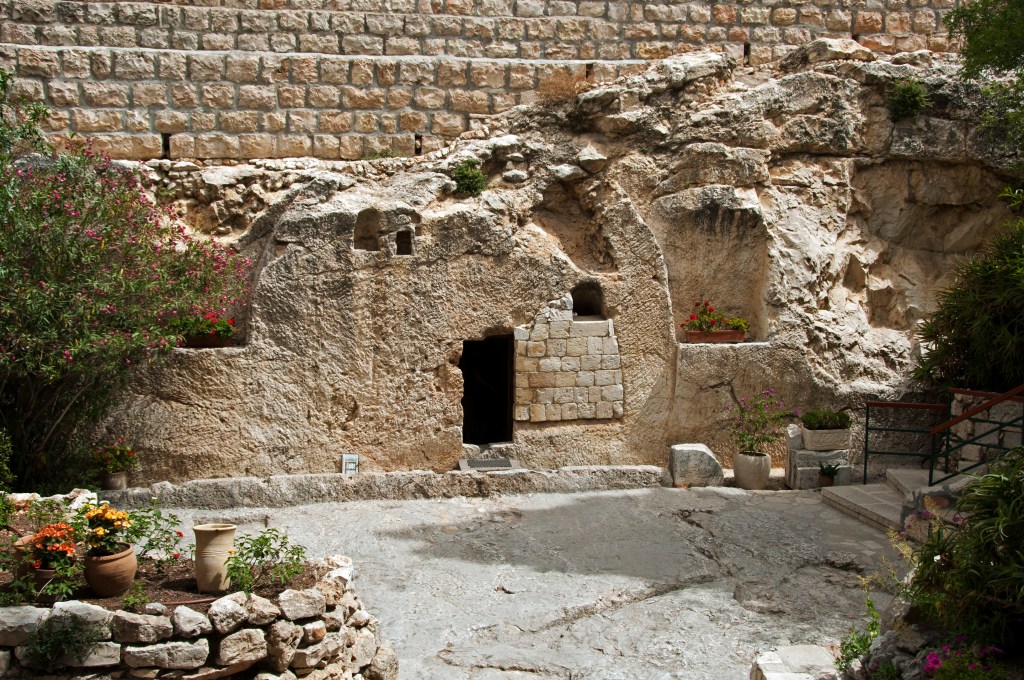
The title of this piece is tongue-in-cheek, a play on the “minimal facts” evidence for the resurrection made famous by Gary Habermas. I don’t really have a killer piece of evidence that uses fewer facts (or no facts) that trumps all other arguments. But, maybe I got your attention!
As often is the case, my inspiration comes from what someone said or wrote. In the podcast interview linked below, Mason Jones describes how he he decided to read through the Gospel accounts as an atheist who knew next to nothing about Christianity. He quickly caught on that the resurrection is the centerpiece of Christianity, so he focused his attention on that.
He researched the evidence for the resurrection. He googled arguments for the resurrection and arguments against the resurrection. Though he was an atheist at that time, he was willing to give the evidence that exists a chance. (Whether there was any, he didn’t know.)
As he considered the arguments and counterarguments, he found that the arguments against the resurrection didn’t address very well the arguments for the resurrection. They didn’t take them seriously.
Then he realized that the arguments against the resurrection only work if you start with the presupposition that the resurrection didn’t happen. Because it is impossible. Because people don’t come back to life. Ever.
If you take that presupposition out of the equation, thought Jones, the evidence favors the conclusion that the resurrection occurred, and the arguments against the resurrection loose their luster. If you want to hear the rest of Mason Jones’s thought journey from atheism to theism to Christianity in his own words, you can listen here.
Meanwhile, I want to spend a little time considering the presuppositions people make about the resurrection.
When we do historical research, the top five (5) most reliable sources of evidence according to Chat GPT are 1) primary sources; 2) archaeological evidence; 3) secondary sources; 4) eyewitness accounts; and 5) official records and documents. I am only going summarize those five elements of evidence for the resurrection quickly to get to a point. (I encourage anyone interested to do your own research.)
According to my results on Chat GPT, “Primary sources are firsthand accounts or direct evidence created or produced at the time of the event…. [that] offer a direct connection to the time and people involved.” The New Testament writings are a collection of firsthand accounts – accounts by people who lived through and participated in the events that happened.
The New Testament is a combination of firsthand accounts (the Gospels of Mathew and John, the Book Acts, and the Epistles) and secondhand accounts (the Gospels of Mark and Luke) summarizing firsthand accounts from people the authors knew. Throughout the Gospels, the Book of Acts, and the Epistles, the writers emphasized the eyewitness character of what they were conveying.
The historical detail of those accounts is remarkable. (See New Evidences the Gospels were Based on Eyewitness Accounts, by Peter J. Williams, for what I mean.) These were obviously contemporaneous accounts. They may have been written down 20-50 years later, but I (personally) question the rationality of anyone who considers the accurate historical detail in these accounts to have been generated by anyone who was not intimately and personally present when those events occurred.
Yet, they get written off completely because they chronicle miracles and the resurrection. Those elements of the accounts are rejected based on presuppositions about what is possible and what is not possible. Because of presuppositions, the accurate historical detail is discounted and the accounts are dismissed without serious consideration.
The Gospel accounts relate the details of the same story from different angles: that a man named Jesus from Nazareth, taught, performed miracles, developed a following, was crucified on a cross, rose again from the dead, and appeared to many people over a 40-day period. The Book of Acts and the Epistles give us a glimpse into the way people lived their lives in light of these events.
We have some archaeological evidence related to the crucifixion, though not a lot. That evidence is largely corroborative. It corroborates the existence of Pontius Pilate, Caiaphas, the high priest, the method of corporal punishment common at the time (crucifixion), etc. It corroborates the message of the earliest followers of Jesus – that he rose from the dead, that the resurrection was the foundation of their belief, and that many followers suffered persecution, they often met in secret, and many gave up their lives for what they believed.
Secondary sources are legion. The writings of the “early church fathers” are ubiquitous. Volumes. The earliest of these writers knew some of the apostles. Of course, they are believers, so skeptics discount them.
Other contemporary secondary sources from non-believing historians corroborate that Jesus was killed on a Roman cross, he had a large following, and his followers believed he rose from the dead – even when faced with persecution and death for that belief. No one refutes these things.
We don’t just have accounts of what happened, we have eyewitness accounts. Paul, the one-time persecutor turned Apostle, lists hundreds of the people who claimed to have encountered Jesus alive in the flesh after his death and burial. He referenced over 500 people who encountered Jesus at the same time, en masse, and most of them, he said, were still alive when he wrote about them. (See 1 Corinthians 15:3-8)
But again, skeptics say that resurrection doesn’t happen. It can’t happen, and (therefore) it never happened in this case. So this evidence is discounted and dismissed. The accounts are considered, if at all, only to develop reasons to dismiss it, but the real weight of the position against it is an assumption that Jesus rising from the dead is an impossibility.
With that said, I will get to the point: Mason Jones realized that the most powerful argument against the resurrection is the presupposition that it didn’t happen.
In coming to this realization, Jones recognized the circularity of the reasoning. When a person starts with an unquestionable assumption that miracles don’t happen and resurrection is impossible, it doesn’t matter what evidence exists.
Jones realized that taking that presupposition off the table changes everything. We are left with consistent eyewitness accounts from credible witnesses (with nothing to gain) who were willing to give up their lives because of what they believed they saw. This is pretty powerful evidence, as historical evidence goes.
Perhaps, the minimalest, non-factual argument in favor of the resurrection isn’t a factual argument at all, but a philosophical one. It is a challenge to put presuppositions aside and wrestle directly and authentically with the evidence we have.

I am not really a fan of presuppositional apologetics, but we should identify this elephant in the room. We all fall back on our basic assumptions (ones we can’t prove, but which form the bedrock of our view of the world). The bedrock presupposition of the skeptical materialist is that nothing exists but the material (“natural”) world, and that “supernatural” (non-material, or transcendent) reality does not exist.
If this is your starting assumption, you cannot allow the possibility of a miracle, let alone the resurrection of a human being from the dead – not even if hundreds of people testify to meeting that person after death, a most cruel and unusual death (by our modern standards) on a Roman cross. You cannot allow the possibility that this person performed many miracles – everywhere he went -, that he foretold his death and his resurrection, and is the embodiment of a transcendent God who lowered and subjected Himself to the whims of His own creation in human form to save us from ourselves.
These are seemingly fantastical claims. Yet, these are the claims of the people in the best position to assert them. These are the claims of those same people who witnessed his death. The test of their sincerity is their willingness to suffer and die for what they claimed to be true.
David Hume famously argued that miracles don’t happen, because they can’t happen, because the standard of proof he set as claimed we should have to prove a miracle is impossible to meet – like the modern elephant in the room – based on presuppositions.
But, how can such a skeptic be so sure?
Perhaps, we should have some healthy skepticism for such a skepticism. Such a position is just as faith-based as any believer in the resurrection of the man, Jesus of Nazareth who claimed to be God and allowed people to worship him. (Matthew 28:9, 17; Luke 24:52; and John 20:28) As finite beings our perspective is limited, and we don’t know what we don’t know. We have to take our basic assumptions on a certain amount of faith.
I will conclude with some brief comments. With science being the study of the natural, physical world, it naturally (pun intended) isn’t going to tell us much about supernatural, metaphysical reality, but science does give us indicators that such a world may exist.
One of those indicators is what science reveals about near death experiences (NDEs). We don’t need to consider the “spiritual” or fantastical elements of NDEs to recognize that they suggest a reality that transcends the physical world. I will identify a few of the credibly scientific findings about NDEs and leave it to you to research the rest.
NDEs are relatively common. They have occurred throughout history, and occur all over the world in every culture. NDEs have common elements and common variations that are identifiable and virtually universal.
To be classified scientifically as an NDE, a person must be clinically dead. That means no detectable heartbeat or brain wave activity. Yet, the corroborated factual details that people report during NDEs cannot be explained adequately on naturalistic principles.
Virtually every NDE includes the experience of hovering “outside” one’s body and viewing the body from a distance. Many NDEs involve seeing details and/or hearing conversations that are remote from the body, often not in the same room, or building, or sometimes even the same geographical area as the body.
The NDEs that of particular significance are the ones in which the circumstances offer no explanation for how those details could be known by the person who “saw” or “heard” them. You will need to read the accounts for yourselves to know exactly what I mean, so I encourage you to do some follow up research.
All NDEs seem to include spiritual and fantastical elements, but we cannot corroborate those details scientifically, so I would encourage you to ignore them and focus on what can be scientifically verified. Those details that are impossible to corroborate are also more likely to be influenced by personal experience, perspective, and belief – at least in the interpretation of them.
I have attempted to focus on the more scientific aspects of NDE research in articles I have written about NDEs linked here. NDE research has been an academic discipline and field of study for only about 50 years, so much is yet to be learned. Some sources for further reading are as follows in no particular order:
- Journal of Near Death Studies (University of Northern Texas)
- Division of Perceptual Studies: Near Death Experiences (University of Virginia School of medicine)
- Near-Death Experiences Evidence for Their Reality (published in PubMed Central, NIH National Library of Medicine)
- Journal of Near-Death Studies (Weill Cornell Medicine-Qatar, Health Sciences Library)

 Navigating by Faith