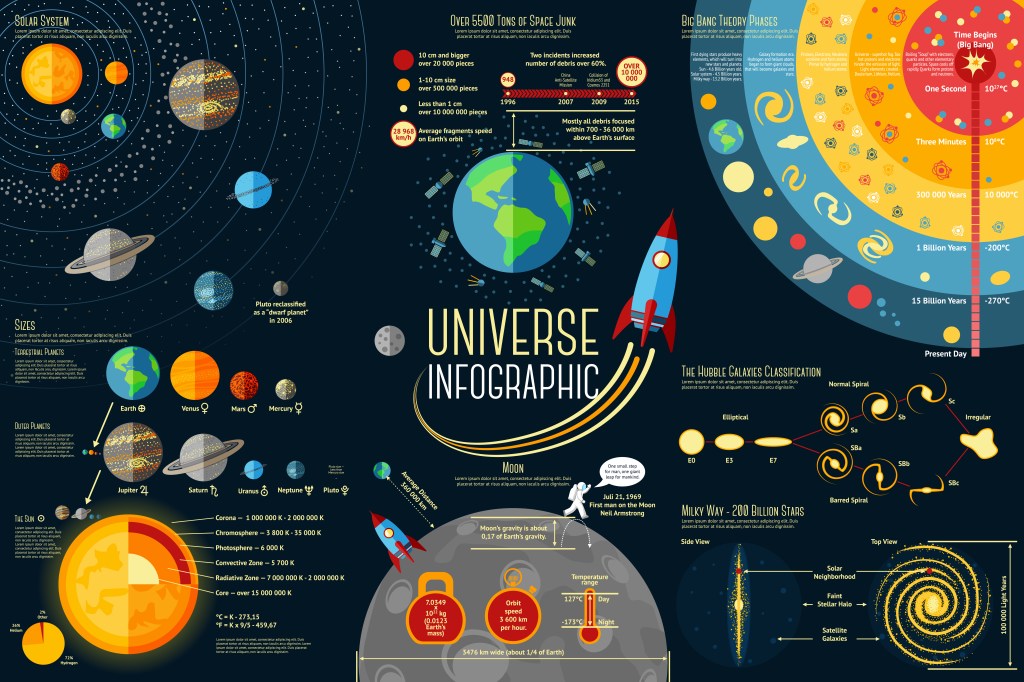
The question that forms the title of this blog article is the subject of a recent video on YoutTube. I am embedding the video here so you can watch and listen for yourself. The suggestion, however, that the James Webb Telescope is disproving the “Big Bang”, is overstated. You might even call it clickbait!
Before launching into my thoughts on this, however, what is meant by the “Big Bang” needs to be defined. The terminology is credited to Fred Hoyle. When Hoyle coined the phrase in a 1949 a talk on BBC Radio, he was probably speaking tongue in cheek.
Hoyle (like most scientists of his age) had long believed in a steady state universe. The new evidence indicating that the universe is expanding was like a big bang to them. It rocked the long-held view that our universe is static and unchanging.
The laws of physics seemed immutable. Why wouldn’t scientists believe the universe was equally immutable?
That the evidence that the universe is expanding was unsettling to the accepted “science” at the time is an understatement. As Hoyle was describing the then recent discoveries and the theories that derived from that evidence, he said:
“These theories were based on the hypothesis that all the matter in the universe was created in one big bang at a particular time in the remote past.”
Because these discoveries came as a shock wave to scientists in the first half of the 20th Century. the term, “big bang”, may have been used to characterize how those discoveries were received!
The evidence that the universe is actually expanding raised the specter that the universe isn’t static, and it might even have had an origination “point”. This realization that the universe may have had a beginning wasn’t lost on scientists at the time, and it wasn’t eagerly received.
The term didn’t really “stick” until the 1970’s, and it isn’t really a good descriptor for what we (think we) know happened. It probably wasn’t a “bang” for instance, because no sound was likely generated. The history of the development of this evidence is interesting and can be found on Wikipedia.
The Big Bang does suggest a beginning to the Universe (to put it bluntly). This possibility, of course, has theological implications, another realization that wasn’t lost on scientists who largely viewed the universe through a materialistic lens. That possibility was largely downplayed then, and many scientists have continued to downplay that possibility.
We still don’t have evidence that reveals how the universe was formed. We can’t see back that far, and doubt exists whether we ever will be able to see back that far. As the Wikipedia article states: “[T]he Big Bang model does not describe how energy, time, and space were caused, but rather it describes the emergence of the present universe from an ultra-dense and high-temperature initial state.”
The current suggestion that the James Webb Telescope is disproving the “Big Bang” (the implication of an expanding universe with a “beginning”) comes from people who would like to downplay the implication of an expanding universe with a beginning, and it seems to be more wishful thinking than reality.
The James Webb discoveries fueling this resurgence in old thinking include images of old stars and galaxies that are more formed than they should be on our standard (Big Bang expansion) model of the Universe. The standard Big Bang expansion model is similar to the concept of evolution. If the universe expanded, it must have progressed from a simpler state to a more complex state.
Just as life began with a simple, self-replicating molecule and progressed to ever increasing complexity over a long span of time, the thinking has been that the universe must have developed in the same progressive sort of way. This is the paradigm that has driven much of modern science: that natural processes developed from the bottom up.
The new James Webb images reveal more highly developed stars and galaxies than we imagined would exist in the earliest stage of the universe on the standard model. The mature development of ancient galactic stars and star formations is surprising on the progressive view.
These images do not contradict the fact that the universe is expanding, however, and they don’t disprove the appearance of a “beginning”.
People are “surprised that things grew so quickly”. People are perplexed that stars and galaxies are so well-formed at such an early stage, when they would expect to find “fledgling” galaxies in more undeveloped states.
People are scratching their heads at the appearance of extremely small and extremely large galaxies in the early Universe because it does not comport with the progression of the expansion of the Universe as modern scientists have modeled it before the advent of the James Webb Telescope.
These observations have nothing to do with the evidence that the universe is expanding. A more accurate statement is that models for how that expansion occurred are being called into question: not the fact of expansion from “a point of beginning”.
The James Webb findings do not negate the evidence we have that our universe is expanding from some very dense “point”. If anything, the findings evoke even more theological implications, perhaps, than the standard Big Bang model.
The idea that the universe developed from simple to complex over time is difficult to maintain when stars, galaxies, and other formations in the farthest (and earliest) regions of the universe that we can see are so well-formed and “mature”. These things conjure up the specter that this evidence is more consistent with the idea of the universe being created than we previously thought.
Of course, we had clues that this should be not surprising to us: the standard expansion inflation model incorporates the assumption that an early, extremely rapid and short “burst” of expansion occurred, and this assumption was necessary to accommodate the short time frame in which the Universe appeared to have “developed” based on what we could see before the James Webb telescope. Perhaps, then, we shouldn’t be surprised to find even greater “development” at earlier stages.
We shouldn’t be surprised either that modern scientists who are committed to a materialistic worldview are struggling with these things. A materialistic worldview has colored modern science for a couple hundred years, at least.
A materialistic worldview was perfectly at home with the old static state view of the universe. It took a hit with the evidence that the universe is actually not static, but expanding from a point of beginning, though materialist thinking held firm, and most scientists have continued to hold to a strictly materialist position.
Stephen Hawking and Roger Penrose famously calculated “singularity” that “proved” the so-called Big Bang (that expansion necessitates a “beginning”). Vilenkin (and some other guy who I can’t remember, lol) determined that even a multiverse that is expanding would have to have a “singularity” (a euphemism, it seems, for a beginning).
So far, modern discoveries have continued to negate good reason to believe in a static universe (which theory was discarded after centuries of use when we found that our universe is expanding) or an oscillating or cyclic universe. Multiverse(s) seem to make sense theoretically, but we will likely never be able to prove it/them anymore than we are likely to see back before the “beginning” of this universe.
Scientists like Neil de Grasse Tyson, Hawking, and Penrose who are committed to finding explanations for these things that do not implicate a Beginner (a/k/a God), will likely continue to try to prove their point. Hawking spent much of the rest of his life after mathematically proving the “singularity” trying to get around “singularity” and its theological implications. Penrose (and Vilenkin) do not concede any theological implications either.
Nothing (much) has changed on that score, but the new james Webb images are certainly is producing some head scratching! Some scientists, like Hoyle, who were once very antagonistic about people drawing theological implications from cosmology have backed off their dogmatic stances. Penrose seems to concede the possibility of a legitimate “metaphysical” component to reality, though he “doesn’t go there” in his own thinking.
There certainly is a lot of head scratching going on, and these are interesting times. We may all be at the edges of our seats to learn where all of this will take us, though I strongly doubt that we will get definitive answers to our most fundamental questions, like the origin of the Universe in my lifetime – if ever.
The new discoveries do call into question the expansion models that scientists have developed, but they do not call into question the evidence that the universe is, indeed, expanding. The new discoveries do not align with they way scientists have believed the universe expanded, but the evidence that the universe expanded from a “point” of singularity remains solid.

 Navigating by Faith
One thought on “Is the Big Bang Finally Over?”